
solo para uso en investigación
Monastrol Kinesin inhibidor
Cat. No.S8439
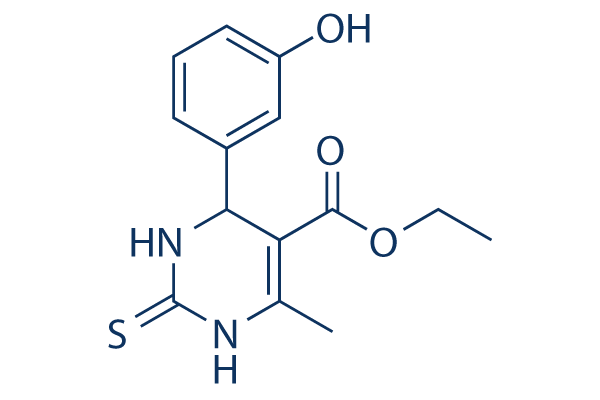
Estructura química
Peso molecular: 292.35
Control de calidad
| Dianas relacionadas | Akt Wnt/beta-catenin PKC HSP ROCK Microtubule Associated Integrin Bcr-Abl Actin FAK |
|---|---|
| Otros Kinesin Inhibidores | GSK923295 Ispinesib (SB-715992) SB743921 HCl ARQ 621 K 858 BTB-1 VLS-1488(KIF18A-IN-6 ) H-Cys(Trt)-OH Filanesib hydrochloride GW406108X |
Cultivo celular, tratamiento y concentración de trabajo
| Líneas celulares | Tipo de ensayo | Concentración | Tiempo de incubación | Formulación | Descripción de la actividad | PMID |
|---|---|---|---|---|---|---|
| HeLa | Function assay | 12 hrs | Inhibition of Eg5 ATPase activity expressed in HeLa cells after 12 hrs, IC50=6.1μM | 17587586 | ||
| HCT116 | Cell cycle assay | Effect on cell cycle progression in human HCT116 cells assessed as mitotic arrest measured by doubling DNA content by fluorescence microscopy, EC50=1.2μM | 18793847 | |||
| HCT116 | Cell cycle assay | Effect on cell cycle progression in human HCT116 cells assessed as increase in phospho-histone H3 by fluorescence microscopy, EC50=1.5μM | 18793847 | |||
| KBV1/KB3-1 | Function assay | Drug resistant ratio of EC50 for human KBV1 cells overexpressing MDR1 to EC50 for KB3-1 cells, EC50=0.0012μM | 20597485 | |||
| HCT116 | Antiproliferative assay | 72 hrs | Antiproliferative activity against human HCT116 cells after 72 hrs by Alamar blue assay, EC50=24.155μM | 20597485 | ||
| hTERT-HME1 | Antiproliferative assay | 72 hrs | Antiproliferative activity against human hTERT-HME1 cells after 72 hrs by Alamar blue assay, EC50=45.082μM | 20597485 | ||
| KBV1 | Antiproliferative assay | 72 hrs | Antiproliferative activity against human KBV1 cells overexpressing MDR1 after 72 hrs by Alamar blue assay in presence of zosuquidar, EC50=45.394μM | 20597485 | ||
| HL-60(TB) | Growth inhibition assay | Growth inhibition of human HL-60(TB) cells, GI50=25.1μM | 21855351 | |||
| M14 | Growth inhibition assay | Growth inhibition of human M14 cells, GI50=25.1μM | 21855351 | |||
| CCRF-CEM | Growth inhibition assay | Growth inhibition of human CCRF-CEM cells, GI50=31.6μM | 21855351 | |||
| K562 | Growth inhibition assay | Growth inhibition of human K562 cells, GI50=31.6μM | 21855351 | |||
| MOLT4 | Growth inhibition assay | Growth inhibition of human MOLT4 cells, GI50=31.6μM | 21855351 | |||
| SR | Growth inhibition assay | Growth inhibition of human SR cells, GI50=31.6μM | 21855351 | |||
| NCI-H522 | Growth inhibition assay | Growth inhibition of human NCI-H522 cells, GI50=31.6μM | 21855351 | |||
| COLO205 | Growth inhibition assay | Growth inhibition of human COLO205 cells, GI50=31.6μM | 21855351 | |||
| HCT116 | Growth inhibition assay | Growth inhibition of human HCT116 cells, GI50=31.6μM | 21855351 | |||
| KM12 | Growth inhibition assay | Growth inhibition of human KM12 cells, GI50=31.6μM | 21855351 | |||
| SF295 | Growth inhibition assay | Growth inhibition of human SF295 cells, GI50=31.6μM | 21855351 | |||
| U251 | Growth inhibition assay | Growth inhibition of human U251 cells, GI50=31.6μM | 21855351 | |||
| SK-MEL-2 | Growth inhibition assay | Growth inhibition of human SK-MEL-2 cells, GI50=31.6μM | 21855351 | |||
| RPMI8266 | Growth inhibition assay | Growth inhibition of human RPMI8266 cells, GI50=31.6μM | 21855351 | |||
| NCI-H322M | Growth inhibition assay | Growth inhibition of human NCI-H322M cells, GI50=39.8μM | 21855351 | |||
| HCC2998 | Growth inhibition assay | Growth inhibition of human HCC2998 cells, GI50=39.8μM | 21855351 | |||
| HCT15 | Growth inhibition assay | Growth inhibition of human HCT15 cells, GI50=39.8μM | 21855351 | |||
| SW620 | Growth inhibition assay | Growth inhibition of human SW620 cells, GI50=39.8μM | 21855351 | |||
| SNB75 | Growth inhibition assay | Growth inhibition of human SNB75 cells, GI50=39.8μM | 21855351 | |||
| SK-MEL-5 | Growth inhibition assay | Growth inhibition of human SK-MEL-5 cells, GI50=39.8μM | 21855351 | |||
| UACC62 | Growth inhibition assay | Growth inhibition of human UACC62 cells, GI50=39.8μM | 21855351 | |||
| SN12C | Growth inhibition assay | Growth inhibition of human SN12C cells, GI50=39.8μM | 21855351 | |||
| HL-60(TB) | Growth inhibition assay | 24 hrs | Growth inhibition of human HL-60(TB) cells incubated for 24 hrs by MTT assay, IC50=0.147μM | 28667871 | ||
| MOLT4 | Growth inhibition assay | 24 hrs | Growth inhibition of human MOLT4 cells incubated for 24 hrs by MTT assay, IC50=0.215μM | 28667871 | ||
| TC32 | qHTS assay | qHTS of pediatric cancer cell lines to identify multiple opportunities for drug repurposing: Primary screen for TC32 cells | 29435139 | |||
| DAOY | qHTS assay | qHTS of pediatric cancer cell lines to identify multiple opportunities for drug repurposing: Primary screen for DAOY cells | 29435139 | |||
| SJ-GBM2 | qHTS assay | qHTS of pediatric cancer cell lines to identify multiple opportunities for drug repurposing: Primary screen for SJ-GBM2 cells | 29435139 | |||
| A673 | qHTS assay | qHTS of pediatric cancer cell lines to identify multiple opportunities for drug repurposing: Primary screen for A673 cells | 29435139 | |||
| SK-N-MC | qHTS assay | qHTS of pediatric cancer cell lines to identify multiple opportunities for drug repurposing: Primary screen for SK-N-MC cells | 29435139 | |||
| NB-EBc1 | qHTS assay | qHTS of pediatric cancer cell lines to identify multiple opportunities for drug repurposing: Primary screen for NB-EBc1 cells | 29435139 | |||
| LAN-5 | qHTS assay | qHTS of pediatric cancer cell lines to identify multiple opportunities for drug repurposing: Primary screen for LAN-5 cells | 29435139 | |||
| BT-12 | qHTS assay | qHTS of pediatric cancer cell lines to identify multiple opportunities for drug repurposing: Primary screen for BT-12 cells | 29435139 | |||
| OHS-50 | qHTS assay | qHTS of pediatric cancer cell lines to identify multiple opportunities for drug repurposing: Primary screen for OHS-50 cells | 29435139 | |||
| A673 | qHTS assay | qHTS of pediatric cancer cell lines to identify multiple opportunities for drug repurposing: Confirmatory screen for A673 cells) | 29435139 | |||
| SK-N-MC | qHTS assay | qHTS of pediatric cancer cell lines to identify multiple opportunities for drug repurposing: Confirmatory screen for SK-N-MC cells | 29435139 | |||
| TC32 | qHTS assay | qHTS of pediatric cancer cell lines to identify multiple opportunities for drug repurposing: Confirmatory screen for TC32 cells | 29435139 | |||
| U-2 OS | qHTS assay | qHTS of pediatric cancer cell lines to identify multiple opportunities for drug repurposing: Confirmatory screen for U-2 OS cells | 29435139 | |||
| McCoy | Cytotoxicity assay | 72 hrs | Cytotoxicity against mouse McCoy cells assessed as decrease in cell viability after 72 hrs by MTT assay, IC50=26.8μM | 29908443 | ||
| MM1S | Antiproliferative assay | 72 hrs | Antiproliferative activity against human MM1S cells incubated for 72 hrs by MTT assay, IC50=8.7μM | ChEMBL | ||
| HCT116 | Antiproliferative assay | 72 hrs | Antiproliferative activity against human HCT116 cells incubated for 72 hrs by MTT assay, IC50=9μM | ChEMBL | ||
| C6 | Antiproliferative assay | 100 uM | 24 hrs | Antiproliferative activity against rat C6 cells assessed as reduction in cell viability at 100 uM after 24 hrs by MTS assay relative to control | ChEMBL | |
| C6 | Cell cycle assay | 100 uM | 24 hrs | Cell cycle arrest in rat C6 cells assessed as accumulation at G2/M phase at 100 uM after 24 hrs by propidium iodide staining based flow cytometry | ChEMBL | |
| U138MG | Apoptosis assay | 200 uM | 48 hrs | Induction of apoptosis in human U138MG cells at 200 uM after 48 hrs by Annexin V/propidium iodide staining based flow cytometry | ChEMBL | |
| U138MG | Necrosis assay | 200 uM | 48 hrs | Induction of necrosis in human U138MG cells at 200 uM after 48 hrs by Annexin V/propidium iodide staining based flow cytometry | ChEMBL | |
| C6 | Apoptosis assay | 100 uM | 48 hrs | Induction of apoptosis in rat C6 cells at 100 uM after 48 hrs by Annexin V/propidium iodide staining based flow cytometry | ChEMBL | |
| U138MG | Function assay | 200 uM | 24 hrs | Inhibition of EG5 in human U138MG cells assessed as monopolar spindle formation at 200 uM after 24 hrs by Hoechst staining based immunofluorescence microscopic method | ChEMBL | |
| C6 | Function assay | 100 uM | 24 hrs | Inhibition of EG5 in rat C6 cells assessed as monopolar spindle formation at 100 uM after 24 hrs by Hoechst staining based immunofluorescence microscopic method | ChEMBL | |
| C6 | Antiproliferative assay | 5 to 50 uM | 48 hrs | Antiproliferative activity against rat C6 cells at 5 to 50 uM after 48 hrs by Neubauer chamber method | ChEMBL | |
| MCF7 | Antiproliferative assay | 25 uM | 48 hrs | Antiproliferative activity against human MCF7 cells at 25 uM after 48 hrs by sulforhodamine B assay | ChEMBL | |
| NCI/ADR-RES | Antiproliferative assay | 25 uM | 48 hrs | Antiproliferative activity against human NCI/ADR-RES cells at 25 uM after 48 hrs by sulforhodamine B assay | ChEMBL | |
| 786-0 | Antiproliferative assay | 25 uM | 48 hrs | Antiproliferative activity against human 786-0 cells at 25 uM after 48 hrs by sulforhodamine B assay | ChEMBL | |
| HT-29 | Antiproliferative assay | 25 uM | 48 hrs | Antiproliferative activity against human HT-29 cells at 25 uM after 48 hrs by sulforhodamine B assay | ChEMBL | |
| UACC62 | Antiproliferative assay | 25 uM | 48 hrs | Antiproliferative activity against human UACC62 cells at 25 uM after 48 hrs by sulforhodamine B assay | ChEMBL | |
| PC3 | Antiproliferative assay | 25 uM | 48 hrs | Antiproliferative activity against human PC3 cells at 25 uM after 48 hrs by sulforhodamine B assay | ChEMBL | |
| OVCAR3 | Antiproliferative assay | 25 uM | 48 hrs | Antiproliferative activity against human OVCAR3 cells at 25 uM after 48 hrs by sulforhodamine B assay | ChEMBL | |
| Haga clic para ver más datos experimentales de líneas celulares | ||||||
Información química, almacenamiento y estabilidad
| Peso molecular | 292.35 | Fórmula | C14H16N2O3S |
Almacenamiento (Desde la fecha de recepción) | 3 years -20°C(in the dark) powder |
|---|---|---|---|---|---|
| Nº CAS | 329689-23-8 | Descargar SDF | Almacenamiento de soluciones madre |
|
|
| Sinónimos | (±)-Monastrol | Smiles | CCOC(=O)C1=C(NC(=S)NC1C2=CC(=CC=C2)O)C | ||
Solubilidad
|
In vitro |
DMSO
: 58 mg/mL
(198.39 mM)
Ethanol : 58 mg/mL Water : Insoluble |
Calculadora de Molaridad
|
In vivo |
|||||
Calculadora de formulación in vivo (Solución clara)
Paso 1: Introduzca la información a continuación (Recomendado: Un animal adicional para tener en cuenta la pérdida durante el experimento)
Paso 2: Introduzca la formulación in vivo (Esto es solo la calculadora, no la formulación. Por favor, contáctenos primero si no hay una formulación in vivo en la sección de Solubilidad.)
Resultados del cálculo:
Concentración de trabajo: mg/ml;
Método para preparar el líquido maestro de DMSO: mg fármaco predissuelto en μL DMSO ( Concentración del líquido maestro mg/mL, Por favor, contáctenos primero si la concentración excede la solubilidad del DMSO del lote del fármaco. )
Método para preparar la formulación in vivo: Tomar μL DMSO líquido maestro, luego añadirμL PEG300, mezclar y clarificar, luego añadirμL Tween 80, mezclar y clarificar, luego añadir μL ddH2O, mezclar y clarificar.
Método para preparar la formulación in vivo: Tomar μL DMSO líquido maestro, luego añadir μL Aceite de maíz, mezclar y clarificar.
Nota: 1. Por favor, asegúrese de que el líquido esté claro antes de añadir el siguiente disolvente.
2. Asegúrese de añadir el (los) disolvente(s) en orden. Debe asegurarse de que la solución obtenida, en la adición anterior, sea una solución clara antes de proceder a añadir el siguiente disolvente. Se pueden utilizar métodos físicos como el vórtice, el ultrasonido o el baño de agua caliente para ayudar a la disolución.
Mecanismo de acción
| Targets/IC50/Ki |
KIF11(Eg5)
(Cell-based assay) 14 μM
|
|---|---|
| In vitro |
Monastrol no inhibe la progresión a través de las fases S y G2 del ciclo celular ni la duplicación de los centrosomas. El arresto mitótico debido a este compuesto también es rápidamente reversible. También inhibe la formación de husos bipolares en extractos de huevos de Xenopus. Este químico detiene las células en mitosis con husos monoastrales compuestos por una disposición radial de microtúbulos rodeados por un anillo de cromosomas, mientras que no afecta a los microtúbulos en células en interfase o la polimerización de microtúbulos in vitro. La exposición de neuronas simpáticas cultivadas a este compuesto durante unas pocas horas aumenta tanto el número como la tasa de crecimiento de los axones. Con tiempo adicional, las longitudes totales de los axones son indistinguibles de los controles. Las neuronas sensoriales muestran un aumento a corto plazo similar en la tasa de crecimiento axonal. Sin embargo, la exposición prolongada da como resultado axones más cortos, lo que sugiere que las neuronas sensoriales pueden ser más sensibles a los efectos tóxicos del fármaco. No obstante, la salud general de los cultivos es mucho más robusta que la de los cultivos tratados con taxol, un fármaco comúnmente utilizado para la terapia contra el cáncer. En células HeLa, este compuesto activa el punto de control del huso, lo que lleva a un arresto mitótico y apoptosis. |
Referencias |
|
Aplicaciones
| Métodos | Biomarcadores | Imágenes | PMID |
|---|---|---|---|
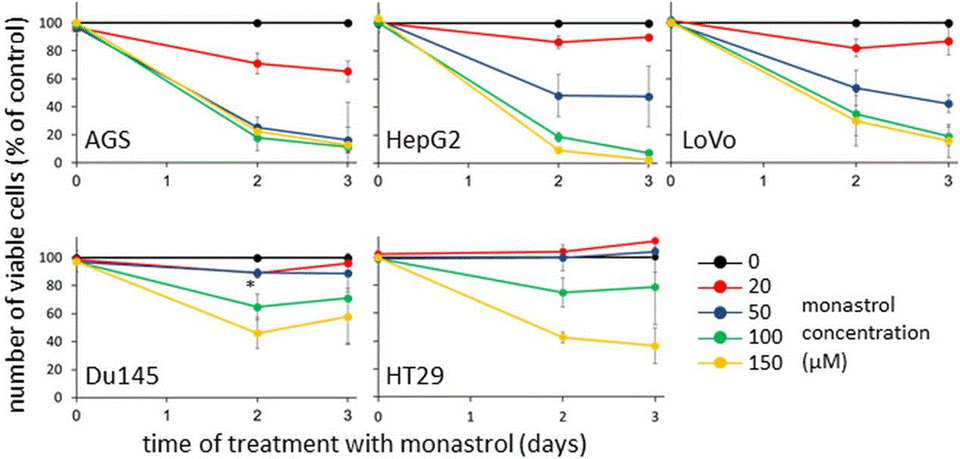
| Growth inhibition assay | Cell viability |
|
26035434 |
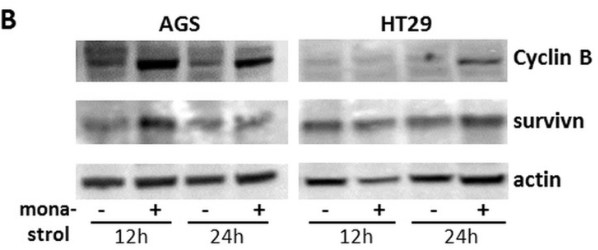
| Western blot | Cyclin B / Survivin |
|
26035434 |
Soporte técnico
Tel: +1-832-582-8158 Ext:3
Si tiene alguna otra consulta, por favor deje un mensaje.

Los productos son solo para uso de investigación. No para uso humano. No vendemos a pacientes.
©Copyright 2013 Selleck Chemicals. Todos los derechos reservados.