
solo para uso en investigación
Ispinesib (SB-715992) Kinesin Inhibidor
Cat. No.: S1452
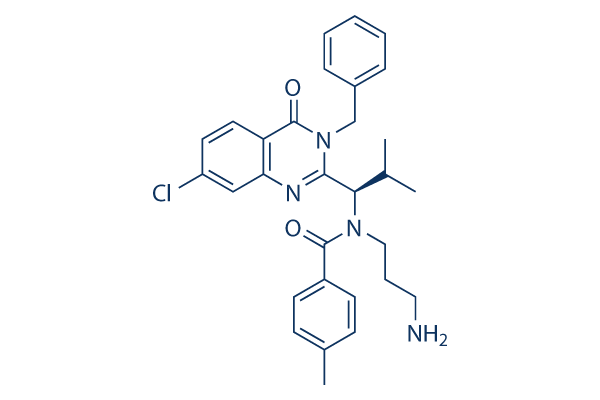
Estructura química
Peso molecular: 517.06
Control de calidad (Quality Control)
| Dianas relacionadas | Akt Wnt/beta-catenin PKC HSP ROCK Microtubule Associated Integrin Bcr-Abl Actin FAK |
|---|---|
| Otros Kinesin Inhibidores | GSK-923295 SB743921 HCl Monastrol ARQ 621 GW406108X H-Cys(Trt)-OH K 858 BTB-1 SB-743921 VLS-1488(KIF18A-IN-6 ) |
Cultivo celular, tratamiento y concentración de trabajo
(Cell Culture, Treatment & Working Concentration)
| Líneas celulares | Tipo de ensayo | Concentración | Tiempo de incubación | Formulación | Descripción de la actividad | PMID |
|---|---|---|---|---|---|---|
| HCT116 | Antiproliferative assay | 72 hrs | Antiproliferative activity against human HCT116 cells after 72 hrs by Alamar blue assay, GI50=0.025μM | 22248262 | ||
| hTERT-HME1 | Antiproliferative assay | 72 hrs | Antiproliferative activity against human hTERT-HME1 cells after 72 hrs by Alamar blue assay, GI50=0.032μM | 22248262 | ||
| K562 | Antiproliferative assay | 72 hrs | Antiproliferative activity against human K562 cells after 72 hrs by Alamar blue assay, GI50=0.071μM | 22248262 | ||
| BxPC3 | Antiproliferative assay | 72 hrs | Antiproliferative activity against human BxPC3 cells after 72 hrs by Alamar blue assay, GI50=0.08μM | 22248262 | ||
| NCI-H1299 | Antiproliferative assay | 72 hrs | Antiproliferative activity against human NCI-H1299 cells after 72 hrs by Alamar blue assay, GI50=0.082μM | 22248262 | ||
| LNCAP | Growth inhibition assay | 72 hrs | Growth inhibition of human LNCAP cells after 72 hrs by Alamar blue assay, GI50=0.022μM | 23394180 | ||
| HCT116 | Growth inhibition assay | 72 hrs | Growth inhibition of human HCT116 cells after 72 hrs by Alamar blue assay, GI50=0.025μM | 23394180 | ||
| PC3 | Growth inhibition assay | 72 hrs | Growth inhibition of human PC3 cells after 72 hrs by Alamar blue assay, GI50=0.05μM | 23394180 | ||
| BxPC3 | Growth inhibition assay | 72 hrs | Growth inhibition of human BxPC3 cells after 72 hrs by Alamar blue assay, GI50=0.08μM | 23394180 | ||
| NCI-H1299 | Growth inhibition assay | 72 hrs | Growth inhibition of human NCI-H1299 cells after 72 hrs by Alamar blue assay, GI50=0.082μM | 23394180 | ||
| LXFS 538 | Antitumor assay | 6 mg/kg | Antitumor activity against human LXFS 538 cells xenografted in NMRI nu/nu mouse assessed as tumor regression at 6 mg/kg, ip measured on day 13 | 23394180 | ||
| HeLa | Antiproliferative assay | 48 hrs | Antiproliferative activity against human HeLa cells after 48 hrs by MTT assay, IC50=1μM | 24184776 | ||
| MCF7 | Antiproliferative assay | 48 hrs | Antiproliferative activity against human MCF7 cells after 48 hrs by MTT assay, IC50=1.3μM | 24184776 | ||
| HCT116 | Growth inhibition assay | 72 hrs | Growth inhibition of human HCT116 cells after 72 hrs by MTS assay, IC50=0.0011μM | 26396688 | ||
| TC32 | qHTS assay | qHTS of pediatric cancer cell lines to identify multiple opportunities for drug repurposing: Primary screen for TC32 cells | 29435139 | |||
| DAOY | qHTS assay | qHTS of pediatric cancer cell lines to identify multiple opportunities for drug repurposing: Primary screen for DAOY cells | 29435139 | |||
| SJ-GBM2 | qHTS assay | qHTS of pediatric cancer cell lines to identify multiple opportunities for drug repurposing: Primary screen for SJ-GBM2 cells | 29435139 | |||
| A673 | qHTS assay | qHTS of pediatric cancer cell lines to identify multiple opportunities for drug repurposing: Primary screen for A673 cells | 29435139 | |||
| SK-N-MC | qHTS assay | qHTS of pediatric cancer cell lines to identify multiple opportunities for drug repurposing: Primary screen for SK-N-MC cells | 29435139 | |||
| NB-EBc1 | qHTS assay | qHTS of pediatric cancer cell lines to identify multiple opportunities for drug repurposing: Primary screen for NB-EBc1 cells | 29435139 | |||
| Saos-2 | qHTS assay | qHTS of pediatric cancer cell lines to identify multiple opportunities for drug repurposing: Primary screen for Saos-2 cells | 29435139 | |||
| LAN-5 | qHTS assay | qHTS of pediatric cancer cell lines to identify multiple opportunities for drug repurposing: Primary screen for LAN-5 cells | 29435139 | |||
| BT-12 | qHTS assay | qHTS of pediatric cancer cell lines to identify multiple opportunities for drug repurposing: Primary screen for BT-12 cells | 29435139 | |||
| OHS-50 | qHTS assay | qHTS of pediatric cancer cell lines to identify multiple opportunities for drug repurposing: Primary screen for OHS-50 cells | 29435139 | |||
| A673 | qHTS assay | qHTS of pediatric cancer cell lines to identify multiple opportunities for drug repurposing: Confirmatory screen for A673 cells) | 29435139 | |||
| SK-N-MC | qHTS assay | qHTS of pediatric cancer cell lines to identify multiple opportunities for drug repurposing: Confirmatory screen for SK-N-MC cells | 29435139 | |||
| BT-12 | qHTS assay | qHTS of pediatric cancer cell lines to identify multiple opportunities for drug repurposing: Confirmatory screen for BT-12 cells | 29435139 | |||
| DAOY | qHTS assay | qHTS of pediatric cancer cell lines to identify multiple opportunities for drug repurposing: Confirmatory screen for DAOY cells | 29435139 | |||
| BT-37 | qHTS assay | qHTS of pediatric cancer cell lines to identify multiple opportunities for drug repurposing: Confirmatory screen for BT-37 cells | 29435139 | |||
| TC32 | qHTS assay | qHTS of pediatric cancer cell lines to identify multiple opportunities for drug repurposing: Confirmatory screen for TC32 cells | 29435139 | |||
| MG 63 (6-TG R) | qHTS assay | qHTS of pediatric cancer cell lines to identify multiple opportunities for drug repurposing: Confirmatory screen for MG 63 (6-TG R) cells | 29435139 | |||
| U-2 OS | qHTS assay | qHTS of pediatric cancer cell lines to identify multiple opportunities for drug repurposing: Confirmatory screen for U-2 OS cells | 29435139 | |||
| Rh41 | qHTS assay | qHTS of pediatric cancer cell lines to identify multiple opportunities for drug repurposing: Confirmatory screen for Rh41 cells | 29435139 | |||
| RD | qHTS assay | qHTS of pediatric cancer cell lines to identify multiple opportunities for drug repurposing: Confirmatory screen for RD cells | 29435139 | |||
| Rh30 | qHTS assay | qHTS of pediatric cancer cell lines to identify multiple opportunities for drug repurposing: Confirmatory screen for Rh30 cells | 29435139 | |||
| Saos-2 | qHTS assay | qHTS of pediatric cancer cell lines to identify multiple opportunities for drug repurposing: Confirmatory screen for Saos-2 cells | 29435139 | |||
| SK-N-SH | qHTS assay | qHTS of pediatric cancer cell lines to identify multiple opportunities for drug repurposing: Confirmatory screen for SK-N-SH cells | 29435139 | |||
| Haga clic para ver más datos experimentales de líneas celulares | ||||||
Información química, almacenamiento y estabilidad (Chemical Information, Storage & Stability)
| Peso molecular | 517.06 | Fórmula | C30H33ClN4O2 |
Almacenamiento (Desde la fecha de recepción) | |
|---|---|---|---|---|---|
| Nº CAS | 336113-53-2 | Descargar SDF | Almacenamiento de soluciones madre |
|
|
| Sinónimos | CK0238273 | Smiles | CC1=CC=C(C=C1)C(=O)N(CCCN)C(C2=NC3=C(C=CC(=C3)Cl)C(=O)N2CC4=CC=CC=C4)C(C)C | ||
Solubilidad (Solubility)
|
In vitro |
DMSO
: 103 mg/mL
(199.2 mM)
Ethanol : 103 mg/mL Water : Insoluble |
Calculadora de Molaridad
|
In vivo |
|||||
Calculadora de formulación in vivo (Solución clara)
Paso 1: Introduzca la información a continuación (Recomendado: Un animal adicional para tener en cuenta la pérdida durante el experimento)
Paso 2: Introduzca la formulación in vivo (Esto es solo la calculadora, no la formulación. Por favor, contáctenos primero si no hay una formulación in vivo en la sección de Solubilidad.)
Resultados del cálculo:
Concentración de trabajo: mg/ml;
Método para preparar el líquido maestro de DMSO: mg fármaco predissuelto en μL DMSO ( Concentración del líquido maestro mg/mL, Por favor, contáctenos primero si la concentración excede la solubilidad del DMSO del lote del fármaco. )
Método para preparar la formulación in vivo: Tomar μL DMSO líquido maestro, luego añadirμL PEG300, mezclar y clarificar, luego añadirμL Tween 80, mezclar y clarificar, luego añadir μL ddH2O, mezclar y clarificar.
Método para preparar la formulación in vivo: Tomar μL DMSO líquido maestro, luego añadir μL Aceite de maíz, mezclar y clarificar.
Nota: 1. Por favor, asegúrese de que el líquido esté claro antes de añadir el siguiente disolvente.
2. Asegúrese de añadir el (los) disolvente(s) en orden. Debe asegurarse de que la solución obtenida, en la adición anterior, sea una solución clara antes de proceder a añadir el siguiente disolvente. Se pueden utilizar métodos físicos como el vórtice, el ultrasonido o el baño de agua caliente para ayudar a la disolución.
Mecanismo de acción (Mechanism of Action)
| Características |
An allosteric, potent, specific, and reversible inhibitor of the mitotic kinesin spindle protein (KSP) (HsEg5).
|
|---|---|
| Targets/IC50/Ki |
KSP (HsEg5)
(Cell-free assay) 1.7 nM(Ki app)
|
| In vitro |
Ispinesib (SB-715992) is a potent, allosteric, reversible, and specific inhibitor of KSP, which changes the binding property of KSP to microtubules and disturbs its movement by inhibiting ADP release without altering the release of the KSP-ADP complex from the microtubule. This compound shows potent cytotoxic activity in a panel of tumor cell lines, including Colo205, Colo201, HT-29, M5076, Madison-109, and MX-1, with IC50 of 1.2 nM to 9.5 nM. In PC-3 prostate cancer cells, it (15 nM and 30 nM) blocks cell proliferation and induces apoptosis by regulating the expression levels of genes that controls apoptosis, cell proliferation, cell cycle, and cell signaling, such as EGFR, p27, p15, and IL-11. In a panel of 53 breast cell lines, Ispinesib (7.4 nM–600 nM) demonstrates broad inhibitory activity. In BT-474 and MDA-MB-468 cells, it (150 nM) induces apoptosis, as revealed by a higher proportion of apoptotic cells, lower antiapoptotic Bcl-XL level, and higher proapoptotic Bax and Bid levels. |
| Ensayo de quinasa |
Análisis Cinético en Estado Estacionario de la Actividad ATPasa de KSP Humana y su Inhibición por Ispinesib
|
|
El análisis de la especificidad de la Kinesin se lleva a cabo utilizando un sistema de detección de piruvato quinasa-lactato deshidrogenasa que acopla la producción de ADP a la oxidación de NADH. Los cambios de absorbancia se monitorean a 340 nm. Los estudios en estado estacionario utilizando concentraciones nanomolares de KSP se realizan mediante un ensayo sensible basado en fluorescencia que utiliza un sistema de detección acoplado de piruvato quinasa, piruvato oxidasa y peroxidasa de rábano (HRP) que acopla la generación de ADP a la oxidación de Amplex Red a resorufina fluorescente. La generación de resorufina se monitorea por fluorescencia (λexcitación = 520 nm y λemisión = 580 nm). Los experimentos bioquímicos en estado estacionario se realizan en tampón PEM25 [25 mM Pipes-K+ (pH 6,8), 2 mM MgCl2, 1 mM EGTA] para experimentos que involucran microtúbulos. La IC50 para la inhibición en estado estacionario se determina a 500 µM ATP, 5 µM microtúbulos y 1 nM KSP en tampón PEM25. Los valores de Ki app (constante de disociación aparente del inhibidor) de Ispinesib (SB-715992) se extraen de las curvas de dosis-respuesta, con corrección explícita de la concentración de la enzima utilizando la ecuación de Morrison. La modalidad del inhibidor (por ejemplo, competitivo, no competitivo, acompetitivo o mixto) bajo condiciones de estado estacionario se determina midiendo el efecto de su concentración sobre la velocidad inicial en función de las concentraciones de sustrato. Los datos se ajustan utilizando ecuaciones en GraFit a ecuaciones de velocidad para los diversos modos de inhibición.
|
|
| In vivo |
Ispinesib (SB-715992) (4.5 mg/kg–15 mg/kg) exhibits inhibitory effects against Colo205, Colo201, HT-29, but not MX-1 cells, in mouse xenograft models. This compound (6 mg/kg–10 mg/kg) also inhibits murine solid tumors, including Madison 109 lung carcinoma, M5076 sarcoma, as well as L1210 and P388 leukemias. In mice xenograft models of breast cancer cells MCF-7, HCC1954, MDA-MB-468, and KPL4, it (8 mg/kg–10 mg/kg) inhibits tumor growth. |
Referencias |
|
Información del ensayo clínico (Clinical Trial Information)
(datos de https://clinicaltrials.gov, actualizado el 2017-03-06)
| Número NCT | Reclutamiento | Condiciones | Patrocinador/Colaboradores | Fecha de inicio | Fases |
|---|---|---|---|---|---|
| NCT00095628 | COMPLETED | Metastatic Squamous Neck Cancer With Occult Primary Squamous Cell Carcinoma; Recurrent Metastatic Squamous Neck Cancer With Occult Primary; Recurrent Salivary Gland Cancer; Recurrent Squamous Cell Carcinoma of the Hypopharynx; Recurrent Squamous Cell Carcinoma of the Larynx; Recurrent Squamous Cell Carcinoma of the Lip and Oral Cavity; Recurrent Squamous Cell Carcinoma of the Oropharynx; Recurrent Squamous Cell Carcinoma of the Paranasal Sinus and Nasal Cavity; Recurrent Verrucous Carcinoma of the Larynx; Recurrent Verrucous Carcinoma of the Oral Cavity; Stage IV Squamous Cell Carcinoma of the Hypopharynx; Stage IV Squamous Cell Carcinoma of the Larynx; Stage IV Squamous Cell Carcinoma of the Lip and Oral Cavity; Stage IV Squamous Cell Carcinoma of the Oropharynx; Stage IV Verrucous Carcinoma of the Larynx; Stage IV Verrucous Carcinoma of the Oral Cavity; Stage IVA Salivary Gland Cancer; Stage IVA Squamous Cell Carcinoma of the Paranasal Sinus and Nasal Cavity; Stage IVB Salivary Gland Cancer; Stage IVB Squamous Cell Carcinoma of the Paranasal Sinus and Nasal Cavity; Stage IVC Salivary Gland Cancer; Stage IVC Squamous Cell Carcinoma of the Paranasal Sinus and Nasal Cavity |
National Cancer Institute (NCI) |
2005-01 | PHASE2 |
| NCT00101244 | TERMINATED | Adult Grade III Lymphomatoid Granulomatosis; Extranodal Marginal Zone B-cell Lymphoma of Mucosa-associated Lymphoid Tissue; Nodal Marginal Zone B-cell Lymphoma; Recurrent Adult Burkitt Lymphoma; Recurrent Adult Diffuse Large Cell Lymphoma; Recurrent Adult Diffuse Mixed Cell Lymphoma; Recurrent Adult Diffuse Small Cleaved Cell Lymphoma; Recurrent Adult Grade III Lymphomatoid Granulomatosis; Recurrent Adult Hodgkin Lymphoma; Recurrent Adult Immunoblastic Large Cell Lymphoma; Recurrent Adult Lymphoblastic Lymphoma; Recurrent Grade 1 Follicular Lymphoma; Recurrent Grade 2 Follicular Lymphoma; Recurrent Grade 3 Follicular Lymphoma; Recurrent Mantle Cell Lymphoma; Recurrent Marginal Zone Lymphoma; Recurrent Small Lymphocytic Lymphoma; Splenic Marginal Zone Lymphoma; Stage IV Adult Burkitt Lymphoma; Stage IV Adult Diffuse Large Cell Lymphoma; Stage IV Adult Diffuse Mixed Cell Lymphoma; Stage IV Adult Diffuse Small Cleaved Cell Lymphoma; Stage IV Adult Hodgkin Lymphoma; Stage IV Adult Immunoblastic Large Cell Lymphoma; Stage IV Adult Lymphoblastic Lymphoma; Stage IV Grade 1 Follicular Lymphoma; Stage IV Grade 2 Follicular Lymphoma; Stage IV Grade 3 Follicular Lymphoma; Stage IV Mantle Cell Lymphoma; Stage IV Marginal Zone Lymphoma; Stage IV Small Lymphocytic Lymphoma; Unspecified Adult Solid Tumor, Protocol Specific; Waldenström Macroglobulinemia |
National Cancer Institute (NCI) |
2004-11 | PHASE1 |
| NCT00103311 | COMPLETED | Recurrent Colon Cancer; Recurrent Rectal Cancer; Stage IIIA Colon Cancer; Stage IIIA Rectal Cancer; Stage IIIB Colon Cancer; Stage IIIB Rectal Cancer; Stage IIIC Colon Cancer; Stage IIIC Rectal Cancer; Stage IVA Colon Cancer; Stage IVA Rectal Cancer; Stage IVB Colon Cancer; Stage IVB Rectal Cancer |
National Cancer Institute (NCI) |
2005-01 | PHASE2 |
| NCT00607841 | TERMINATED | Breast Neoplasms |
Cytokinetics |
2007-12 | PHASE1 |
| NCT00363272 | COMPLETED | Childhood Burkitt Lymphoma; Childhood Central Nervous System Germ Cell Tumor; Childhood Choroid Plexus Tumor; Childhood Craniopharyngioma; Childhood Grade I Meningioma; Childhood Grade II Meningioma; Childhood Grade III Meningioma; Childhood High-grade Cerebral Astrocytoma; Childhood Infratentorial Ependymoma; Childhood Low-grade Cerebral Astrocytoma; Childhood Spinal Cord Neoplasm; Childhood Supratentorial Ependymoma; Recurrent Childhood Brain Stem Glioma; Recurrent Childhood Brain Tumor; Recurrent Childhood Cerebellar Astrocytoma; Recurrent Childhood Cerebral Astrocytoma; Recurrent Childhood Ependymoma; Recurrent Childhood Grade III Lymphomatoid Granulomatosis; Recurrent Childhood Large Cell Lymphoma; Recurrent Childhood Lymphoblastic Lymphoma; Recurrent Childhood Medulloblastoma; Recurrent Childhood Small Noncleaved Cell Lymphoma; Recurrent Childhood Supratentorial Primitive Neuroectodermal Tumor; Recurrent Childhood Visual Pathway and Hypothalamic Glioma; Unspecified Childhood Solid Tumor, Protocol Specific |
National Cancer Institute (NCI) |
2006-06 | PHASE1 |
| NCT00098826 | COMPLETED | Acute Undifferentiated Leukemia; Adult Acute Megakaryoblastic Leukemia (M7); Adult Acute Minimally Differentiated Myeloid Leukemia (M0); Adult Acute Monoblastic Leukemia (M5a); Adult Acute Monocytic Leukemia (M5b); Adult Acute Myeloblastic Leukemia With Maturation (M2); Adult Acute Myeloblastic Leukemia Without Maturation (M1); Adult Acute Myeloid Leukemia With 11q23 (MLL) Abnormalities; Adult Acute Myeloid Leukemia With Inv(16)(p13;q22); Adult Acute Myeloid Leukemia With t(15;17)(q22;q12); Adult Acute Myeloid Leukemia With t(16;16)(p13;q22); Adult Acute Myeloid Leukemia With t(8;21)(q22;q22); Adult Acute Myelomonocytic Leukemia (M4); Adult Acute Promyelocytic Leukemia (M3); Adult Erythroleukemia (M6a); Adult Pure Erythroid Leukemia (M6b); Blastic Phase Chronic Myelogenous Leukemia; de Novo Myelodysplastic Syndromes; Previously Treated Myelodysplastic Syndromes; Recurrent Adult Acute Lymphoblastic Leukemia; Recurrent Adult Acute Myeloid Leukemia; Refractory Anemia With Excess Blasts; Refractory Anemia With Excess Blasts in Transformation; Relapsing Chronic Myelogenous Leukemia; Secondary Acute Myeloid Leukemia; Secondary Myelodysplastic Syndromes; Untreated Adult Acute Myeloid Leukemia |
National Cancer Institute (NCI) |
2004-12 | PHASE1 |

Los productos son solo para uso de investigación. No para uso humano. No vendemos a pacientes.
©Copyright 2013 Selleck Chemicals. Todos los derechos reservados.