
solo para uso en investigación
L-Arginine HCl (L-Arg) NOS químico
Cat. No.S3174
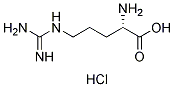
Estructura química
Peso molecular: 210.66
Control de calidad
Información química, almacenamiento y estabilidad
| Peso molecular | 210.66 | Fórmula | C6H14N4O2.HCl |
Almacenamiento (Desde la fecha de recepción) | |
|---|---|---|---|---|---|
| Nº CAS | 1119-34-2 | Descargar SDF | Almacenamiento de soluciones madre |
|
|
| Sinónimos | (S)-(+)-Arginine hydrochloride | Smiles | C(CC(C(=O)O)N)CN=C(N)N.Cl | ||
Solubilidad
|
In vitro |
Water : 42 mg/mL
DMSO
: Insoluble
Ethanol : Insoluble |
Calculadora de Molaridad
|
In vivo |
|||||
Calculadora de formulación in vivo (Solución clara)
Paso 1: Introduzca la información a continuación (Recomendado: Un animal adicional para tener en cuenta la pérdida durante el experimento)
Paso 2: Introduzca la formulación in vivo (Esto es solo la calculadora, no la formulación. Por favor, contáctenos primero si no hay una formulación in vivo en la sección de Solubilidad.)
Resultados del cálculo:
Concentración de trabajo: mg/ml;
Método para preparar el líquido maestro de DMSO: mg fármaco predissuelto en μL DMSO ( Concentración del líquido maestro mg/mL, Por favor, contáctenos primero si la concentración excede la solubilidad del DMSO del lote del fármaco. )
Método para preparar la formulación in vivo: Tomar μL DMSO líquido maestro, luego añadirμL PEG300, mezclar y clarificar, luego añadirμL Tween 80, mezclar y clarificar, luego añadir μL ddH2O, mezclar y clarificar.
Método para preparar la formulación in vivo: Tomar μL DMSO líquido maestro, luego añadir μL Aceite de maíz, mezclar y clarificar.
Nota: 1. Por favor, asegúrese de que el líquido esté claro antes de añadir el siguiente disolvente.
2. Asegúrese de añadir el (los) disolvente(s) en orden. Debe asegurarse de que la solución obtenida, en la adición anterior, sea una solución clara antes de proceder a añadir el siguiente disolvente. Se pueden utilizar métodos físicos como el vórtice, el ultrasonido o el baño de agua caliente para ayudar a la disolución.
Mecanismo de acción
| In vitro |
La suplementación con L-Arginine HCl (L-Arg) (0,3 mM, 30 minutos) no induce aumentos significativos en la concentración máxima de NO a bajo nivel de LDL nativo. Sin embargo, a concentraciones de LDL nativo de 60-130 mg de colesterol/dL, la concentración de NO es 2 veces mayor que antes del tratamiento en células endoteliales aórticas bovinas. Este compuesto resulta en un aumento significativo de la producción de NO tanto en células tratadas con n-LDL como en células tratadas con LDL oxidado en el mismo tipo celular. No aumenta la concentración de O2- a bajas concentraciones de LDL nativo, pero reduce la producción de O2- en un 50 % cuando se incuba con n-LDL a concentraciones >40 mg de colesterol/dL. Además, suprime completamente la producción de O2- en cada dosis de LDL oxidado en células endoteliales aórticas bovinas. |
|---|---|
| In vivo |
El tratamiento con L-Arginine HCl (L-Arg) (4 mg/kg/min durante 1 hora) disminuye la generación de superóxido por la cNOS mientras aumenta la acumulación de NO en la extremidad de conejo durante la isquemia/reperfusión. Este compuesto previene la constricción microvascular en el músculo reperfundido a pesar de un edema intersticial reducido pero aún aparente en la extremidad de conejo, y resulta en una reducción significativa del edema de reperfusión muscular en la extremidad de conejo. Su suplementación (0,1 g/kg, oral) reduce significativamente la presión sistólica de la arteria pulmonar en un promedio de 15,2% después de 5 días de terapia en pacientes con enfermedad de células falciformes. Las concentraciones de L-Arginine y ornitina aumentaron significativamente después de 5 días de suplementación oral en pacientes con enfermedad de células falciformes. Se asocia con una disminución del índice cardíaco mientras que el índice de volumen sistólico se mantiene en pacientes con sepsis grave. La resolución del shock a las 72 horas se logra en el 40% y el 24% de los pacientes en las cohortes de L-Arginine y placebo, respectivamente. Este compuesto (450 mg/kg durante un período de 15 minutos) amplifica y sostiene la hiperemia (38%) y aumenta el flujo sanguíneo cerebral absoluto después de la regulación al alza de eNOS mediante el tratamiento crónico con simvastatina (2 mg/kg por vía subcutánea, diariamente durante 14 días) en ratones SV-129. |
Referencias |
|
Información del ensayo clínico
(datos de https://clinicaltrials.gov, actualizado el 2024-05-22)
| Número NCT | Reclutamiento | Condiciones | Patrocinador/Colaboradores | Fecha de inicio | Fases |
|---|---|---|---|---|---|
| NCT06265623 | Not yet recruiting | Chronic Obstructive Pulmonary Disease (COPD) |
Universitätsklinikum Hamburg-Eppendorf |
March 1 2024 | -- |
| NCT06244758 | Recruiting | Type2diabetes |
University of Erlangen-Nürnberg Medical School|Bayer |
January 18 2024 | Phase 3 |
| NCT06137833 | Not yet recruiting | Fatigue|Breast Cancer |
Pharmanutra S.p.a.|Latis S.r.l. |
November 27 2023 | Not Applicable |
| NCT05934318 | Not yet recruiting | Pregnancy|Malaria|Nutrition|Placental Development|Preterm Birth|Fetal Growth Restriction |
Liverpool School of Tropical Medicine|Kenya Medical Research Institute|University of Toronto|Telethon Kids Institute |
September 30 2023 | Not Applicable |
Soporte técnico
Tel: +1-832-582-8158 Ext:3
Si tiene alguna otra consulta, por favor deje un mensaje.

Los productos son solo para uso de investigación. No para uso humano. No vendemos a pacientes.
©Copyright 2013 Selleck Chemicals. Todos los derechos reservados.