
solo para uso en investigación
Dronedarone HCl Potassium Channel inhibidor
Cat. No.S2114
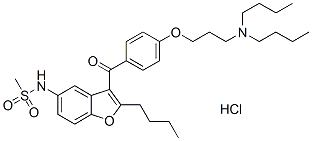
Estructura química
Peso molecular: 593.22
Control de calidad
- Citado en Nature Medicine por su máxima calidad
- COA
- NMR
- SDS
- Hoja de datos
| Dianas relacionadas | CFTR CRM1 CD markers AChR Calcium Channel Sodium Channel GABA Receptor TRP Channel ATPase GluR |
|---|---|
| Otros Potassium Channel Inhibidores | TRAM-34 Nicorandil ML133 HCl Sophocarpine Hydralazine HCl Nigericin Gliquidone E-4031 dihydrochloride PAP-1 Ajmaline |
Información química, almacenamiento y estabilidad
| Peso molecular | 593.22 | Fórmula | C31H44N2O5S.HCl |
Almacenamiento (Desde la fecha de recepción) | |
|---|---|---|---|---|---|
| Nº CAS | 141625-93-6 | Descargar SDF | Almacenamiento de soluciones madre |
|
|
| Sinónimos | SR33589 | Smiles | CCCCC1=C(C2=C(O1)C=CC(=C2)NS(=O)(=O)C)C(=O)C3=CC=C(C=C3)OCCCN(CCCC)CCCC.Cl | ||
Solubilidad
|
In vitro |
DMSO
: 80 mg/mL
(134.85 mM)
Ethanol : 40 mg/mL Water : Insoluble |
Calculadora de Molaridad
|
In vivo |
|||||
Calculadora de formulación in vivo (Solución clara)
Paso 1: Introduzca la información a continuación (Recomendado: Un animal adicional para tener en cuenta la pérdida durante el experimento)
Paso 2: Introduzca la formulación in vivo (Esto es solo la calculadora, no la formulación. Por favor, contáctenos primero si no hay una formulación in vivo en la sección de Solubilidad.)
Resultados del cálculo:
Concentración de trabajo: mg/ml;
Método para preparar el líquido maestro de DMSO: mg fármaco predissuelto en μL DMSO ( Concentración del líquido maestro mg/mL, Por favor, contáctenos primero si la concentración excede la solubilidad del DMSO del lote del fármaco. )
Método para preparar la formulación in vivo: Tomar μL DMSO líquido maestro, luego añadirμL PEG300, mezclar y clarificar, luego añadirμL Tween 80, mezclar y clarificar, luego añadir μL ddH2O, mezclar y clarificar.
Método para preparar la formulación in vivo: Tomar μL DMSO líquido maestro, luego añadir μL Aceite de maíz, mezclar y clarificar.
Nota: 1. Por favor, asegúrese de que el líquido esté claro antes de añadir el siguiente disolvente.
2. Asegúrese de añadir el (los) disolvente(s) en orden. Debe asegurarse de que la solución obtenida, en la adición anterior, sea una solución clara antes de proceder a añadir el siguiente disolvente. Se pueden utilizar métodos físicos como el vórtice, el ultrasonido o el baño de agua caliente para ayudar a la disolución.
Mecanismo de acción
| Targets/IC50/Ki |
Potassium channel
Sodium channel
Calcium channel
|
|---|---|
| In vitro |
La Dronedarone reduce la incidencia de despolarizaciones tempranas y tardías evocadas por 1 mM de Dofetilide y 0,2 mM de Estrofantidina en las fibras de Purkinje. La Dronedarone (10 mM) reduce marcadamente la corriente de calcio tipo L (76,5%) y el componente rápido de la corriente de potasio rectificadora tardía (97%) en los miocitos ventriculares. La Dronedarone inhibe la actividad de los canales I(K(ACh)) registrados en parches adheridos a células, reduciendo la probabilidad de apertura del canal (de 0,56 a 0,11) sin modificar la conductancia del canal único en células individuales aisladas del tejido del nodo sinoauricular (SAN) de corazones de conejo. La Dronedarone exhibe una inhibición dependiente del estado de la corriente rápida del canal Na(+) con una IC50 de 0,7 μM en miocitos ventriculares de cobaya, cuando el potencial de mantenimiento (V (hold)) es de -80 mV. La Dronedarone bloquea las corrientes de Ca(2+) provocadas por pulsos rectangulares a V (hold) = -40 mV con un valor de IC50 de 0,4 μM, mientras que a V (hold) = -80 mV, la Dronedarone (10 μM) bloquea solo el 20 % de la corriente.
|
| In vivo |
La Dronedarone aumenta la duración del potencial de acción en corazones normales de ratas. La Dronedarone reduce la corriente de K(+) tardía sostenida, I(K) (o Isus) en un 69%. La Dronedarone induce solo un bloqueo tónico de I(K). La Dronedarone induce un débil aumento en la corriente transitoria de salida rápida, I(to), en ratas después de un infarto de miocardio.
|
Referencias |
|
Información del ensayo clínico
(datos de https://clinicaltrials.gov, actualizado el 2024-05-22)
| Número NCT | Reclutamiento | Condiciones | Patrocinador/Colaboradores | Fecha de inicio | Fases |
|---|---|---|---|---|---|
| NCT01430806 | Unknown status | ICD|ICD SHOCKS|DRONEDARONE |
Rabin Medical Center |
October 2011 | Not Applicable |
| NCT01266681 | Unknown status | Atrial Fibrillation |
Eastbourne General Hospital |
March 2011 | Not Applicable |
| NCT01199081 | Completed | Atrial Fibrillation |
Sanofi |
October 2010 | Phase 4 |
| NCT01213368 | Completed | Atrial Fibrillation |
Sanofi |
September 2010 | Phase 2 |
| NCT01140581 | Completed | Atrial Fibrillation |
Sanofi |
September 2010 | Phase 4 |
| NCT01070667 | Unknown status | Paroxysmal Atrial Fibrillation |
Eastbourne General Hospital |
March 2010 | Phase 4 |
Soporte técnico
Tel: +1-832-582-8158 Ext:3
Si tiene alguna otra consulta, por favor deje un mensaje.

Los productos son solo para uso de investigación. No para uso humano. No vendemos a pacientes.
©Copyright 2013 Selleck Chemicals. Todos los derechos reservados.