
solo para uso en investigación
Quinine HCl Dihydrate Potassium Channel inhibidor
Cat. No.S2502
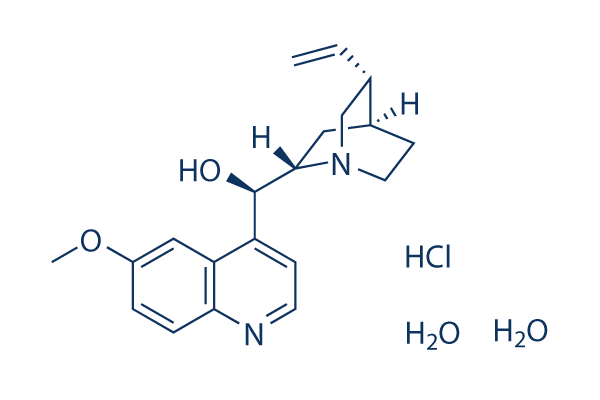
Estructura química
Peso molecular: 396.91
Control de calidad
| Dianas relacionadas | CFTR CRM1 CD markers AChR Calcium Channel Sodium Channel GABA Receptor TRP Channel ATPase GluR |
|---|---|
| Otros Potassium Channel Inhibidores | TRAM-34 Nicorandil ML133 HCl Sophocarpine Hydralazine HCl Nigericin Gliquidone E-4031 dihydrochloride PAP-1 Ajmaline |
Información química, almacenamiento y estabilidad
| Peso molecular | 396.91 | Fórmula | C20H24N2O2.HCl.2H2O |
Almacenamiento (Desde la fecha de recepción) | |
|---|---|---|---|---|---|
| Nº CAS | 6119-47-7 | Descargar SDF | Almacenamiento de soluciones madre |
|
|
| Sinónimos | N/A | Smiles | COC1=CC2=C(C=CN=C2C=C1)C(C3CC4CCN3CC4C=C)O.O.O.Cl | ||
Solubilidad
|
In vitro |
DMSO
: 79 mg/mL
(199.03 mM)
Ethanol : 79 mg/mL Water : 43 mg/mL |
Calculadora de Molaridad
|
In vivo |
|||||
Calculadora de formulación in vivo (Solución clara)
Paso 1: Introduzca la información a continuación (Recomendado: Un animal adicional para tener en cuenta la pérdida durante el experimento)
Paso 2: Introduzca la formulación in vivo (Esto es solo la calculadora, no la formulación. Por favor, contáctenos primero si no hay una formulación in vivo en la sección de Solubilidad.)
Resultados del cálculo:
Concentración de trabajo: mg/ml;
Método para preparar el líquido maestro de DMSO: mg fármaco predissuelto en μL DMSO ( Concentración del líquido maestro mg/mL, Por favor, contáctenos primero si la concentración excede la solubilidad del DMSO del lote del fármaco. )
Método para preparar la formulación in vivo: Tomar μL DMSO líquido maestro, luego añadirμL PEG300, mezclar y clarificar, luego añadirμL Tween 80, mezclar y clarificar, luego añadir μL ddH2O, mezclar y clarificar.
Método para preparar la formulación in vivo: Tomar μL DMSO líquido maestro, luego añadir μL Aceite de maíz, mezclar y clarificar.
Nota: 1. Por favor, asegúrese de que el líquido esté claro antes de añadir el siguiente disolvente.
2. Asegúrese de añadir el (los) disolvente(s) en orden. Debe asegurarse de que la solución obtenida, en la adición anterior, sea una solución clara antes de proceder a añadir el siguiente disolvente. Se pueden utilizar métodos físicos como el vórtice, el ultrasonido o el baño de agua caliente para ayudar a la disolución.
Mecanismo de acción
| Targets/IC50/Ki |
Potassium channel
|
|---|---|
| In vitro |
La quinina bloquea las corrientes de unión Cx36 y Cx50 de manera reversible y dependiente de la concentración con concentraciones de bloqueo semimáximas de 32 mM y 73 mM, respectivamente. La quinina induce transiciones lentas entre estados abiertos y completamente cerrados que disminuyen la probabilidad de apertura del canal. Por lo tanto, la quinina ofrece un método potencialmente útil para bloquear ciertos tipos de canales de unión comunicante, incluidos los que se encuentran entre las neuronas formadas por Cx36. La quinina, un bloqueador de los canales de K+, previene la formación del factor de necrosis tumoral (TNF), así como la posterior fragmentación del ADN hepático y la fuga de enzimas hepáticas. La quinina provoca inmunorreactividad tipo Fos (FLI) concentrada en el tercio medial del núcleo; el ácido provocó una FLI más ampliamente distribuida y concentrada más lateralmente. La quinina tiene un efecto relativamente débil sobre la acumulación de doxorrubicina, pero fue capaz de restaurar completamente la sensibilidad a la doxorrubicina en las células resistentes. La quinina también modifica la tolerancia intracelular a la doxorrubicina, lo que sugiere que es capaz de modificar la distribución del fármaco dentro de las células. La quinina bloquea principalmente las corrientes de potasio de toda la célula (IK) de manera dependiente del voltaje. La quinina también reduce el tamaño de las corrientes de sodio (INa) de manera dependiente del uso, mientras que deja las corrientes de calcio (ICa) relativamente inafectadas.
|
Referencias |
|
Información del ensayo clínico
(datos de https://clinicaltrials.gov, actualizado el 2024-05-22)
| Número NCT | Reclutamiento | Condiciones | Patrocinador/Colaboradores | Fecha de inicio | Fases |
|---|---|---|---|---|---|
| NCT04873011 | Unknown status | Obesity |
Universitaire Ziekenhuizen KU Leuven |
October 29 2020 | Phase 1 |
| NCT02817919 | Completed | Malaria |
African Collaborating Centre for Pharmacovigilance|Kintampo Health Research Centre Ghana|University of Health and Allied Sciences |
May 2016 | -- |
| NCT02598713 | Recruiting | Pneumonia|Aspiration |
Massachusetts General Hospital |
December 2015 | Phase 1 |
Soporte técnico
Tel: +1-832-582-8158 Ext:3
Si tiene alguna otra consulta, por favor deje un mensaje.

Los productos son solo para uso de investigación. No para uso humano. No vendemos a pacientes.
©Copyright 2013 Selleck Chemicals. Todos los derechos reservados.