
solo para uso en investigación
Masitinib c-Kit Inhibidor
Cat. No.: S1064
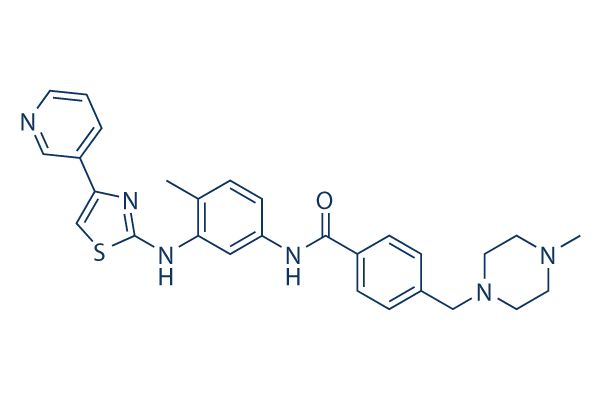
Estructura química
Peso molecular: 498.64
Control de calidad (Quality Control)
| Dianas relacionadas | EGFR VEGFR FGFR PDGFR c-Met Src MEK CSF-1R FLT3 HER2 |
|---|---|
| Otros c-Kit Inhibidores | Amuvatinib (MP-470) Sitravatinib (MGCD516) OSI-930 PDGFR inhibitor 1 AZD3229 ISCK03 Masitinib mesylate Bezuclastinib Elenestinib phosphate M4205(IDRX-42) |
Información química, almacenamiento y estabilidad (Chemical Information, Storage & Stability)
| Peso molecular | 498.64 | Fórmula | C28H30N6OS |
Almacenamiento (Desde la fecha de recepción) | |
|---|---|---|---|---|---|
| Nº CAS | 790299-79-5 | Descargar SDF | Almacenamiento de soluciones madre |
|
|
| Sinónimos | AB1010 | Smiles | CC1=C(C=C(C=C1)NC(=O)C2=CC=C(C=C2)CN3CCN(CC3)C)NC4=NC(=CS4)C5=CN=CC=C5 | ||
Solubilidad (Solubility)
|
In vitro |
DMSO
: 99 mg/mL
(198.54 mM)
Ethanol : 99 mg/mL Water : Insoluble |
Calculadora de Molaridad
|
In vivo |
|||||
Calculadora de formulación in vivo (Solución clara)
Paso 1: Introduzca la información a continuación (Recomendado: Un animal adicional para tener en cuenta la pérdida durante el experimento)
Paso 2: Introduzca la formulación in vivo (Esto es solo la calculadora, no la formulación. Por favor, contáctenos primero si no hay una formulación in vivo en la sección de Solubilidad.)
Resultados del cálculo:
Concentración de trabajo: mg/ml;
Método para preparar el líquido maestro de DMSO: mg fármaco predissuelto en μL DMSO ( Concentración del líquido maestro mg/mL, Por favor, contáctenos primero si la concentración excede la solubilidad del DMSO del lote del fármaco. )
Método para preparar la formulación in vivo: Tomar μL DMSO líquido maestro, luego añadirμL PEG300, mezclar y clarificar, luego añadirμL Tween 80, mezclar y clarificar, luego añadir μL ddH2O, mezclar y clarificar.
Método para preparar la formulación in vivo: Tomar μL DMSO líquido maestro, luego añadir μL Aceite de maíz, mezclar y clarificar.
Nota: 1. Por favor, asegúrese de que el líquido esté claro antes de añadir el siguiente disolvente.
2. Asegúrese de añadir el (los) disolvente(s) en orden. Debe asegurarse de que la solución obtenida, en la adición anterior, sea una solución clara antes de proceder a añadir el siguiente disolvente. Se pueden utilizar métodos físicos como el vórtice, el ultrasonido o el baño de agua caliente para ayudar a la disolución.
Mecanismo de acción (Mechanism of Action)
| Características |
Potential low side-effect profile.
|
|---|---|
| Targets/IC50/Ki |
Kit
(Cell-free assay) 200 nM
Lyn B
(Cell-free assay) 510 nM
PDGFRα
(Cell-free assay) 540 nM
PDGFRβ
(Cell-free assay) 800 nM
Abl1
(Cell-free assay) 1.20 μM
c-Fms
(Cell-free assay) 1.48 μM
Src
(Cell-free assay) 1.87 μM
Hck
(Cell-free assay) 2.0 μM
|
| In vitro |
Masitinib is a competitive inhibitor against ATP at concentrations ≤500 nM. This compound also potently inhibits recombinant PDGFR and the intracellular kinase Lyn, and to a lesser extent, fibroblast growth factor receptor 3. In contrast, it demonstrates weak inhibition of Abl and c-Fms. This chemical more strongly inhibits degranulation, cytokine production, and bone marrow mast cell migration than imatinib. In Ba/F3 cells expressing human wild-type Kit, it inhibits SCF (stem cell factor)-induced cell proliferation with an IC50 of 150 nM, while the IC50 for inhibition of IL-3-stimulated proliferation is at approximately >10 µM. In Ba/F3 cells expressing PDGFRα, it inhibits PDGF-BB-stimulated proliferation and PDGFRα tyrosine phosphorylation with IC50 of 300 nM. It also causes inhibition of SCF-stimulated tyrosine phosphorylation of human Kit in mastocytoma cell-lines and BMMC. This compound inhibits Kit gain-of-function mutants, including V559D mutant and Δ27 mouse mutant with IC50 of 3 and 5 nM in Ba/F3 cells. It inhibits the cell proliferation of mastocytoma cell lines including HMC-1α155 and FMA3 with IC50 of 10 and 30 nM, respectively. This chemical inhibits cell growth and PDGFR phosphorylation in two novel ISS cell lines, which suggest that it displays activity against both primary and metastatic ISS cell line and may aid in the clinical management of ISS.
|
| Ensayo de quinasa |
Inmunoensayo ligado a enzimas in vitro con proteínas quinasas recombinantes
|
|
Una placa de microtitulación de 96 pocillos se recubre durante la noche con 0,25 mg/ml de poli(Glu,Tyr 4:1), se enjuaga dos veces con 250 µL de tampón de lavado (10 mM de solución salina tamponada con fosfato [pH 7,4] y 0,05% de Tween 20) y se seca durante 2 horas a temperatura ambiente. Los ensayos se realizan a temperatura ambiente con un volumen final de 50 µL en tampón de quinasa (10 mM de MgCl2, 1 mM de MnCl2, 1 mM de ortovanadato de sodio, 20 mM de HEPES, pH 7,8) que contiene ATP a una concentración de al menos el doble del Km para cada enzima y una cantidad apropiada de enzima recombinante para asegurar una velocidad de reacción lineal. Las reacciones se inician con la introducción de la enzima y se terminan con la adición de un volumen de reacción (50 µL) de 100 mM de EDTA por mezcla de urea 5 M. Las placas se lavan tres veces y se incuban con un anticuerpo monoclonal anti-fosfotirosina conjugado con peroxidasa de rábano picante 1:30.000, luego se lavan tres veces y se incuban con tetrametilbencidina. El producto de reacción final se cuantifica por espectrofotometría a 450 nm.
|
|
| In vivo |
Masitinib inhibits tumour growth and increases the median survival time in Δ27-expressing Ba/F3 tumor models at 30 mg/kg, without cardiotoxicity or genotoxicity. This compound (12.5 mg/kg/d PO) increases overall TTP (time-to-tumor progression) compared with placebo in dogs. The combination of this compound/gemcitabine shows synergy in vitro on proliferation of gemcitabine-refractory cell lines Mia Paca2 and Panc1, and to a lesser extent on Mia Paca-2 pancreatic tumours in Nog璖CID mice.
|
Referencias |
|
Información del ensayo clínico (Clinical Trial Information)
(datos de https://clinicaltrials.gov, actualizado el 2025-10-03)
| Número NCT | Reclutamiento | Condiciones | Patrocinador/Colaboradores | Fecha de inicio | Fases |
|---|---|---|---|---|---|
| NCT07174492 | NOT_YET_RECRUITING | Amyotrophic Lateral Sclerosis (ALS) |
AB Science |
2026-01-01 | PHASE3 |
| NCT07174492 | NOT_YET_RECRUITING | Amyotrophic Lateral Sclerosis (ALS) |
AB Science |
2026-01-01 | PHASE3 |
| NCT05441488 | SUSPENDED | Progressive Multiple Sclerosis |
AB Science |
2022-06-28 | PHASE3 |
| NCT05564169 | NOT_YET_RECRUITING | Alzheimer Disease |
AB Science |
2026-06 | PHASE3 |
| NCT05441488 | SUSPENDED | Progressive Multiple Sclerosis |
AB Science |
2022-06-28 | PHASE3 |
| NCT05564169 | NOT_YET_RECRUITING | Alzheimer Disease |
AB Science |
2026-06 | PHASE3 |

Los productos son solo para uso de investigación. No para uso humano. No vendemos a pacientes.
©Copyright 2013 Selleck Chemicals. Todos los derechos reservados.