
solo para uso en investigación
Glyburide (Glibenclamide) Potassium Channel inhibidor
Cat. No.S1716
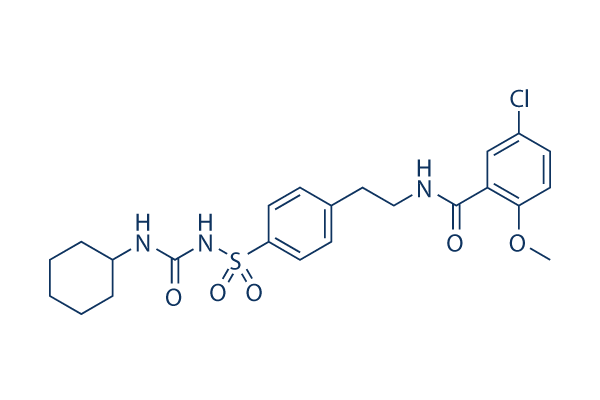
Estructura química
Peso molecular: 494
Control de calidad
| Dianas relacionadas | CFTR CRM1 CD markers AChR Calcium Channel Sodium Channel GABA Receptor TRP Channel ATPase GluR |
|---|---|
| Otros Potassium Channel Inhibidores | TRAM-34 Nicorandil ML133 HCl Sophocarpine Hydralazine HCl Nigericin Gliquidone E-4031 dihydrochloride PAP-1 Ajmaline |
Cultivo celular, tratamiento y concentración de trabajo
| Líneas celulares | Tipo de ensayo | Concentración | Tiempo de incubación | Formulación | Descripción de la actividad | PMID |
|---|---|---|---|---|---|---|
| INS-1E cells | Function assay | 1 h | Stimulation of insulin secretion in rat INS-1E cells after 1 hr by alphaLISA assay in presence of 5 mM glucose, EC50=0.003 μM | |||
| CHO cells | Function assay | Inhibition of human SUR1/Kir6.2 expressed in CHO cells, IC50=0.0043 μM | ||||
| HEK293 cells | Function assay | Inhibition of OATP1B1 (unknown origin) expressed in HEK293 cells using estradiol-17beta-glucuronide substrate, IC50=1.4 μM | ||||
| Haga clic para ver más datos experimentales de líneas celulares | ||||||
Información química, almacenamiento y estabilidad
| Peso molecular | 494 | Fórmula | C23H28ClN3O5S |
Almacenamiento (Desde la fecha de recepción) | |
|---|---|---|---|---|---|
| Nº CAS | 10238-21-8 | Descargar SDF | Almacenamiento de soluciones madre |
|
|
| Sinónimos | Glibenclamide | Smiles | COC1=C(C=C(C=C1)Cl)C(=O)NCCC2=CC=C(C=C2)S(=O)(=O)NC(=O)NC3CCCCC3 | ||
Solubilidad
|
In vitro |
DMSO
: 99 mg/mL
(200.4 mM)
Water : Insoluble Ethanol : Insoluble |
Calculadora de Molaridad
|
In vivo |
|||||
Calculadora de formulación in vivo (Solución clara)
Paso 1: Introduzca la información a continuación (Recomendado: Un animal adicional para tener en cuenta la pérdida durante el experimento)
Paso 2: Introduzca la formulación in vivo (Esto es solo la calculadora, no la formulación. Por favor, contáctenos primero si no hay una formulación in vivo en la sección de Solubilidad.)
Resultados del cálculo:
Concentración de trabajo: mg/ml;
Método para preparar el líquido maestro de DMSO: mg fármaco predissuelto en μL DMSO ( Concentración del líquido maestro mg/mL, Por favor, contáctenos primero si la concentración excede la solubilidad del DMSO del lote del fármaco. )
Método para preparar la formulación in vivo: Tomar μL DMSO líquido maestro, luego añadirμL PEG300, mezclar y clarificar, luego añadirμL Tween 80, mezclar y clarificar, luego añadir μL ddH2O, mezclar y clarificar.
Método para preparar la formulación in vivo: Tomar μL DMSO líquido maestro, luego añadir μL Aceite de maíz, mezclar y clarificar.
Nota: 1. Por favor, asegúrese de que el líquido esté claro antes de añadir el siguiente disolvente.
2. Asegúrese de añadir el (los) disolvente(s) en orden. Debe asegurarse de que la solución obtenida, en la adición anterior, sea una solución clara antes de proceder a añadir el siguiente disolvente. Se pueden utilizar métodos físicos como el vórtice, el ultrasonido o el baño de agua caliente para ayudar a la disolución.
Mecanismo de acción
| Targets/IC50/Ki |
Potassium channel
|
|---|---|
| In vitro |
Glyburide (Glibenclamide), una sulfonilurea que ha demostrado bloquear el Potassium Channel modulado por ATP en las células secretoras de insulina, provoca desplazamientos concentración-dependientes hacia la derecha (hasta 100 veces) del valor de IC50 para BRL 34915 y diazoxide, y a 1 μM, anula la respuesta de relajación al sulfato de minoxidil. Este compuesto aumenta la afinidad aparente de la unión de HDL al receptor carroñero clase B tipo I (SR-BI). Bloquea la captación y el eflujo selectivos de lípidos mediados por SR-BI con una potencia similar a la de su inhibición de ABCA1 (IC50 aproximadamente 275-300 mM). A 6 mM, reduce la apertura de los canales KATP, agravando la carga de Ca2+ solo cuando se aplica a miocitos pretratados con dinitrofenol, pero no cuando se aplica con tratamiento con dinitrofenol. En concentraciones de 10-500 nM, produce una inhibición dosis-dependiente del curso temporal de relajación de los Potassium Channel openers (PCOs). También revierte la relajación existente de Pinacidil independientemente del grado de relajación preexistente, y es capaz de producir su bloqueo independientemente del estado de activación del canal K+.
|
| In vivo |
S1716 aumenta de forma dosis-dependiente la excreción urinaria de Na+ con pocos cambios en la excreción urinaria de K+ después de la administración i.p. (10-100 mg/kg) en ratas conscientes cargadas con solución salina. S1716 (25 mg/kg i.v.) aumenta la excreción de Na+ en un 350% durante la primera hora post-tratamiento sin afectar la excreción de K+, la tasa de filtración glomerular, la presión arterial media o la frecuencia cardíaca.
|
Referencias |
|
Información del ensayo clínico
(datos de https://clinicaltrials.gov, actualizado el 2024-05-22)
| Número NCT | Reclutamiento | Condiciones | Patrocinador/Colaboradores | Fecha de inicio | Fases |
|---|---|---|---|---|---|
| NCT05426681 | Recruiting | Acute Spinal Cord Injury |
University of Kentucky |
July 7 2022 | Phase 1 |
| NCT03832595 | Completed | Chronic Kidney Diseases |
University of Pittsburgh|Vanderbilt University Medical Center|National Institute of Diabetes and Digestive and Kidney Diseases (NIDDK) |
May 1 2019 | Not Applicable |
Soporte técnico
Tel: +1-832-582-8158 Ext:3
Si tiene alguna otra consulta, por favor deje un mensaje.

Los productos son solo para uso de investigación. No para uso humano. No vendemos a pacientes.
©Copyright 2013 Selleck Chemicals. Todos los derechos reservados.