
solo para uso en investigación
Terfenadine Potassium Channel inhibidor
Cat. No.S4353
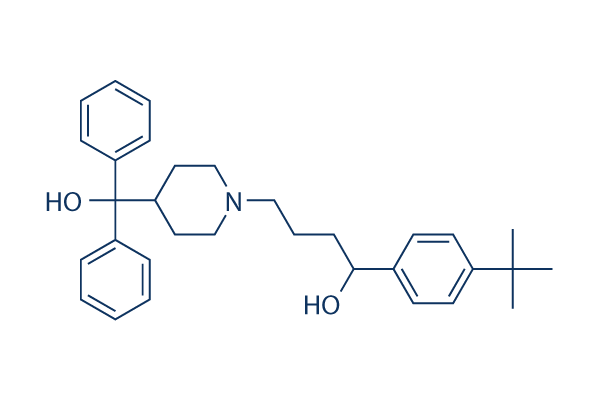
Estructura química
Peso molecular: 471.67
Control de calidad
| Dianas relacionadas | CFTR CRM1 CD markers AChR Calcium Channel Sodium Channel GABA Receptor TRP Channel ATPase GluR |
|---|---|
| Otros Potassium Channel Inhibidores | TRAM-34 Nicorandil ML133 HCl Sophocarpine Hydralazine HCl Nigericin Gliquidone E-4031 dihydrochloride PAP-1 Ajmaline |
Información química, almacenamiento y estabilidad
| Peso molecular | 471.67 | Fórmula | C32H41NO2 |
Almacenamiento (Desde la fecha de recepción) | |
|---|---|---|---|---|---|
| Nº CAS | 50679-08-8 | Descargar SDF | Almacenamiento de soluciones madre |
|
|
| Sinónimos | N/A | Smiles | CC(C)(C)C1=CC=C(C=C1)C(CCCN2CCC(CC2)C(C3=CC=CC=C3)(C4=CC=CC=C4)O)O | ||
Solubilidad
|
In vitro |
DMSO
: 94 mg/mL
(199.29 mM)
Ethanol : 27 mg/mL Water : Insoluble |
Calculadora de Molaridad
|
In vivo |
|||||
Calculadora de formulación in vivo (Solución clara)
Paso 1: Introduzca la información a continuación (Recomendado: Un animal adicional para tener en cuenta la pérdida durante el experimento)
Paso 2: Introduzca la formulación in vivo (Esto es solo la calculadora, no la formulación. Por favor, contáctenos primero si no hay una formulación in vivo en la sección de Solubilidad.)
Resultados del cálculo:
Concentración de trabajo: mg/ml;
Método para preparar el líquido maestro de DMSO: mg fármaco predissuelto en μL DMSO ( Concentración del líquido maestro mg/mL, Por favor, contáctenos primero si la concentración excede la solubilidad del DMSO del lote del fármaco. )
Método para preparar la formulación in vivo: Tomar μL DMSO líquido maestro, luego añadirμL PEG300, mezclar y clarificar, luego añadirμL Tween 80, mezclar y clarificar, luego añadir μL ddH2O, mezclar y clarificar.
Método para preparar la formulación in vivo: Tomar μL DMSO líquido maestro, luego añadir μL Aceite de maíz, mezclar y clarificar.
Nota: 1. Por favor, asegúrese de que el líquido esté claro antes de añadir el siguiente disolvente.
2. Asegúrese de añadir el (los) disolvente(s) en orden. Debe asegurarse de que la solución obtenida, en la adición anterior, sea una solución clara antes de proceder a añadir el siguiente disolvente. Se pueden utilizar métodos físicos como el vórtice, el ultrasonido o el baño de agua caliente para ayudar a la disolución.
Mecanismo de acción
| Targets/IC50/Ki |
Caspase-4
Caspase-2
Caspase-9
Ca2+ homeostasis
H1 histamine receptor
hERG
|
|---|---|
| In vitro |
Terfenadine es equipotente a la quinidina como bloqueador de la corriente de potasio rectificadora tardía en miocitos felinos aislados. Este compuesto inhibe los canales codificados por el gen humano relacionado con ether-a-go-go (HERG) expresados en ovocitos de Xenopus a concentraciones nanomolares de una manera dependiente del uso y del voltaje. Él (2 μM) bloquea la corriente máxima en estado estacionario a 0 mV en un 65% en ovocitos de Xenopus. Este bloqueo químico es dependiente de la dosis e igualmente potente en las corrientes máximas en estado estacionario y de cola, sus valores de Kd son 350 nM y 390 nM, respectivamente. Bloquea Kv1.5 (un miembro de la subfamilia Kv1 de los Potassium Channel dependientes del voltaje) en miocitos auriculares humanos y en el sistema de expresión de células de riñón embrionarias humanas. Este agente (10 μM) produce un bloqueo dependiente de la dosis con una reducción del 60% de la corriente en estado estacionario en ovocitos de Xenopus. Se oxida por N-desalquilación oxidativa a 4-(hidroxidifenilmetil)-piperidina y por oxidación de un grupo tert-butilo a un alcohol primario, que posteriormente se oxida a un ácido carboxílico, lo cual es marcadamente inhibido por gestodeno, un inactivador selectivo basado en el mecanismo de las enzimas P-450 3A, pero no por ninguno de los otros inhibidores de P-450. Este compuesto aumenta significativamente la duración del potencial de acción de los miocitos de cobaya. Bloquea potentemente el componente de activación rápida del rectificador tardío, IKr, con valores de IC50 de 1,5 nM y 50 nM, respectivamente. Este químico (10 μM) bloquea el componente de activación lenta del rectificador tardío, IKs (58,4%), y el rectificador interno, IK1 (20,5%). |
| In vivo |
Terfenadine (1,0 a 3,0 mg/kg, i.v.) prolonga significativamente el intervalo QTc y el período refractario efectivo ventricular en perros anestesiados con cloralosa. |
Referencias |
|
Soporte técnico
Tel: +1-832-582-8158 Ext:3
Si tiene alguna otra consulta, por favor deje un mensaje.

Los productos son solo para uso de investigación. No para uso humano. No vendemos a pacientes.
©Copyright 2013 Selleck Chemicals. Todos los derechos reservados.