
solo para uso en investigación
PF-573228 FAK inhibitor
Cat. No.S2013
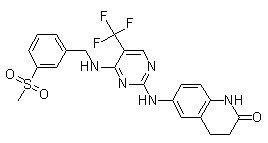
Estructura química
Peso molecular: 491.49
Control de calidad
| Dianas relacionadas | EGFR VEGFR JAK PDGFR FGFR Src HIF FLT FLT3 HER2 |
|---|---|
| Otros FAK Inhibidores | Defactinib (VS-6063) PF-562271 (VS-6062) VS-4718 (PND-1186) PF-562271 HCl PF-562271 Besylate TAE226 (NVP-TAE226) GSK2256098 PF-431396 Y15 Solanesol (Nonaisoprenol) |
Cultivo celular, tratamiento y concentración de trabajo
| Líneas celulares | Tipo de ensayo | Concentración | Tiempo de incubación | Formulación | Descripción de la actividad | PMID |
|---|---|---|---|---|---|---|
| A431 | Kinase assay | ~10 μM | DMSO | inhibits FAK phosphorylation with IC50 of 11 nM | 17395594 | |
| REF52 | Kinase assay | ~10 μM | DMSO | inhibits the phosphorylation of FAK Tyr397 with IC50 of ~100 nM | 17395594 | |
| PC3 | Kinase assay | ~10 μM | DMSO | inhibits the phosphorylation of FAK Tyr397 with IC50 of 100 nM | 17395594 | |
| SKOV-3 | Kinase assay | ~10 μM | DMSO | inhibits the phosphorylation of FAK Tyr397 with IC50 of 50 nM | 17395594 | |
| L3.6p1 | Kinase assay | ~10 μM | DMSO | inhibits the phosphorylation of FAK Tyr397 with IC50 of 300 nM | 17395594 | |
| F-G | Kinase assay | ~10 μM | DMSO | inhibits the phosphorylation of FAK Tyr397 with IC50 of 30 nM | 17395594 | |
| MDCK | Kinase assay | ~10 μM | DMSO | inhibits the phosphorylation of FAK Tyr397 with IC50 of 500 nM | 17395594 | |
| PC3 | Growth inhibitory assay | 10 μM | DMSO | significantly inhibits cell growth. | 17395594 | |
| REF52 | Growth inhibitory assay | 10 μM | DMSO | significantly inhibits cell growth. | 17395594 | |
| MDCK | Apoptosis assay | 10 μM | DMSO | induces apoptosis | 17395594 | |
| REF52 | Apoptosis assay | 10 μM | DMSO | induces apoptosis | 17395594 | |
| REF52 | Function assay | 10 μM | DMSO | blocks serum and FN-stimulated migration | 17395594 | |
| platelet | Function assay | 1 μM | DMSO | inhibits platelet aggregation and spreading | 19716803 | |
| platelet | Function assay | 1 μM | DMSO | leads to inhibition of PAK and AKT | 19716803 | |
| platelet | Function assay | 1 μM | DMSO | blocks calcium mobilization and dense granule secretion | 19716803 | |
| 4T1 | Function assay | DMSO | abolishes the interaction between β3 integrin and TβR-II | 19740433 | ||
| MCF7 | Kinase assay | ~10 μM | DMSO | inhibits the phosphorylation of FAK Tyr397 with IC50 of 430 nM | 20354780 | |
| TamR | Kinase assay | ~10 μM | DMSO | inhibits the phosphorylation of FAK Tyr397 with IC50 of 50 nM | 20354780 | |
| FasR | Kinase assay | ~10 μM | DMSO | inhibits the phosphorylation of FAK Tyr397 with IC50 of 130 nM | 20354780 | |
| TamR | Function assay | 1 μM | DMSO | inhibits cell migration | 20354780 | |
| FasR | Function assay | 1 μM | DMSO | inhibits cell migration | 20354780 | |
| endothelial cell | Kinase assay | 40 nM | DMSO | inhibits H2O2-induced phosphorylation of FAK | 21212402 | |
| endothelial cell | Function assay | 40 nM | DMSO | inhibits H2O2-induced stress fiber formation | 21212402 | |
| endothelial cell | Apoptosis assay | 40 nM | DMSO | inhibits apoptosis | 21212402 | |
| GH3 | Function assay | 3 μM | DMSO | increases IK(Ca) amplitude | 21925512 | |
| GH3 | Function assay | 3 μM | DMSO | enhances BKCa-channel activity | 21925512 | |
| HUVEC | cytotoxicity assay | ~10 μM | DMSO | impairs endothelial cell viability | 22075057 | |
| HUVEC | Kinase assay | 5 μM | DMSO | inhibits FAK kinase activity | 22075057 | |
| HUVEC | Function assay | 5 μM | DMSO | induces cell cycle arrest | 22075057 | |
| HUVEC | Apoptosis assay | 5 μM | DMSO | induces apoptosis | 22075057 | |
| HUVEC | Function assay | 5 μM | DMSO | impedes endothelial cell migration and alters the cellular actin cytoskeleton | 22075057 | |
| HUVEC | Function assay | 5 μM | DMSO | blocks HUVEC sprouting on collagen I gels | 22075057 | |
| human peripheral blood T cells | Kinase assay | ~10 μM | DMSO | inhibits site-specific phosphorylation of FAK | 23928188 | |
| human peripheral blood T cells | Function assay | ~10 μM | DMSO | impairs TCR-induced T cell morphological changes and alters activity of RhoA | 23928188 | |
| human peripheral blood T cells | Function assay | ~10 μM | DMSO | inhibits phosphorylation of ZAP-70 and LAT | 23928188 | |
| human peripheral blood T cells | Function assay | ~10 μM | DMSO | impairs Antigen-dependent T cell conjugation | 23928188 | |
| U-2 OS | qHTS assay | qHTS of pediatric cancer cell lines to identify multiple opportunities for drug repurposing: Primary screen for U-2 OS cells | 29435139 | |||
| A673 | qHTS assay | qHTS of pediatric cancer cell lines to identify multiple opportunities for drug repurposing: Primary screen for A673 cells | 29435139 | |||
| Saos-2 | qHTS assay | qHTS of pediatric cancer cell lines to identify multiple opportunities for drug repurposing: Primary screen for Saos-2 cells | 29435139 | |||
| BT-37 | qHTS assay | qHTS of pediatric cancer cell lines to identify multiple opportunities for drug repurposing: Primary screen for BT-37 cells | 29435139 | |||
| RD | qHTS assay | qHTS of pediatric cancer cell lines to identify multiple opportunities for drug repurposing: Primary screen for RD cells | 29435139 | |||
| SK-N-SH | qHTS assay | qHTS of pediatric cancer cell lines to identify multiple opportunities for drug repurposing: Primary screen for SK-N-SH cells | 29435139 | |||
| MG 63 (6-TG R) | qHTS assay | qHTS of pediatric cancer cell lines to identify multiple opportunities for drug repurposing: Primary screen for MG 63 (6-TG R) cells | 29435139 | |||
| NB1643 | qHTS assay | qHTS of pediatric cancer cell lines to identify multiple opportunities for drug repurposing: Primary screen for NB1643 cells | 29435139 | |||
| OHS-50 | qHTS assay | qHTS of pediatric cancer cell lines to identify multiple opportunities for drug repurposing: Primary screen for OHS-50 cells | 29435139 | |||
| SJ-GBM2 | qHTS assay | qHTS of pediatric cancer cell lines to identify multiple opportunities for drug repurposing: Primary screen for SJ-GBM2 cells | 29435139 | |||
| SK-N-MC | qHTS assay | qHTS of pediatric cancer cell lines to identify multiple opportunities for drug repurposing: Primary screen for SK-N-MC cells | 29435139 | |||
| NB-EBc1 | qHTS assay | qHTS of pediatric cancer cell lines to identify multiple opportunities for drug repurposing: Primary screen for NB-EBc1 cells | 29435139 | |||
| LAN-5 | qHTS assay | qHTS of pediatric cancer cell lines to identify multiple opportunities for drug repurposing: Primary screen for LAN-5 cells | 29435139 | |||
| Haga clic para ver más datos experimentales de líneas celulares | ||||||
Información química, almacenamiento y estabilidad
| Peso molecular | 491.49 | Fórmula | C22H20F3N5O3S |
Almacenamiento (Desde la fecha de recepción) | |
|---|---|---|---|---|---|
| Nº CAS | 869288-64-2 | Descargar SDF | Almacenamiento de soluciones madre |
|
|
| Sinónimos | N/A | Smiles | CS(=O)(=O)C1=CC=CC(=C1)CNC2=NC(=NC=C2C(F)(F)F)NC3=CC4=C(C=C3)NC(=O)CC4 | ||
Solubilidad
|
In vitro |
DMSO
: 26 mg/mL
(52.9 mM)
Water : Insoluble Ethanol : Insoluble |
Calculadora de Molaridad
|
In vivo |
|||||
Calculadora de formulación in vivo (Solución clara)
Paso 1: Introduzca la información a continuación (Recomendado: Un animal adicional para tener en cuenta la pérdida durante el experimento)
Paso 2: Introduzca la formulación in vivo (Esto es solo la calculadora, no la formulación. Por favor, contáctenos primero si no hay una formulación in vivo en la sección de Solubilidad.)
Resultados del cálculo:
Concentración de trabajo: mg/ml;
Método para preparar el líquido maestro de DMSO: mg fármaco predissuelto en μL DMSO ( Concentración del líquido maestro mg/mL, Por favor, contáctenos primero si la concentración excede la solubilidad del DMSO del lote del fármaco. )
Método para preparar la formulación in vivo: Tomar μL DMSO líquido maestro, luego añadirμL PEG300, mezclar y clarificar, luego añadirμL Tween 80, mezclar y clarificar, luego añadir μL ddH2O, mezclar y clarificar.
Método para preparar la formulación in vivo: Tomar μL DMSO líquido maestro, luego añadir μL Aceite de maíz, mezclar y clarificar.
Nota: 1. Por favor, asegúrese de que el líquido esté claro antes de añadir el siguiente disolvente.
2. Asegúrese de añadir el (los) disolvente(s) en orden. Debe asegurarse de que la solución obtenida, en la adición anterior, sea una solución clara antes de proceder a añadir el siguiente disolvente. Se pueden utilizar métodos físicos como el vórtice, el ultrasonido o el baño de agua caliente para ayudar a la disolución.
Mecanismo de acción
| Targets/IC50/Ki |
FAK
(Cell-free assay) 4 nM
|
|---|---|
| In vitro |
PF-573228 bloquea la fosforilación de FAK Tyr397 en células REF52, células PC3, células SKOV-3, L3.6p1 y F-G, células MDCK con una IC50 de 30-500 nM. Sin embargo, este compuesto (1 μM) con una inhibición del 80% de la fosforilación de FAK no logra inhibir el crecimiento celular o la apoptosis. Un tratamiento similar de las células con este químico resultó en la inhibición de la migración dirigida por suero o FN y una disminución de la renovación de las adhesiones focales.
|
| Ensayo de quinasa |
Determinación de la afinidad
|
|
El dominio cinasa de FAK activado purificado (aminoácidos 410–689) se hace reaccionar con 50 μM de ATP y 10 μg/pocillo de un polímero peptídico aleatorio de Glu y Tyr (relación molar de 4:1), poli(Glu/Tyr) en tampón de cinasa (50 mM HEPES, pH 7,5, 125 mM NaCl, 48 mM MgCl2) durante 15 min. La fosforilación de poli(Glu/Tyr) se desafía con compuestos diluidos en serie a concentraciones de 1/2-Log, comenzando con una concentración máxima de 1 μM. Cada concentración se ejecuta por triplicado. La fosforilación de poli(Glu/Tyr) se detecta con un anticuerpo general anti-fosfotirosina (PY20), seguido de un anticuerpo IgG de cabra anti-ratón conjugado con peroxidasa de rábano picante. El sustrato estándar de peroxidasa de rábano picante 3, 3
|
|
| In vivo |
La inhibición de FAK por PF-573,228 en ratones Ctrl-MT conduce a una supresión significativa de la tumorigénesis mamaria, así como de la metástasis pulmonar. En contraste, el tratamiento de ratones MFCKO-MT con este compuesto no afectó el inicio de los tumores mamarios en estos ratones, como se esperaría debido a la ausencia de FAK en las células epiteliales mamarias de estos ratones .
|
Referencias |
|
Aplicaciones
| Métodos | Biomarcadores | Imágenes | PMID |
|---|---|---|---|
| Western blot | cyclin B1 p-FAK / FAK Lamin A / Lamin C |

|
30761269 |
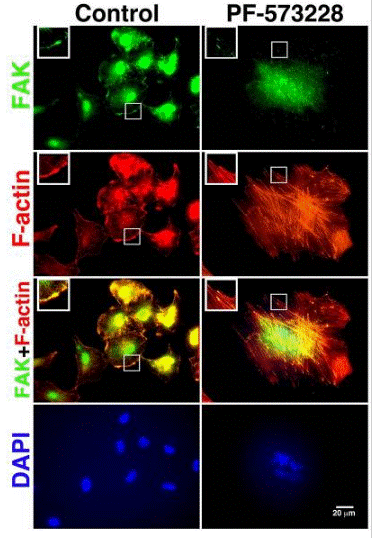
| Immunofluorescence | FAK / F-actin Emerin |
|
30761269 |
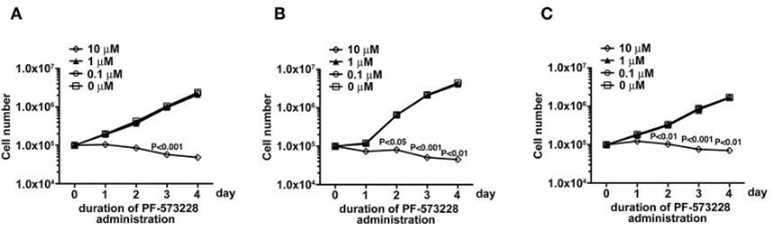
| Growth inhibition assay | Cell viability |
|
30761269 |
Soporte técnico
Tel: +1-832-582-8158 Ext:3
Si tiene alguna otra consulta, por favor deje un mensaje.
Preguntas frecuentes
Pregunta 1:
Would you please let me know the detail of how to dissolve it for in vivo study (oral administration)? This compound is referred to as Catalog No.S2013.
Respuesta:
A suspension of this compound in 30% PEG400+0.5% Tween80+ 5% Propylene glycol at 30mg/ml is fine for oral gavage.

Los productos son solo para uso de investigación. No para uso humano. No vendemos a pacientes.
©Copyright 2013 Selleck Chemicals. Todos los derechos reservados.