
solo para uso en investigación
lurasidone Dopamine Receptor antagonista
Cat. No.S5714
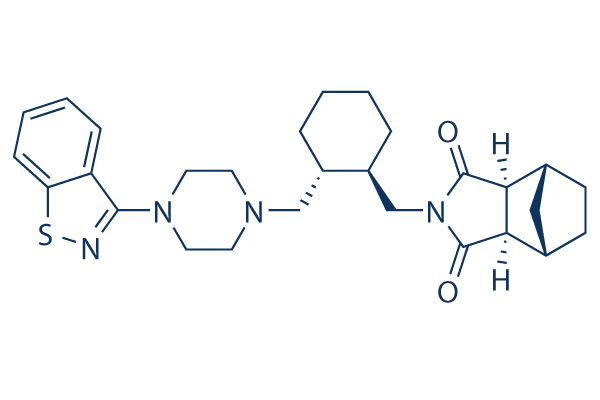
Estructura química
Peso molecular: 492.68
Control de calidad
- Citado en Nature Medicine por su máxima calidad
- COA
- SDS
- Hoja de datos
| Dianas relacionadas | Adrenergic Receptor AChR 5-HT Receptor COX Calcium Channel Histamine Receptor GABA Receptor TRP Channel Cholinesterase (ChE) GluR |
|---|---|
| Otros Dopamine Receptor Inhibidores | MPTP Hydrochloride Trifluoperazine Trifluoperazine 2HCl Penfluridol Sulpiride Levosulpiride SCH-23390 hydrochloride Domperidone Rotundine Azaperone |
Información química, almacenamiento y estabilidad
| Peso molecular | 492.68 | Fórmula | C28H36N4O2S |
Almacenamiento (Desde la fecha de recepción) | 3 years -20°C powder |
|---|---|---|---|---|---|
| Nº CAS | 367514-87-2 | -- | Almacenamiento de soluciones madre |
|
|
| Sinónimos | SM-13496 | Smiles | C1CCC(C(C1)CN2CCN(CC2)C3=NSC4=CC=CC=C43)CN5C(=O)C6C7CCC(C7)C6C5=O | ||
Solubilidad
|
In vitro |
DMSO
: 7 mg/mL
(14.2 mM)
Water : Insoluble Ethanol : Insoluble |
Calculadora de Molaridad
|
In vivo |
|||||
Calculadora de formulación in vivo (Solución clara)
Paso 1: Introduzca la información a continuación (Recomendado: Un animal adicional para tener en cuenta la pérdida durante el experimento)
Paso 2: Introduzca la formulación in vivo (Esto es solo la calculadora, no la formulación. Por favor, contáctenos primero si no hay una formulación in vivo en la sección de Solubilidad.)
Resultados del cálculo:
Concentración de trabajo: mg/ml;
Método para preparar el líquido maestro de DMSO: mg fármaco predissuelto en μL DMSO ( Concentración del líquido maestro mg/mL, Por favor, contáctenos primero si la concentración excede la solubilidad del DMSO del lote del fármaco. )
Método para preparar la formulación in vivo: Tomar μL DMSO líquido maestro, luego añadirμL PEG300, mezclar y clarificar, luego añadirμL Tween 80, mezclar y clarificar, luego añadir μL ddH2O, mezclar y clarificar.
Método para preparar la formulación in vivo: Tomar μL DMSO líquido maestro, luego añadir μL Aceite de maíz, mezclar y clarificar.
Nota: 1. Por favor, asegúrese de que el líquido esté claro antes de añadir el siguiente disolvente.
2. Asegúrese de añadir el (los) disolvente(s) en orden. Debe asegurarse de que la solución obtenida, en la adición anterior, sea una solución clara antes de proceder a añadir el siguiente disolvente. Se pueden utilizar métodos físicos como el vórtice, el ultrasonido o el baño de agua caliente para ayudar a la disolución.
Mecanismo de acción
| Targets/IC50/Ki |
5-HT2A
(Cell-free assay) 0.5 nM(Ki)
5-HT7 receptor
(Cell-free assay) 0.5 nM(Ki)
D2 receptor
(Cell-free assay) 1 nM(Ki)
5-HT1A receptor
(Cell-free assay) 6.4 nM(Ki)
|
|---|---|
| In vitro |
Lurasidone es un nuevo antipsicótico atípico de la clase química de las benzoisotiazolas. Como la mayoría de los antipsicóticos de segunda generación, es un antagonista completo de los receptores dopamina D2 y serotonina 5-HT2A, y es un agonista parcial de los receptores 5-HT1A. Tiene una afinidad mucho mayor por los receptores del subtipo 5-HT7 que otros antipsicóticos atípicos. Este compuesto también tiene alta afinidad por el subtipo 5-HT1A, los receptores alfa2c-adrenérgicos y baja afinidad por los receptores alfa1-adrenérgicos. Tiene una afinidad mínima por los receptores 5-HT2C y una afinidad despreciable por los receptores de histamina H1 y muscarínicos.
|
| In vivo |
Lurasidone se absorbe rápidamente, alcanzando concentraciones máximas en 1,5–3 horas (tmax) después de dosis orales únicas y múltiples. Una vez absorbido, se distribuye ampliamente en los tejidos y entra rápidamente en el SNC. Este compuesto tiene una alta unión a la albúmina plasmática humana y a la alfa-1-glicoproteína (>=99%). El tratamiento a largo plazo de la esquizofrenia con este agente ha demostrado reducir el riesgo de recaída. La vida media de eliminación de este químico es de aproximadamente 20-40 h. La Cmax media y el área bajo la curva (AUC) para este fármaco fueron aproximadamente tres y dos veces mayores, respectivamente, en una comparación de administración con alimentos vs. ayuno. Su absorción es independiente del contenido de grasa de los alimentos. Se metaboliza principalmente a través de CYP3A4. En estudios con animales, este compuesto penetró la barrera placentaria y se distribuyó en el feto, y se excretó en la leche durante la lactancia.
|
Referencias |
|
Información del ensayo clínico
(datos de https://clinicaltrials.gov, actualizado el 2024-05-22)
| Número NCT | Reclutamiento | Condiciones | Patrocinador/Colaboradores | Fecha de inicio | Fases |
|---|---|---|---|---|---|
| NCT03627195 | Completed | Schizophrenia |
Sumitomo Pharma America Inc. |
June 7 2018 | Phase 1 |
| NCT02731612 | Recruiting | Bipolar Disorder |
Nazlin Walji|University of British Columbia |
May 8 2017 | Phase 3 |
| NCT02147379 | Completed | Bipolar I Disorder |
University of British Columbia |
May 2014 | Phase 3 |
| NCT02174523 | Completed | Schizophrenia |
Sumitomo Pharma (Suzhou) Co. Ltd.|Xuhui Central Hospital Shanghai |
April 2014 | Phase 1 |
Soporte técnico
Tel: +1-832-582-8158 Ext:3
Si tiene alguna otra consulta, por favor deje un mensaje.

Los productos son solo para uso de investigación. No para uso humano. No vendemos a pacientes.
©Copyright 2013 Selleck Chemicals. Todos los derechos reservados.