
solo para uso en investigación
MPTP Hydrochloride Neurotoxina Dopaminérgica
Cat. No.S4732
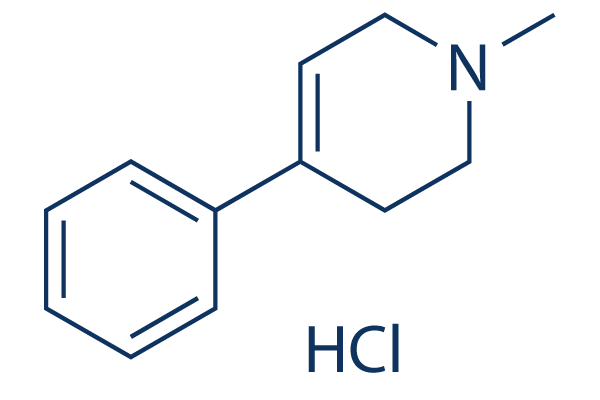
Estructura química
Peso molecular: 209.72
Saltar a
Control de calidad
Lote:
Pureza:
99.94%
99.94
| Dianas relacionadas | Adrenergic Receptor AChR 5-HT Receptor COX Calcium Channel Histamine Receptor GABA Receptor TRP Channel Cholinesterase (ChE) GluR |
|---|---|
| Otros Dopamine Receptor Inhibidores | Trifluoperazine Trifluoperazine 2HCl Penfluridol Sulpiride Levosulpiride SCH-23390 hydrochloride Domperidone Rotundine Azaperone SKF38393 HCl |
Cultivo celular, tratamiento y concentración de trabajo
| Líneas celulares | Tipo de ensayo | Concentración | Tiempo de incubación | Formulación | Descripción de la actividad | PMID |
|---|---|---|---|---|---|---|
| insect cells | Function assay | 120 mins | Inhibition of human recombinant MAOA expressed in insect cells assessed as oxidation of kynuramine substrate at 50 uM measured after additional enzyme added after 120 mins incubation | 22078410 | ||
| insect cells | Function assay | 90 mins | Inhibition of human recombinant MAOA expressed in insect cells assessed as oxidation of kynuramine substrate at 50 uM measured after additional substrate added after 90 mins incubation | 22078410 | ||
| Haga clic para ver más datos experimentales de líneas celulares | ||||||
Información química, almacenamiento y estabilidad
| Peso molecular | 209.72 | Fórmula | C12H15N·HCl |
Almacenamiento (Desde la fecha de recepción) | |
|---|---|---|---|---|---|
| Nº CAS | 23007-85-4 | Descargar SDF | Almacenamiento de soluciones madre |
|
|
| Sinónimos | N/A | Smiles | CN1CCC(=CC1)C2=CC=CC=C2.Cl | ||
Solubilidad
|
In vitro |
Water : 41 mg/mL Ethanol : 41 mg/mL
DMSO
: 26 mg/mL
(123.97 mM)
|
Calculadora de Molaridad
Calculadora de Dilución
Calculadora de Peso Molecular
|
In vivo |
|||||
Calculadora de formulación in vivo (Solución clara)
Paso 1: Introduzca la información a continuación (Recomendado: Un animal adicional para tener en cuenta la pérdida durante el experimento)
mg/kg
g
μL
Paso 2: Introduzca la formulación in vivo (Esto es solo la calculadora, no la formulación. Por favor, contáctenos primero si no hay una formulación in vivo en la sección de Solubilidad.)
% DMSO
%
% Tween 80
% ddH2O
%DMSO
%
Resultados del cálculo:
Concentración de trabajo: mg/ml;
Método para preparar el líquido maestro de DMSO: mg fármaco predissuelto en μL DMSO ( Concentración del líquido maestro mg/mL, Por favor, contáctenos primero si la concentración excede la solubilidad del DMSO del lote del fármaco. )
Método para preparar la formulación in vivo: Tomar μL DMSO líquido maestro, luego añadirμL PEG300, mezclar y clarificar, luego añadirμL Tween 80, mezclar y clarificar, luego añadir μL ddH2O, mezclar y clarificar.
Método para preparar la formulación in vivo: Tomar μL DMSO líquido maestro, luego añadir μL Aceite de maíz, mezclar y clarificar.
Nota: 1. Por favor, asegúrese de que el líquido esté claro antes de añadir el siguiente disolvente.
2. Asegúrese de añadir el (los) disolvente(s) en orden. Debe asegurarse de que la solución obtenida, en la adición anterior, sea una solución clara antes de proceder a añadir el siguiente disolvente. Se pueden utilizar métodos físicos como el vórtice, el ultrasonido o el baño de agua caliente para ayudar a la disolución.
Mecanismo de acción
| In vitro |
La morfología de las células N2AB-1 y las células de glioma no se alteró cuando estas células fueron expuestas a todas las dosis de MPTP Hydrochloride. Y la proliferación de células de glioma C6 tampoco se vio afectada por el tratamiento con este compuesto. MPTP Promotes Apoptosis and Tau Phosphorylation in Human Neuroblastoma M17 Cells. Este compuesto promueve significativamente la fosforilación de Tau en Ser262 en células de neuroblastoma humano M17. Causó un aumento dosis-dependiente en el nivel intracelular de α-sinucleína en nuestras células de neuroblastoma humano M17. Esta sustancia química parece promover la fosforilación de Tau en el cerebro activando tanto la PKA como la GSK3β.
|
|---|---|
| In vivo |
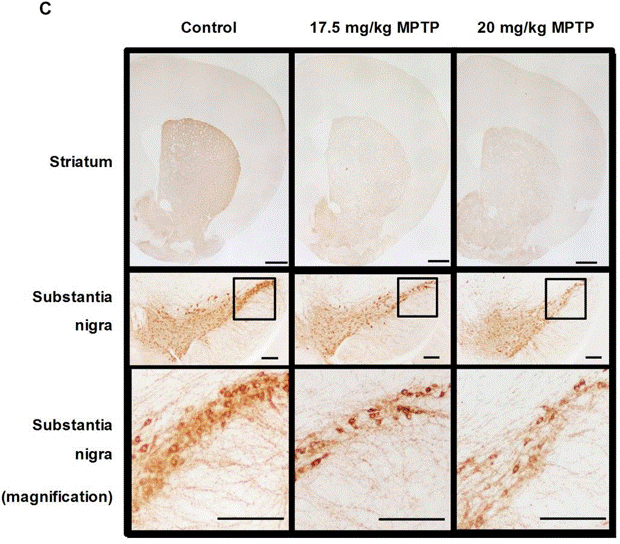
El número de neuronas tirosina hidroxilasa-positivas disminuyó en la sustancia negra pars compacta de ratones tratados con MPTP. Este compuesto disminuyó la expresión de tiorredoxina reductasa 1 y la actividad de tiorredoxina reductasa en el mesencéfalo del ratón, reduciendo el número de células tiorredoxina reductasa 1-positivas en la sustancia negra pars compacta de los ratones. La administración de esta toxina puede causar alteraciones neuroquímicas, conductuales e histopatológicas en primates humanos y no humanos que son similares a las observadas en pacientes parkinsonianos. En comparación con los primates, los roedores son insensibles al MPTP. Este químico puede administrarse por diversas vías, como la sonda gástrica y la inyección estereotáctica, pero la vía más común y reproducible es la administración sistémica, que incluye la inyección subcutánea, intravenosa, intraperitoneal e intramuscular. Es una protoxina lipofílica que puede cruzar rápidamente la barrera hematoencefálica después de una inyección sistémica. Una vez que entra en el cerebro, el MPTP se convierte en 1-metil-4-fenilpiridina por la monoamino oxidasa B. Se ha demostrado que es tóxico para las neuronas dopaminérgicas del sistema nigroestriado en humanos, monos y ratones, y que produce una depleción duradera de DA y sus metabolitos en el estriado.
|
Referencias |
|
Aplicaciones
| Métodos | Biomarcadores | Imágenes | PMID |
|---|---|---|---|
| Western blot | TH / Actin pCaMKIIβ / pCaMKIIα / CaMKIIβ / CaMKIIα / β-Actin TH / p-α-Syn / α-Syn / β-actin / CDK5 / LC3-I / LC3-II / p62 / NLRP3 / ASC / Casp1 p20 / Procasp1 p-ERK1/2 / ERK1/2 / GAPDH GDH2 / GDH1 / GFAP / GAPDH |

|
23391753 |
| IHC | tyrosine hydroxylase (TH) tyrosine hydroxylase (TH) SNpc tyrosine hydroxylase (TH) Substantia nigra |
|
31427934 |
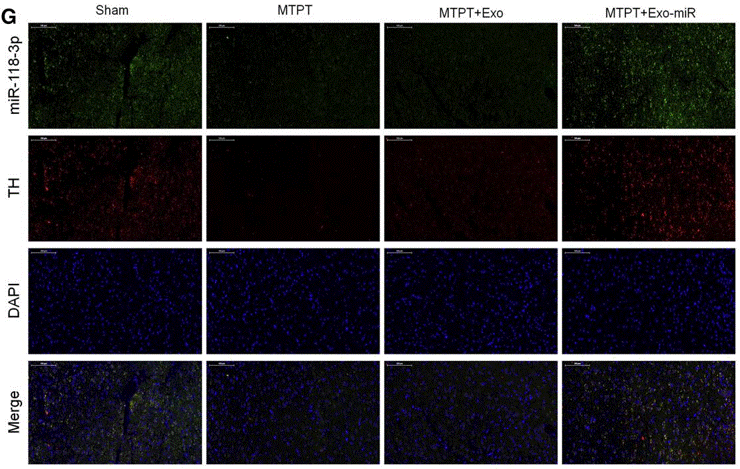
| Immunofluorescence | tyrosine hydroxylase (TH) / miR-188-3p α-Syn tyrosine hydroxylase (TH) / Tunel tyrosine hydroxylase (TH) / Tunel tyrosine hydroxylase (TH) GFAP |
|
33717653 |
Soporte técnico
Tel: +1-832-582-8158 Ext:3
Si tiene alguna otra consulta, por favor deje un mensaje.

Los productos son solo para uso de investigación. No para uso humano. No vendemos a pacientes.
©Copyright 2013 Selleck Chemicals. Todos los derechos reservados.