
solo para uso en investigación
CHIR-98014 GSK-3 inhibidor
Cat. No.S2745
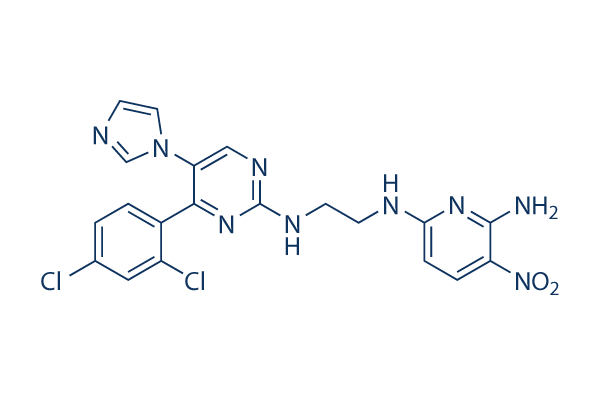
Estructura química
Peso molecular: 486.31
Control de calidad
| Dianas relacionadas | PI3K Akt mTOR ATM/ATR DNA-PK AMPK PDPK1 PTEN PP2A PDK |
|---|---|
| Otros GSK-3 Inhibidores | CHIR-99021 (Laduviglusib) Laduviglusib (CHIR-99021) Hydrochloride SB216763 TWS119 GSK-3 Inhibitor IX (BIO) LY2090314 Tideglusib SB415286 AR-A014418 IM-12 |
Cultivo celular, tratamiento y concentración de trabajo
| Líneas celulares | Tipo de ensayo | Concentración | Tiempo de incubación | Formulación | Descripción de la actividad | PMID |
|---|---|---|---|---|---|---|
| BGC-823 | Proliferation assay | 50 nM | 48 h | abrogated rLMO3 protein-induced proliferation | 29436606 | |
| HGC-27 | Proliferation assay | 50 nM | 48 h | abrogated rLMO3 protein-induced proliferation | 29436606 | |
| DAOY | qHTS assay | qHTS of pediatric cancer cell lines to identify multiple opportunities for drug repurposing: Primary screen for DAOY cells | 29435139 | |||
| SJ-GBM2 | qHTS assay | qHTS of pediatric cancer cell lines to identify multiple opportunities for drug repurposing: Primary screen for SJ-GBM2 cells | 29435139 | |||
| A673 | qHTS assay | qHTS of pediatric cancer cell lines to identify multiple opportunities for drug repurposing: Primary screen for A673 cells | 29435139 | |||
| SK-N-MC | qHTS assay | qHTS of pediatric cancer cell lines to identify multiple opportunities for drug repurposing: Primary screen for SK-N-MC cells | 29435139 | |||
| NB-EBc1 | qHTS assay | qHTS of pediatric cancer cell lines to identify multiple opportunities for drug repurposing: Primary screen for NB-EBc1 cells | 29435139 | |||
| Saos-2 | qHTS assay | qHTS of pediatric cancer cell lines to identify multiple opportunities for drug repurposing: Primary screen for Saos-2 cells | 29435139 | |||
| NB1643 | qHTS assay | qHTS of pediatric cancer cell lines to identify multiple opportunities for drug repurposing: Primary screen for NB1643 cells | 29435139 | |||
| LAN-5 | qHTS assay | qHTS of pediatric cancer cell lines to identify multiple opportunities for drug repurposing: Primary screen for LAN-5 cells | 29435139 | |||
| BT-12 | qHTS assay | qHTS of pediatric cancer cell lines to identify multiple opportunities for drug repurposing: Primary screen for BT-12 cells | 29435139 | |||
| Rh18 | qHTS assay | qHTS of pediatric cancer cell lines to identify multiple opportunities for drug repurposing: Primary screen for Rh18 cells | 29435139 | |||
| OHS-50 | qHTS assay | qHTS of pediatric cancer cell lines to identify multiple opportunities for drug repurposing: Primary screen for OHS-50 cells | 29435139 | |||
| RD | qHTS assay | qHTS of pediatric cancer cell lines to identify multiple opportunities for drug repurposing: Primary screen for RD cells | 29435139 | |||
| MG 63 (6-TG R) | qHTS assay | qHTS of pediatric cancer cell lines to identify multiple opportunities for drug repurposing: Primary screen for MG 63 (6-TG R) cells | 29435139 | |||
| Haga clic para ver más datos experimentales de líneas celulares | ||||||
Información química, almacenamiento y estabilidad
| Peso molecular | 486.31 | Fórmula | C20H17Cl2N9O2 |
Almacenamiento (Desde la fecha de recepción) | |
|---|---|---|---|---|---|
| Nº CAS | 252935-94-7 | Descargar SDF | Almacenamiento de soluciones madre |
|
|
| Sinónimos | CT98014 | Smiles | C1=CC(=C(C=C1Cl)Cl)C2=NC(=NC=C2N3C=CN=C3)NCCNC4=NC(=C(C=C4)[N+](=O)[O-])N | ||
Solubilidad
|
In vitro |
DMSO
: 10 mg/mL
(20.56 mM)
Water : Insoluble Ethanol : Insoluble |
Calculadora de Molaridad
|
In vivo |
|||||
Calculadora de formulación in vivo (Solución clara)
Paso 1: Introduzca la información a continuación (Recomendado: Un animal adicional para tener en cuenta la pérdida durante el experimento)
Paso 2: Introduzca la formulación in vivo (Esto es solo la calculadora, no la formulación. Por favor, contáctenos primero si no hay una formulación in vivo en la sección de Solubilidad.)
Resultados del cálculo:
Concentración de trabajo: mg/ml;
Método para preparar el líquido maestro de DMSO: mg fármaco predissuelto en μL DMSO ( Concentración del líquido maestro mg/mL, Por favor, contáctenos primero si la concentración excede la solubilidad del DMSO del lote del fármaco. )
Método para preparar la formulación in vivo: Tomar μL DMSO líquido maestro, luego añadirμL PEG300, mezclar y clarificar, luego añadirμL Tween 80, mezclar y clarificar, luego añadir μL ddH2O, mezclar y clarificar.
Método para preparar la formulación in vivo: Tomar μL DMSO líquido maestro, luego añadir μL Aceite de maíz, mezclar y clarificar.
Nota: 1. Por favor, asegúrese de que el líquido esté claro antes de añadir el siguiente disolvente.
2. Asegúrese de añadir el (los) disolvente(s) en orden. Debe asegurarse de que la solución obtenida, en la adición anterior, sea una solución clara antes de proceder a añadir el siguiente disolvente. Se pueden utilizar métodos físicos como el vórtice, el ultrasonido o el baño de agua caliente para ayudar a la disolución.
Mecanismo de acción
| Targets/IC50/Ki |
GSK-3β
(Cell-free assay) 0.58 nM
GSK-3α
(Cell-free assay) 0.65 nM
|
|---|---|
| In vitro |
CHIR-98014 inhibe la GSK-3β humana con un Ki de 0,87 nM. Este compuesto es muy eficaz en la prevención de GSK-3 murina y de rata. Aunque actúa como un inhibidor competitivo simple de la unión de ATP, muestra una selectividad de 500 a >1000 veces mayor para GSK-3 frente a otras 20 proteínas quinasas, incluyendo Cdc2, ERK2, Tie-2 y KDR. Este inhibidor previene Cdc2 con una IC50 de 3,7 μM. Sin embargo, revela una potencia similar contra las isoformas α y β altamente homólogas de GSK-3; es de destacar que discrimina fuertemente entre GSK-3 y sus homólogos más cercanos CDC2 y ERK2. La exposición de células CHO-IR que expresan el receptor de insulina o hepatocitos primarios de rata a concentraciones crecientes de este químico resulta en una estimulación de dos a tres veces la relación de actividad GS por encima del nivel basal. Las concentraciones que dan lugar a una estimulación de GS semimáxima (EC50) son 106 nM y 107 nM para CHO-IR y hepatocitos de rata, respectivamente.
|
| Ensayo de quinasa |
Ensayos de quinasas
|
|
Las placas de 96 pocillos de polipropileno se llenan con 300 μL/pocillo de tampón (50 mM Tris HCl, 10 mM MgCl2, 1 mM EGTA, 1 mM ditiotreitol, 25 mM β-glicerofosfato, 1 mM NaF, 0,01% BSA, pH 7,5) que contiene la quinasa, el sustrato peptídico y cualquier activador. CHIR-98014 o los controles se añaden en 3,5 μL de DMSO, seguido de 50 μL de stock de ATP para obtener una concentración final de 1 μM de ATP en todos los ensayos libres de células. Después de la incubación, se transfieren alícuotas de 100 μL por triplicado a placas Combiplate ocho que contienen 100 μL/pocillo de 50 μM de ATP y 20 mM de EDTA. Después de 1 hora, los pocillos se enjuagan cinco veces con PBS, se llenan con 200 μL de líquido de centelleo, se sellan, se dejan 30 minutos y se cuentan en un contador de centelleo. Todos los pasos se realizan a temperatura ambiente.
|
|
| In vivo |
El inhibidor de GSK-3, CHIR-98014, activa la relación de actividad GS en el músculo esquelético tipo I aislado de ratas Zucker delgadas sensibles a la insulina y de ratas ZDF resistentes a la insulina. El músculo sóleo aislado de ratas ZDF muestra una resistencia significativa a la insulina para la activación de GS, pero respondió a 500 nM de este compuesto en la misma medida (aumento del 40%) que el músculo de ratas Zucker delgadas. Cabe destacar que la activación de GS por insulina más este químico es aditiva en el músculo de ratas Zucker delgadas y mayor que aditiva en el músculo de las ratas ZDF. La actividad total de GS no se altera por este inhibidor ni por la insulina en estas células y músculos. Mientras tanto, este compuesto no influye en la respuesta a la dosis de insulina en el músculo de animales delgados. La reducción de la hiperglucemia y la mejora de la eliminación de glucosa no se limitan a los ratones db/db y las ratas ZDF, ya que se observan resultados similares con ratones ob/ob, ratones C57BL/6 diabéticos inducidos por la dieta y ratas SHHF intolerantes a la glucosa tratados con este químico. Además, este compuesto disminuye la fosforilación (Ser396) de la proteína tau en la corteza y el hipocampo de ratas postnatales.
|
Referencias |
|
Aplicaciones
| Métodos | Biomarcadores | Imágenes | PMID |
|---|---|---|---|
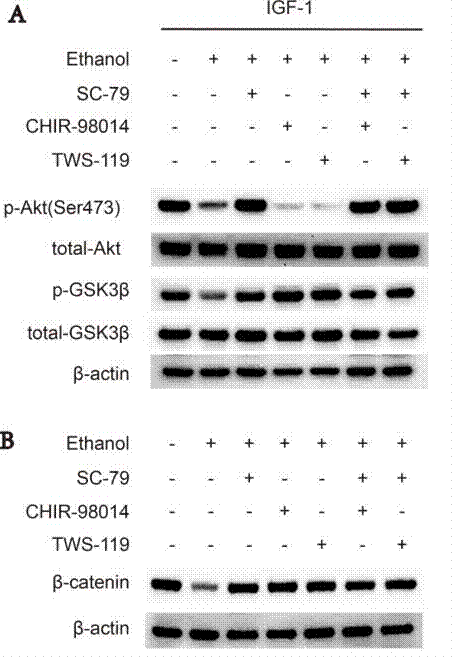
| Western blot | p-AKT / AKT / p-GSK3β / GSK3β / β-catenin |
|
28415692 |
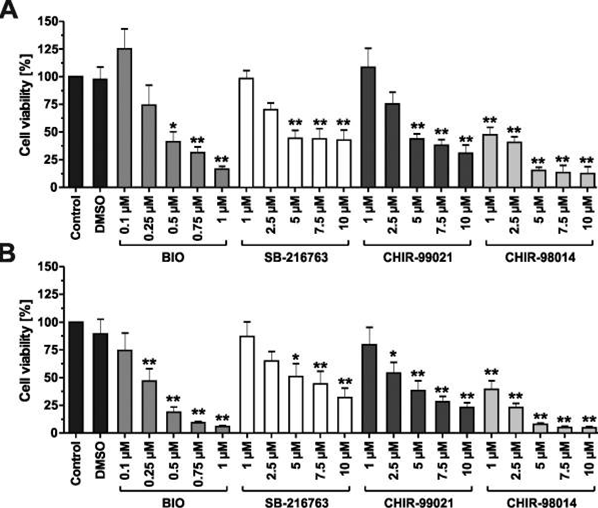
| Growth inhibition assay | Cell viability |
|
24779365 |
Soporte técnico
Tel: +1-832-582-8158 Ext:3
Si tiene alguna otra consulta, por favor deje un mensaje.

Los productos son solo para uso de investigación. No para uso humano. No vendemos a pacientes.
©Copyright 2013 Selleck Chemicals. Todos los derechos reservados.