
solo para uso en investigación
TWS119 GSK-3 inhibidor
Cat. No.S1590
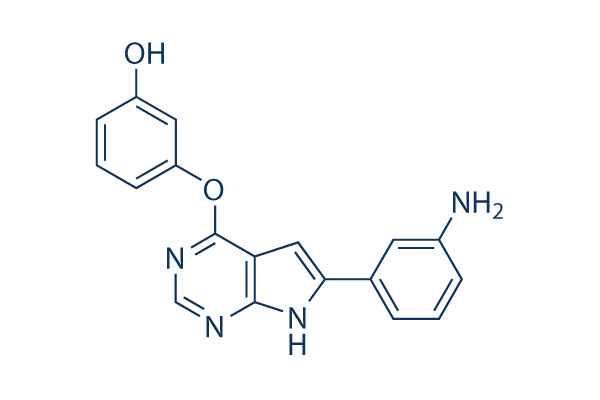
Estructura química
Peso molecular: 318.33
Control de calidad
| Dianas relacionadas | PI3K Akt mTOR ATM/ATR DNA-PK AMPK PDPK1 PTEN PP2A PDK |
|---|---|
| Otros GSK-3 Inhibidores | CHIR-99021 (Laduviglusib) Laduviglusib (CHIR-99021) Hydrochloride SB216763 CHIR-98014 GSK-3 Inhibitor IX (BIO) LY2090314 Tideglusib SB415286 AR-A014418 IM-12 |
Cultivo celular, tratamiento y concentración de trabajo
| Líneas celulares | Tipo de ensayo | Concentración | Tiempo de incubación | Formulación | Descripción de la actividad | PMID |
|---|---|---|---|---|---|---|
| RAW 264.7 | Cytotoxicity Assay | 0-10000ng/ml | 24 h | induces cell death in a dose dependent manner | 24330853 | |
| D3 | Function assay | Binding affinity to GSK-3 beta in mouse D3 cells, IC50=0.03μM. | 16408003 | |||
| D3 | Function assay | Inhibition of GSK-3 beta in mouse D3 cells, Kd=0.126μM. | 16408003 | |||
| D3 | Function assay | Inhibition of GSK-3 beta in mouse D3 cells assessed as induction of neuron specific marker neurofilament-M by immunofluorescence method, EC50=1μM. | 16408003 | |||
| D3 | Function assay | Inhibition of GSK-3 beta in mouse D3 cells assessed as induction of neuron specific marker microtubule-associated protein 2 by immunofluorescence method, EC50=1μM. | 16408003 | |||
| D3 | Function assay | Inhibition of GSK-3 beta in mouse D3 cells assessed as induction of neuron specific marker beta3-tubulin by immunofluorescence method, EC50=1μM. | 16408003 | |||
| DAOY | qHTS assay | qHTS of pediatric cancer cell lines to identify multiple opportunities for drug repurposing: Primary screen for DAOY cells | 29435139 | |||
| SJ-GBM2 | qHTS assay | qHTS of pediatric cancer cell lines to identify multiple opportunities for drug repurposing: Primary screen for SJ-GBM2 cells | 29435139 | |||
| A673 | qHTS assay | qHTS of pediatric cancer cell lines to identify multiple opportunities for drug repurposing: Primary screen for A673 cells | 29435139 | |||
| SK-N-MC | qHTS assay | qHTS of pediatric cancer cell lines to identify multiple opportunities for drug repurposing: Primary screen for SK-N-MC cells | 29435139 | |||
| NB-EBc1 | qHTS assay | qHTS of pediatric cancer cell lines to identify multiple opportunities for drug repurposing: Primary screen for NB-EBc1 cells | 29435139 | |||
| Saos-2 | qHTS assay | qHTS of pediatric cancer cell lines to identify multiple opportunities for drug repurposing: Primary screen for Saos-2 cells | 29435139 | |||
| SK-N-SH | qHTS assay | qHTS of pediatric cancer cell lines to identify multiple opportunities for drug repurposing: Primary screen for SK-N-SH cells | 29435139 | |||
| NB1643 | qHTS assay | qHTS of pediatric cancer cell lines to identify multiple opportunities for drug repurposing: Primary screen for NB1643 cells | 29435139 | |||
| LAN-5 | qHTS assay | qHTS of pediatric cancer cell lines to identify multiple opportunities for drug repurposing: Primary screen for LAN-5 cells | 29435139 | |||
| Rh18 | qHTS assay | qHTS of pediatric cancer cell lines to identify multiple opportunities for drug repurposing: Primary screen for Rh18 cells | 29435139 | |||
| RD | qHTS assay | qHTS of pediatric cancer cell lines to identify multiple opportunities for drug repurposing: Primary screen for RD cells | 29435139 | |||
| Rh41 | qHTS assay | qHTS of pediatric cancer cell lines to identify multiple opportunities for drug repurposing: Primary screen for Rh41 cells | 29435139 | |||
| Haga clic para ver más datos experimentales de líneas celulares | ||||||
Información química, almacenamiento y estabilidad
| Peso molecular | 318.33 | Fórmula | C18H14N4O2 |
Almacenamiento (Desde la fecha de recepción) | |
|---|---|---|---|---|---|
| Nº CAS | 601514-19-6 | Descargar SDF | Almacenamiento de soluciones madre |
|
|
| Sinónimos | N/A | Smiles | C1=CC(=CC(=C1)N)C2=CC3=C(N2)N=CN=C3OC4=CC=CC(=C4)O | ||
Solubilidad
|
In vitro |
DMSO
: 64 mg/mL
(201.04 mM)
Water : Insoluble Ethanol : Insoluble |
Calculadora de Molaridad
|
In vivo |
|||||
Calculadora de formulación in vivo (Solución clara)
Paso 1: Introduzca la información a continuación (Recomendado: Un animal adicional para tener en cuenta la pérdida durante el experimento)
Paso 2: Introduzca la formulación in vivo (Esto es solo la calculadora, no la formulación. Por favor, contáctenos primero si no hay una formulación in vivo en la sección de Solubilidad.)
Resultados del cálculo:
Concentración de trabajo: mg/ml;
Método para preparar el líquido maestro de DMSO: mg fármaco predissuelto en μL DMSO ( Concentración del líquido maestro mg/mL, Por favor, contáctenos primero si la concentración excede la solubilidad del DMSO del lote del fármaco. )
Método para preparar la formulación in vivo: Tomar μL DMSO líquido maestro, luego añadirμL PEG300, mezclar y clarificar, luego añadirμL Tween 80, mezclar y clarificar, luego añadir μL ddH2O, mezclar y clarificar.
Método para preparar la formulación in vivo: Tomar μL DMSO líquido maestro, luego añadir μL Aceite de maíz, mezclar y clarificar.
Nota: 1. Por favor, asegúrese de que el líquido esté claro antes de añadir el siguiente disolvente.
2. Asegúrese de añadir el (los) disolvente(s) en orden. Debe asegurarse de que la solución obtenida, en la adición anterior, sea una solución clara antes de proceder a añadir el siguiente disolvente. Se pueden utilizar métodos físicos como el vórtice, el ultrasonido o el baño de agua caliente para ayudar a la disolución.
Mecanismo de acción
| Targets/IC50/Ki |
GSK-3β
(Cell-free assay) 30 nM
|
|---|---|
| In vitro |
El tratamiento de una monocapa de células P19 con 1 μM de TWS119 provoca que el 30-40% de las células se diferencien específicamente en linajes neuronales, basándose en el recuento de células TuJ1 positivas con morfología neuronal correcta (hasta un 60% de diferenciación neuronal se produjo a través del protocolo estándar de formación de EB con tratamiento concomitante con este compuesto). Este compuesto se une fuertemente a la GSK-3β (K D = 126 nM), lo que se cuantifica por resonancia de plasmones de superficie (SPR) y demuestra además una IC50 de 30 nM. Se ha descubierto que induce potentemente la diferenciación neuronal tanto en células de carcinoma embrionario de ratón como en células ES. El tratamiento con este químico en células estrelladas hepáticas (HSC) conduce a una reducción de la fosforilación de la β-catenina, induce la translocación nuclear de la β-catenina, eleva la producción de glutamina sintetasa, impide la síntesis de actina de músculo liso y Wnt5a, pero promueve la expresión de proteína ácida fibrilar glial, Wnt10b y el factor de transcripción homeodominio de tipo apareado 2c. Este agente desencadena una rápida acumulación de β-catenina (aumento medio de 6,8 veces por densitometría), aumenta la interacción de la proteína nuclear con un oligonucleótido que contiene las secuencias de ADN a las que se unen Tcf y Lef y regula al alza bruscamente la expresión de Tcf7, Lef1 y otros genes diana de Wnt, incluyendo Jun, Ezd7 (que codifica Frizzled-7), Nlk (que codifica la cinasa similar a Nemo). Induce una disminución dependiente de la dosis en la muerte específica de células T y la liberación de IFN-γ asociada con la preservación de la capacidad de producir IL-2. Un estudio reciente indica que la señalización Wnt se induce en células T humanas activadas policlonalmente por el tratamiento con este compuesto. Estas células T conservan un fenotipo nativo CD45RA(+)CD62L(+) en comparación con las células T activadas de control que progresan a un fenotipo efector CD45RO(+)CD62L(-) y esto ocurre de manera dependiente de la dosis de este químico. La señalización Wnt inducida por este químico reduce la expansión de las células T como resultado de un bloqueo en la división celular e interfiere con la adquisición de la función efectora de las células T, medida por la degranulación y la producción de IFN-γ en respuesta a la activación de las células T. El bloqueo en la división de las células T puede atribuirse a la reducción de la expresión de IL-2Rα en las células T tratadas con este agente, lo que disminuye su capacidad para utilizar IL-2 autocrina para la expansión.
|
| In vivo |
Una población celular que expresó bajos niveles de CD44 y altos niveles de CD62L en la superficie celular cuando se administraron 30 mg/kg de TWS119.
|
Referencias |
|
Aplicaciones
| Métodos | Biomarcadores | Imágenes | PMID |
|---|---|---|---|
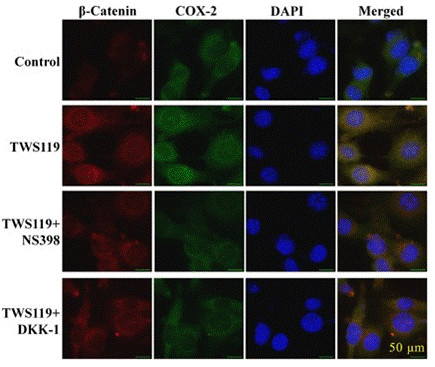
| Immunofluorescence | β-catenin / COX-2 |
|
30618773 |
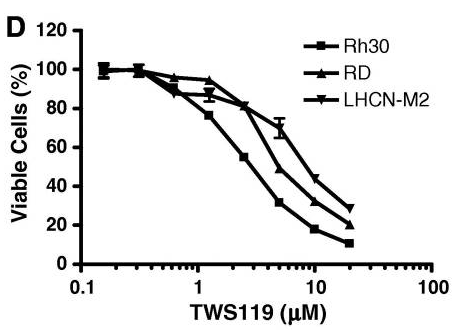
| Growth inhibition assay | Cell viability |
|
19995556 |
Soporte técnico
Tel: +1-832-582-8158 Ext:3
Si tiene alguna otra consulta, por favor deje un mensaje.

Los productos son solo para uso de investigación. No para uso humano. No vendemos a pacientes.
©Copyright 2013 Selleck Chemicals. Todos los derechos reservados.