
solo para uso en investigación
Allicin Fungal inhibidor
Cat. No.S3860
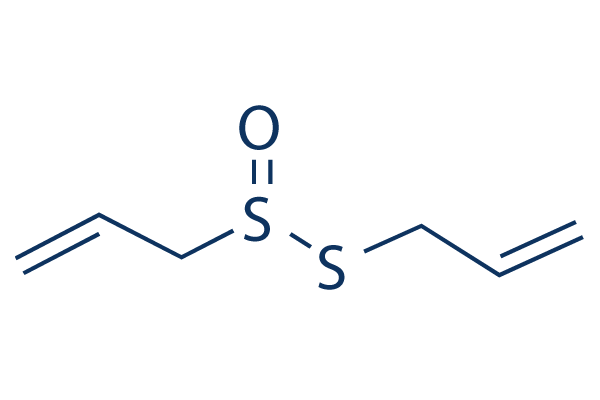
Estructura química
Peso molecular: 162.27
Control de calidad
- Citado en Nature Medicine por su calidad de primer nivel
- COA
- NMR
- Ficha técnica
- SDS
- Citado en Nature Medicine por su calidad de primer nivel
- COA
- NMR
- Ficha técnica
- SDS
- Citado en Nature Medicine por su calidad de primer nivel
- COA
- NMR
- Ficha técnica
- SDS
- Citado en Nature Medicine por su calidad de primer nivel
- COA
- NMR
- Ficha técnica
- SDS
- Citado en Nature Medicine por su calidad de primer nivel
- COA
- NMR
- Ficha técnica
- SDS
| Dianas relacionadas | Dehydrogenase HSP Transferase P450 (e.g. CYP17) PDE phosphatase PPAR Vitamin Carbohydrate Metabolism Mitochondrial Metabolism |
|---|---|
| Otros Fungal Inhibidores | Cycloheximide Tolnaftate Manogepix (E1210) Amorolfine HCl Isavuconazole Thimerosal Neticonazole Hydrochloride Juglone Pseudolaric Acid B Neticonazole |
Información química, almacenamiento y estabilidad
| Peso molecular | 162.27 | Fórmula | C6H10OS2 |
Almacenamiento (Desde la fecha de recepción) | 2 years -20°C liquid |
|---|---|---|---|---|---|
| Nº CAS | 539-86-6 | Descargar SDF | Almacenamiento de soluciones madre |
|
|
Solubilidad
|
In vitro |
DMSO
: 32 mg/mL
(197.2 mM)
Ethanol : 32 mg/mL Water : Insoluble |
Calculadora de Molaridad
|
In vivo |
|||||
Calculadora de formulación in vivo (Solución clara)
Paso 1: Introduzca la información a continuación (Recomendado: Un animal adicional para tener en cuenta la pérdida durante el experimento)
Paso 2: Introduzca la formulación in vivo (Esto es solo la calculadora, no la formulación. Por favor, contáctenos primero si no hay una formulación in vivo en la sección de Solubilidad.)
Resultados del cálculo:
Concentración de trabajo: mg/ml;
Método para preparar el líquido maestro de DMSO: mg fármaco predissuelto en μL DMSO ( Concentración del líquido maestro mg/mL, Por favor, contáctenos primero si la concentración excede la solubilidad del DMSO del lote del fármaco. )
Método para preparar la formulación in vivo: Tomar μL DMSO líquido maestro, luego añadirμL PEG300, mezclar y clarificar, luego añadirμL Tween 80, mezclar y clarificar, luego añadir μL ddH2O, mezclar y clarificar.
Método para preparar la formulación in vivo: Tomar μL DMSO líquido maestro, luego añadir μL Aceite de maíz, mezclar y clarificar.
Nota: 1. Por favor, asegúrese de que el líquido esté claro antes de añadir el siguiente disolvente.
2. Asegúrese de añadir el (los) disolvente(s) en orden. Debe asegurarse de que la solución obtenida, en la adición anterior, sea una solución clara antes de proceder a añadir el siguiente disolvente. Se pueden utilizar métodos físicos como el vórtice, el ultrasonido o el baño de agua caliente para ayudar a la disolución.
Mecanismo de acción
| In vitro |
Allicin es fácilmente permeable a través de las membranas fosfolipídicas, lo que facilita su actividad biológica. Inhibe el crecimiento de células cancerosas de origen murino y humano. Este compuesto induce la formación de cuerpos apoptóticos, condensación nuclear y una escalera de ADN típica en células cancerosas. Además, la activación de las caspasas-3, -8 y -9 y la escisión de la poli(ADP-ribosa) polimerasa son inducidas por este químico. Es altamente reactivo con los grupos tiol, pero bajo ciertas condiciones también reacciona consigo mismo formando otros compuestos que también pueden ser bioactivos, como las vinil-ditiinas, el ajoeno y los polisulfanos. Dado que esta sustancia es capaz de oxidar biomoléculas como el glutatión o los residuos de cisteína de proteínas bajo condiciones fisiológicas, cumple con la definición de Especie Reactiva de Azufre (RSS). Ciertamente actúa como un “antioxidante fisiológico” al inducir el “sistema de desintoxicación de fase II” celular. Este agente activa el factor de transcripción mamífero dependiente de redox Nrf-2, cuya localización depende de la proteína Keap1 (proteína asociada a ECH1 tipo Kelch), presumiblemente oxidando los residuos de cisteína reguladores, como se demostró para el factor de transcripción YAP1, que es un homólogo funcional del sistema Nrf-2 en levaduras. Los estudios in vitro muestran que inhibe la adhesión de células T mediada por TNF-α a los componentes de la matriz extracelular y a las células endoteliales. También inhibe la expresión de la molécula de adhesión intercelular-1 y la molécula de adhesión de células vasculares-1 mediada por TNF-α en células endoteliales vasculares humanas.
|
|---|---|
| In vivo |
Allicin tiene un efecto protector sobre la hepatitis inmunomediada, inducida por Con A en ratones.
|
Referencias |
|
Soporte técnico
Tel: +1-832-582-8158 Ext:3
Si tiene alguna otra consulta, por favor deje un mensaje.

Los productos son solo para uso de investigación. No para uso humano. No vendemos a pacientes.
©Copyright 2013 Selleck Chemicals. Todos los derechos reservados.