
solo para uso en investigación
Ezetimibe (SCH-58235) LDL modulador
Cat. No.S1655
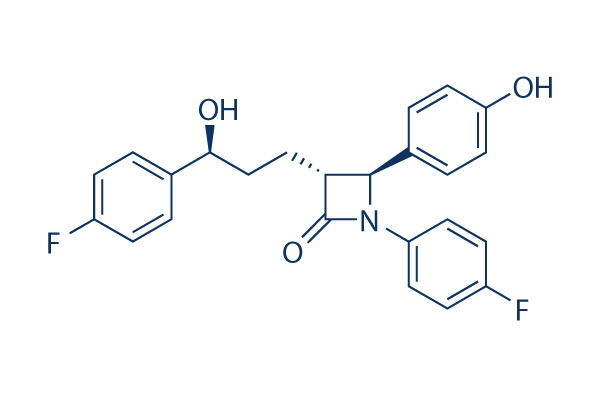
Estructura química
Peso molecular: 409.4
Control de calidad
| Dianas relacionadas | Dehydrogenase HSP Transferase P450 (e.g. CYP17) PDE phosphatase PPAR Vitamin Carbohydrate Metabolism Mitochondrial Metabolism |
|---|---|
| Otros LDL Inhibidores | Phillygenin Cashew Extract |
Información química, almacenamiento y estabilidad
| Peso molecular | 409.4 | Fórmula | C24H21F2NO3 |
Almacenamiento (Desde la fecha de recepción) | |
|---|---|---|---|---|---|
| Nº CAS | 163222-33-1 | Descargar SDF | Almacenamiento de soluciones madre |
|
|
| Sinónimos | SCH-58235 | Smiles | C1=CC(=CC=C1C2C(C(=O)N2C3=CC=C(C=C3)F)CCC(C4=CC=C(C=C4)F)O)O | ||
Solubilidad
|
In vitro |
DMSO
: 82 mg/mL
(200.29 mM)
Ethanol : 82 mg/mL Water : Insoluble |
Calculadora de Molaridad
|
In vivo |
|||||
Calculadora de formulación in vivo (Solución clara)
Paso 1: Introduzca la información a continuación (Recomendado: Un animal adicional para tener en cuenta la pérdida durante el experimento)
Paso 2: Introduzca la formulación in vivo (Esto es solo la calculadora, no la formulación. Por favor, contáctenos primero si no hay una formulación in vivo en la sección de Solubilidad.)
Resultados del cálculo:
Concentración de trabajo: mg/ml;
Método para preparar el líquido maestro de DMSO: mg fármaco predissuelto en μL DMSO ( Concentración del líquido maestro mg/mL, Por favor, contáctenos primero si la concentración excede la solubilidad del DMSO del lote del fármaco. )
Método para preparar la formulación in vivo: Tomar μL DMSO líquido maestro, luego añadirμL PEG300, mezclar y clarificar, luego añadirμL Tween 80, mezclar y clarificar, luego añadir μL ddH2O, mezclar y clarificar.
Método para preparar la formulación in vivo: Tomar μL DMSO líquido maestro, luego añadir μL Aceite de maíz, mezclar y clarificar.
Nota: 1. Por favor, asegúrese de que el líquido esté claro antes de añadir el siguiente disolvente.
2. Asegúrese de añadir el (los) disolvente(s) en orden. Debe asegurarse de que la solución obtenida, en la adición anterior, sea una solución clara antes de proceder a añadir el siguiente disolvente. Se pueden utilizar métodos físicos como el vórtice, el ultrasonido o el baño de agua caliente para ayudar a la disolución.
Mecanismo de acción
| Targets/IC50/Ki |
NPC1L1
|
|---|---|
| In vitro |
Ezetimibe (SCH-58235) produce una reducción significativa del colesterol total, del colesterol LDL y de los triglicéridos, así como un pequeño pero significativo aumento del colesterol HDL. Este compuesto reduce el transporte de colesterol en un 31% en células Caco-2, pero no el transporte de retinol. Resulta en una disminución significativa de la expresión de ARNm para los receptores de superficie SR-BI, la proteína Niemann-Pick tipo C1 Like 1 (NPC1L1) y el transportador de casete de unión a ATP, subfamilia A (ABCA1) y para los receptores nucleares del receptor de ácido retinoico (RAR)gamma, las proteínas de unión a elementos reguladores de esteroles (SREBP)-1 y -2, y el receptor X hepático (LXR)beta, según lo evaluado por análisis de PCR en tiempo real en células Caco-2.
|
| In vivo |
Ezetimibe (SCH-58235) reduce los niveles de colesterol plasmático de 964 a 374 mg/dL, de 726 a 231 mg/dL y de 516 a 178 mg/dL en ratones con dieta occidental, baja en grasas y sin colesterol, respectivamente. Reduce el área de la superficie de la lesión aterosclerótica aórtica del 20,2% al 4,1% en el grupo con dieta occidental y del 24,1% al 7,0% en ratones con dieta baja en grasas y colesterol. Este compuesto reduce el área de la sección transversal de la lesión aterosclerótica de la arteria carótida en un 97% en los grupos con dieta occidental y baja en grasas y colesterol, y en un 91% en ratones sin colesterol. Inhibe la absorción de colesterol, reduce el colesterol plasmático, aumenta los niveles de lipoproteínas de alta densidad e inhibe la progresión de la aterosclerosis en condiciones dietéticas occidentales, bajas en grasas y sin colesterol en ratones apoE-/-. Ezetimibe inhibe potentemente el transporte de colesterol a través de la pared intestinal, reduciendo así el colesterol plasmático en modelos animales preclínicos de hipercolesterolemia. Elimina la función pancreática exocrina del intestino mientras mantiene el flujo biliar, como se estableció en la rata. El compuesto reduce el colesterol plasmático y la acumulación de colesterol hepático en hámsteres alimentados con colesterol con una ED(50) de 0,04 mg/kg.
|
Referencias |
|
Aplicaciones
| Métodos | Biomarcadores | Imágenes | PMID |
|---|---|---|---|
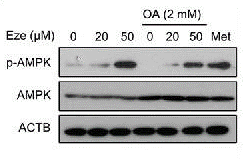
| Western blot | p-AMPK / AMPK LC3B-I / LC3B-II / Nuclear TFEB PCSK9 / LDLR / SREBP2 / HNF1-a |
|
28933629 |
Soporte técnico
Tel: +1-832-582-8158 Ext:3
Si tiene alguna otra consulta, por favor deje un mensaje.
Preguntas frecuentes
Pregunta 1:
I am planning to deliver it per orally and wonder proper vehicle for this compound and effective dose level for lowering intestinal cholesterol absorption.
Respuesta:
It can be dissolved in 2% DMSO/30% PEG 300/5% Tween 80/ddH2O at 10 mg/ml clearly. If you are going to use this vehicle, please dissolve the compound in DMSO clearly first. Then add PEG 300 and Tween 80, after mixed homogeneously, then dilute with water.

Los productos son solo para uso de investigación. No para uso humano. No vendemos a pacientes.
©Copyright 2013 Selleck Chemicals. Todos los derechos reservados.