
Datos técnicos
| Fórmula | C24H21F2NO3 |
||||||
| Peso molecular | 409.4 | Número CAS | 163222-33-1 | ||||
| Solubilidad (25°C)* | In vitro | DMSO | 81 mg/mL (197.85 mM) | ||||
| Ethanol | 81 mg/mL (197.85 mM) | ||||||
| Water | Insoluble | ||||||
| In vivo (Agregue los solventes al producto individualmente y en orden.) |
|
||||||
|
* <1 mg/ml significa ligeramente soluble o insoluble. * Tenga en cuenta que Selleck prueba la solubilidad de todos los compuestos internamente, y la solubilidad real puede diferir ligeramente de los valores publicados. Esto es normal y se debe a ligeras variaciones entre lotes. * Envío a temperatura ambiente (Las pruebas de estabilidad demuestran que este producto se puede enviar sin medidas de refrigeración.) |
|||||||
Preparación de soluciones madre
Actividad biológica
| Descripción | Ezetimibe (SCH-58235) es un potente y selectivo inhibidor de la absorción del colesterol que se utiliza para reducir el colesterol. | |
|---|---|---|
| Objetivos |
|
|
| In vitro | Ezetimibe (SCH-58235) produce una reducción significativa del colesterol total, del colesterol LDL y de los triglicéridos, así como un pequeño pero significativo aumento del colesterol HDL. Este compuesto reduce el transporte de colesterol en un 31% en células Caco-2, pero no el transporte de retinol. Resulta en una disminución significativa de la expresión de ARNm para los receptores de superficie SR-BI, la proteína Niemann-Pick tipo C1 Like 1 (NPC1L1) y el transportador de casete de unión a ATP, subfamilia A (ABCA1) y para los receptores nucleares del receptor de ácido retinoico (RAR)gamma, las proteínas de unión a elementos reguladores de esteroles (SREBP)-1 y -2, y el receptor X hepático (LXR)beta, según lo evaluado por análisis de PCR en tiempo real en células Caco-2. | |
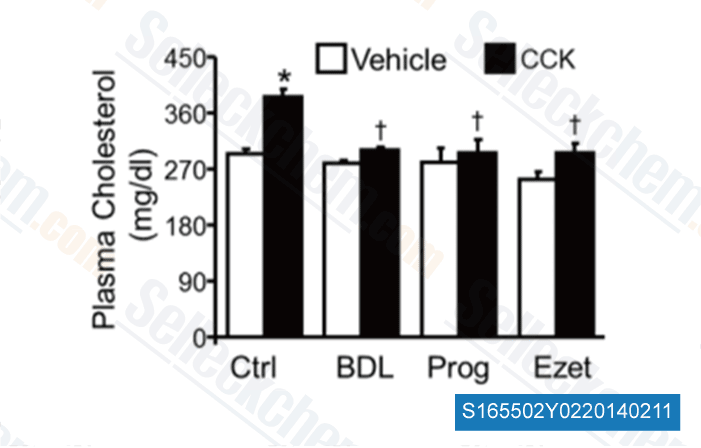
| In vivo | Ezetimibe (SCH-58235) reduce los niveles de colesterol plasmático de 964 a 374 mg/dL, de 726 a 231 mg/dL y de 516 a 178 mg/dL en ratones con dieta occidental, baja en grasas y sin colesterol, respectivamente. Reduce el área de la superficie de la lesión aterosclerótica aórtica del 20,2% al 4,1% en el grupo con dieta occidental y del 24,1% al 7,0% en ratones con dieta baja en grasas y colesterol. Este compuesto reduce el área de la sección transversal de la lesión aterosclerótica de la arteria carótida en un 97% en los grupos con dieta occidental y baja en grasas y colesterol, y en un 91% en ratones sin colesterol. Inhibe la absorción de colesterol, reduce el colesterol plasmático, aumenta los niveles de lipoproteínas de alta densidad e inhibe la progresión de la aterosclerosis en condiciones dietéticas occidentales, bajas en grasas y sin colesterol en ratones apoE-/-. Ezetimibe inhibe potentemente el transporte de colesterol a través de la pared intestinal, reduciendo así el colesterol plasmático en modelos animales preclínicos de hipercolesterolemia. Elimina la función pancreática exocrina del intestino mientras mantiene el flujo biliar, como se estableció en la rata. El compuesto reduce el colesterol plasmático y la acumulación de colesterol hepático en hámsteres alimentados con colesterol con una ED(50) de 0,04 mg/kg. |
Protocolo (de referencia)
Referencias
|
Validación de productos por parte del cliente
![Caco-2 cells grown in transwell inserts were transfected with scrambled siRNA, or siRNA specific for CCK1R, CCK2R, or both CCK1 and CCK2R and then incubated with 0.002 uCi of [<sup>3</sup>H]cholesterol micelles in the apical compartment and with culture medium alone (Control) or 10 nm [Thr28,Nle31]CCK with or without 50 uM ezetimibe (EZ) in the basolateral compartment. Absorbed [<sup>3</sup>H]cholesterol was determined by radioactivity counting of the basolateral medium. Values represent the mean ± S.E. (error bars) of 4-5 independent experiments. *, p < 0.05 versus control; †, p < 0.05 versus cells treated with CCK alone; ‡, p < 0.05 versus cells transfected with scrambled siRNA alone; $, p < 0.05 versus cells treated with scrambled siRNA and CCK.](https://file.selleckchem.com/downloads/review/700px/Ezetimibe-S1655Z0120150115.gif)
-
Datos de [ J Biol Chem , 2014 , 289(19), 12989-99 ]
-
Datos de [ PLoS One , 2012 , 7(12), e51011 ]
Sellecks Ezetimibe (SCH-58235) Ha sido citado por 22 Publicaciones
| Modulation of Mitochondria-Endoplasmic Reticulum Contacts (MERCs) by Small Molecules as a New Strategy for Restoring Lipid Metabolism in an Amyotrophic Lateral Sclerosis Model [ J Med Chem, 2025, 68(2):1179-1194] | PubMed: 39778888 |
| Discovery of non-steroidal aldo-keto reductase 1D1 inhibitors through automated screening and in vitro evaluation [ Toxicol Lett, 2025, 406:31-37] | PubMed: 39988211 |
| Propafenone facilitates mitochondrial-associated ferroptosis and synergizes with immunotherapy in melanoma [ J Immunother Cancer, 2024, 12(11)e009805] | PubMed: 39581704 |
| Inhibition of NPC1L1 disrupts adaptive responses of drug-tolerant persister cells to chemotherapy [ EMBO Mol Med, 2022, 14(2):e14903] | PubMed: 35023619 |
| CircRIC8B regulates the lipid metabolism of chronic lymphocytic leukemia through miR199b-5p/LPL axis [ Exp Hematol Oncol, 2022, 11(1):51] | PubMed: 36064433 |
| The polysaccharide-peptide complex from mushroom Cordyceps militaris ameliorates atherosclerosis by modulating the lncRNA-miRNA-mRNA axis [ Food Funct, 2022, 13(6):3185-3197] | PubMed: 35225320 |
| Development of non-bias phenotypic drug screening for cardiomyocyte hypertrophy by image segmentation using deep learning [ Biochem Biophys Res Commun, 2022, 632:181-188] | PubMed: 36215905 |
| A systems-level study reveals host-targeted repurposable drugs against SARS-CoV-2 infection [ Mol Syst Biol, 2021, 17(8):e10239] | PubMed: 34339582 |
| Polysaccharide CM1 from Cordyceps militaris hinders adipocyte differentiation and alleviates hyperlipidemia in LDLR(+/-) hamsters [ Lipids Health Dis, 2021, 20(1):178] | PubMed: 34895241 |
| Association Between Iron and Cholesterol in Neuroblastomas [ Anticancer Res, 2021, 41(6):2795-2804] | PubMed: 34083269 |
POLÍTICA DE DEVOLUCIÓN
La Política de Devolución Incondicional de Selleck Chemical garantiza una experiencia de compra en línea fluida para nuestros clientes. Si no está satisfecho con su compra de alguna manera, puede devolver cualquier artículo(s) dentro de los 7 días posteriores a su recepción. En caso de problemas de calidad del producto, ya sean problemas relacionados con el protocolo o con el producto, puede devolver cualquier artículo(s) dentro de los 365 días a partir de la fecha de compra original. Siga las instrucciones a continuación al devolver productos.
ENVÍO Y ALMACENAMIENTO
Los productos Selleck se transportan a temperatura ambiente. Si recibe el producto a temperatura ambiente, tenga la seguridad de que el Departamento de Inspección de Calidad de Selleck ha realizado experimentos para verificar que la colocación a temperatura normal durante un mes no afectará la actividad biológica de los productos en polvo. Después de la recogida, guarde el producto de acuerdo con los requisitos descritos en la hoja de datos. La mayoría de los productos Selleck son estables en las condiciones recomendadas.
NO PARA USO HUMANO, DIAGNÓSTICO VETERINARIO O TERAPÉUTICO.