
solo para uso en investigación
3PO PFKFB inhibitor
Cat. No.S7639
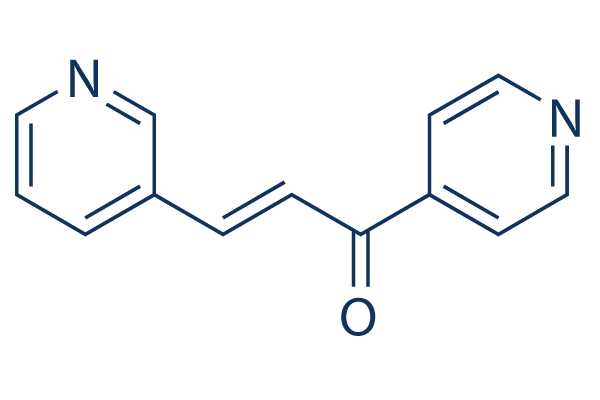
Estructura química
Peso molecular: 210.23
Control de calidad
| Dianas relacionadas | CDK HSP PD-1/PD-L1 ROCK Wee1 DNA/RNA Synthesis Microtubule Associated Ras KRas Aurora Kinase |
|---|---|
| Otros PFKFB Inhibidores | PFK15 PFK158 KAN0438757 |
Cultivo celular, tratamiento y concentración de trabajo
| Líneas celulares | Tipo de ensayo | Concentración | Tiempo de incubación | Formulación | Descripción de la actividad | PMID |
|---|---|---|---|---|---|---|
| Jurkat | Growth inhibition assay | 48 hrs | Growth inhibition of human Jurkat cells expressing inducible FLAG-tagged PFKFB incubated for 48 hrs by trypan blue dye exclusion assay, IC50=1.4μM | ChEMBL | ||
| NHBE | Growth inhibition assay | 48 to 72 hrs | Growth inhibition of human NHBE cells immortalized with human telomerase and large-T antigen and transformed with mutated Ras protein incubated for 48 to 72 hrs by trypan blue dye exclusion assay, IC50=1.5μM | ChEMBL | ||
| K562 | Growth inhibition assay | 48 hrs | Growth inhibition of human K562 cells incubated for 48 hrs by trypan blue dye exclusion assay, IC50=3.2μM | ChEMBL | ||
| HL60 | Growth inhibition assay | 48 hrs | Growth inhibition of human HL60 cells incubated for 48 hrs by trypan blue dye exclusion assay, IC50=4.5μM | ChEMBL | ||
| MDA-MB-231 | Growth inhibition assay | 48 hrs | Growth inhibition of human MDA-MB-231 cells incubated for 48 hrs by trypan blue dye exclusion assay, IC50=4.7μM | ChEMBL | ||
| Jurkat | Growth inhibition assay | 48 hrs | Growth inhibition of human Jurkat cells expressing un-altered PFKFB expression incubated for 48 hrs by trypan blue dye exclusion assay, IC50=8.9μM | ChEMBL | ||
| CRL11174 | Growth inhibition assay | 48 hrs | Growth inhibition of human CRL11174 cells incubated for 48 hrs by trypan blue dye exclusion assay, IC50=15μM | ChEMBL | ||
| LLC | Growth inhibition assay | 48 hrs | Growth inhibition of mouse LLC cells incubated for 48 hrs by trypan blue dye exclusion assay, IC50=19μM | ChEMBL | ||
| Jurkat | Growth inhibition assay | 48 hrs | Growth inhibition of human Jurkat cells expressing inducible FLAG-tagged PFKFB in presence of doxycycline incubated for 48 hrs by trypan blue dye exclusion assay, IC50=19.3μM | ChEMBL | ||
| HeLa | Growth inhibition assay | 48 hrs | Growth inhibition of human HeLa cells incubated for 48 hrs by trypan blue dye exclusion assay, IC50=24μM | ChEMBL | ||
| Jurkat | Growth inhibition assay | 48 hrs | Growth inhibition of PFKFB3+/-ht/LT/Ras human Jurkat cells and incubated for 48 hrs by trypan blue dye exclusion assay, IC50=26μM | ChEMBL | ||
| A549 | Growth inhibition assay | 48 hrs | Growth inhibition of human A549 cells incubated for 48 hrs by trypan blue dye exclusion assay, IC50=48μM | ChEMBL | ||
| Jurkat | Growth inhibition assay | 48 hrs | Growth inhibition of PFKFB3+/+ht/LT/Ras human Jurkat cells and incubated for 48 hrs by trypan blue dye exclusion assay, IC50=49μM | ChEMBL | ||
| Jurkat | Cell proliferation assay | 10 uM | 36 hrs | Inhibition of cell proliferation of human Jurkat cells expressing inducible FLAG-tagged PFKFB at 10 uM incubated for 36 hrs by trypan blue dye exclusion assay | ChEMBL | |
| Jurkat | Cell cycle assay | Inhibition of cell cycle arrest in human Jurkat cells expressing inducible FLAG-tagged PFKFB assessed as accumulation at G2/M phase by propidium iodide staining based flow cytometry | ChEMBL | |||
| Jurkat | Function assay | 10 uM | Reduction in 2-deoxy-glucose uptake in human Jurkat cells expressing inducible FLAG-tagged PFKFB at 10 uM measured within 4 hrs using [14C]-2-deoxy-glucose by scintillation counting method | ChEMBL | ||
| Jurkat | Function assay | 10 uM | 4 hrs | Reduction in Fru-2,6-BP production in human Jurkat cells expressing inducible FLAG-tagged PFKFB at 10 uM measured within 4 hrs | ChEMBL | |
| Jurkat | Function assay | 10 uM | 8 hrs | Reduction in lactate secretion in human Jurkat cells expressing inducible FLAG-tagged PFKFB at 10 uM after 8 hrs by lactate oxidase based colorimetric assay | ChEMBL | |
| Jurkat | Function assay | 10 uM | 16 hrs | Reduction in NADH level in human Jurkat cells expressing inducible FLAG-tagged PFKFB at 10 uM after 16 hrs | ChEMBL | |
| Jurkat | Function assay | 10 uM | 24 hrs | Reduction in NAD+ level in human Jurkat cells expressing inducible FLAG-tagged PFKFB at 10 uM after 24 hrs | ChEMBL | |
| Jurkat | Function assay | 10 uM | 24 hrs | Reduction in ATP level in human Jurkat cells expressing inducible FLAG-tagged PFKFB at 10 uM after 24 hrs | ChEMBL | |
| Jurkat | Function assay | 10 uM | 36 hrs | Suppression of glycolytic flux into lactate in human Jurkat cells expressing inducible FLAG-tagged PFKFB at 10 uM after 36 hrs by NMR spectroscopy | ChEMBL | |
| NHBE | Growth inhibition assay | 1 uM | 48 to 72 hrs | Growth inhibition of human NHBE cells immortalized with human telomerase and large-T antigen and transformed with mutated Ras protein at 1 uM incubated for 48 to 72 hrs by trypan blue dye exclusion assay | ChEMBL | |
| NHBE | Growth inhibition assay | 10 uM | 48 to 72 hrs | Growth inhibition of human NHBE cells immortalized with human telomerase and large-T antigen and transformed with mutated Ras protein at 10 uM incubated for 48 to 72 hrs by trypan blue dye exclusion assay | ChEMBL | |
| Haga clic para ver más datos experimentales de líneas celulares | ||||||
Información química, almacenamiento y estabilidad
| Peso molecular | 210.23 | Fórmula | C13H10N2O |
Almacenamiento (Desde la fecha de recepción) | |
|---|---|---|---|---|---|
| Nº CAS | 18550-98-6 | Descargar SDF | Almacenamiento de soluciones madre |
|
|
| Sinónimos | 3-(3-pyridinyl)-1-(4-pyridinyl)-2-propen-1-one | Smiles | C1=CC(=CN=C1)C=CC(=O)C2=CC=NC=C2 | ||
Solubilidad
|
In vitro |
DMSO
: 42 mg/mL
(199.78 mM)
Ethanol : 11 mg/mL Water : Insoluble |
Calculadora de Molaridad
|
In vivo |
|||||
Calculadora de formulación in vivo (Solución clara)
Paso 1: Introduzca la información a continuación (Recomendado: Un animal adicional para tener en cuenta la pérdida durante el experimento)
Paso 2: Introduzca la formulación in vivo (Esto es solo la calculadora, no la formulación. Por favor, contáctenos primero si no hay una formulación in vivo en la sección de Solubilidad.)
Resultados del cálculo:
Concentración de trabajo: mg/ml;
Método para preparar el líquido maestro de DMSO: mg fármaco predissuelto en μL DMSO ( Concentración del líquido maestro mg/mL, Por favor, contáctenos primero si la concentración excede la solubilidad del DMSO del lote del fármaco. )
Método para preparar la formulación in vivo: Tomar μL DMSO líquido maestro, luego añadirμL PEG300, mezclar y clarificar, luego añadirμL Tween 80, mezclar y clarificar, luego añadir μL ddH2O, mezclar y clarificar.
Método para preparar la formulación in vivo: Tomar μL DMSO líquido maestro, luego añadir μL Aceite de maíz, mezclar y clarificar.
Nota: 1. Por favor, asegúrese de que el líquido esté claro antes de añadir el siguiente disolvente.
2. Asegúrese de añadir el (los) disolvente(s) en orden. Debe asegurarse de que la solución obtenida, en la adición anterior, sea una solución clara antes de proceder a añadir el siguiente disolvente. Se pueden utilizar métodos físicos como el vórtice, el ultrasonido o el baño de agua caliente para ayudar a la disolución.
Mecanismo de acción
| Targets/IC50/Ki |
PFKFB3
22.9 μM
|
|---|---|
| In vitro |
3PO es un inhibidor de la isoenzima PFKFB3 principalmente a través de la competencia con Fru-6-P y no inhibe la actividad de PFK-1 purificada. Este compuesto atenúa marcadamente la proliferación de varias líneas celulares hematopoyéticas malignas humanas y de adenocarcinoma (IC50, 1,4-24 μmol/L) y es selectivamente citostático para las células epiteliales bronquiales humanas transformadas por ras en relación con las células epiteliales bronquiales humanas normales. Puede causar un G2-M phase arrest.
|
| In vivo |
La administración i.p. de 3PO (0,07 mg/g) a ratones portadores de tumores reduce marcadamente la concentración intracelular de Fru-2,6-BP, la captación de glucosa y el crecimiento de tumores establecidos in vivo. Suprime el crecimiento tumorigénico de células de adenocarcinoma de mama, leucemia y adenocarcinoma de pulmón in vivo. Las propiedades farmacocinéticas de este compuesto se examinan en ratones C57Bl/6 a los que se les administró esta sustancia química por vía intravenosa: aclaramiento CL=2312 mL/min/kg, T1/2=0,3 h, Cmax=113 ng/ml, AUC0-inf=36 ng/h/ml. Se ha informado que tiene una potente actividad contra un modelo de ratón de leucemia altamente relevante.
|
Referencias |
|
Soporte técnico
Tel: +1-832-582-8158 Ext:3
Si tiene alguna otra consulta, por favor deje un mensaje.

Los productos son solo para uso de investigación. No para uso humano. No vendemos a pacientes.
©Copyright 2013 Selleck Chemicals. Todos los derechos reservados.