
solo para uso en investigación
Ipriflavone (Osteofix) AGEs inhibidor
Cat. No.S2422
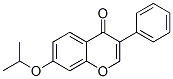
Estructura química
Peso molecular: 280.32
Control de calidad
| Dianas relacionadas | Dehydrogenase HSP Transferase P450 (e.g. CYP17) PDE phosphatase PPAR Vitamin Carbohydrate Metabolism Mitochondrial Metabolism |
|---|---|
| Otros AGEs Inhibidores | Azeliragon (TTP488) |
Información química, almacenamiento y estabilidad
| Peso molecular | 280.32 | Fórmula | C18H16O3 |
Almacenamiento (Desde la fecha de recepción) | |
|---|---|---|---|---|---|
| Nº CAS | 35212-22-7 | Descargar SDF | Almacenamiento de soluciones madre |
|
|
Solubilidad
|
In vitro |
DMSO
: 56 mg/mL
(199.77 mM)
Ethanol : 2 mg/mL Water : Insoluble |
Calculadora de Molaridad
|
In vivo |
|||||
Calculadora de formulación in vivo (Solución clara)
Paso 1: Introduzca la información a continuación (Recomendado: Un animal adicional para tener en cuenta la pérdida durante el experimento)
Paso 2: Introduzca la formulación in vivo (Esto es solo la calculadora, no la formulación. Por favor, contáctenos primero si no hay una formulación in vivo en la sección de Solubilidad.)
Resultados del cálculo:
Concentración de trabajo: mg/ml;
Método para preparar el líquido maestro de DMSO: mg fármaco predissuelto en μL DMSO ( Concentración del líquido maestro mg/mL, Por favor, contáctenos primero si la concentración excede la solubilidad del DMSO del lote del fármaco. )
Método para preparar la formulación in vivo: Tomar μL DMSO líquido maestro, luego añadirμL PEG300, mezclar y clarificar, luego añadirμL Tween 80, mezclar y clarificar, luego añadir μL ddH2O, mezclar y clarificar.
Método para preparar la formulación in vivo: Tomar μL DMSO líquido maestro, luego añadir μL Aceite de maíz, mezclar y clarificar.
Nota: 1. Por favor, asegúrese de que el líquido esté claro antes de añadir el siguiente disolvente.
2. Asegúrese de añadir el (los) disolvente(s) en orden. Debe asegurarse de que la solución obtenida, en la adición anterior, sea una solución clara antes de proceder a añadir el siguiente disolvente. Se pueden utilizar métodos físicos como el vórtice, el ultrasonido o el baño de agua caliente para ayudar a la disolución.
Mecanismo de acción
| Targets/IC50/Ki |
advanced glycation end products (AGE)
|
|---|---|
| In vitro |
Ipriflavone (Osteofix) regula la diferenciación y las propiedades biosintéticas de las células osteoprogenitoras estromales de médula ósea humana (BMC) al mejorar la expresión de algunas proteínas importantes de la matriz y facilitar el proceso de mineralización. El tratamiento a 10 μM inhibe significativamente la resorción ósea potenciada por productos finales de glicación avanzada (AGE) en células óseas de ratón no fraccionadas cultivadas. Además, potencia la captación de calcio por las células duodenales. Este compuesto inhibe la proliferación y la síntesis de ADN de las células MDA-231 de manera dosis-dependiente, y bloquea la fosforilación de Tyr845 del EGFR inducida por ligando. El tratamiento a 50 μM no induce apoptosis de las células MDA-231.
|
| In vivo |
La administración oral de Ipriflavone (Osteofix) a 12 mg, pero no a 6 mg, inhibe significativamente el desarrollo de nuevas metástasis óseas osteolíticas de células MDA-231, suprime la progresión de las lesiones osteolíticas establecidas y reduce el número de osteoclastos adyacentes a las células cancerosas en las metástasis óseas. En consonancia con la actividad in vitro, el tratamiento con este compuesto a 6 o 12 mg/día inhibe significativamente el crecimiento tumoral de los xenoinjertos MDA-231 con reducciones del 25% y 45% por volumen y del 47% y 63% por peso, respectivamente, en comparación con ratones no tratados, y prolonga la vida de los ratones portadores de tumores. DL50: Ratones >2,5 g/kg (i.p.), >5 g/kg (s.c.), >10 g/kg (i.g.); Ratas >2,5 g/kg (i.p.), >5 g/kg (s.c.), >10 g/kg (i.g.)
|
Referencias |
|
Soporte técnico
Tel: +1-832-582-8158 Ext:3
Si tiene alguna otra consulta, por favor deje un mensaje.

Los productos son solo para uso de investigación. No para uso humano. No vendemos a pacientes.
©Copyright 2013 Selleck Chemicals. Todos los derechos reservados.