
solo para uso en investigación
Histamine Phosphate Histamine Receptor agonista
Cat. No.S4117
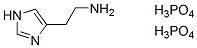
Estructura química
Peso molecular: 307.14
Saltar a
Control de calidad
Lote:
Pureza:
99.99%
99.99
| Dianas relacionadas | Adrenergic Receptor AChR 5-HT Receptor COX Calcium Channel Dopamine Receptor GABA Receptor TRP Channel Cholinesterase (ChE) GluR |
|---|---|
| Otros Histamine Receptor Inhibidores | GSK2879552 Dihydrochloride JNJ-7777120 Ebastine Ciproxifan Maleate Mianserin HCl Astemizole Lafutidine Mizolastine Rupatadine Fumarate Betahistine 2HCl |
Información química, almacenamiento y estabilidad
| Peso molecular | 307.14 | Fórmula | C5H9N.2H3O4P |
Almacenamiento (Desde la fecha de recepción) | |
|---|---|---|---|---|---|
| Nº CAS | 51-74-1 | Descargar SDF | Almacenamiento de soluciones madre |
|
|
| Sinónimos | Histamine diphosphate | Smiles | C1=C(NC=N1)CCN.OP(=O)(O)O.OP(=O)(O)O | ||
Solubilidad
|
In vitro |
Water : 61 mg/mL
DMSO
: Insoluble
Ethanol : Insoluble |
Calculadora de Molaridad
Calculadora de Dilución
Calculadora de Peso Molecular
|
In vivo |
|||||
Calculadora de formulación in vivo (Solución clara)
Paso 1: Introduzca la información a continuación (Recomendado: Un animal adicional para tener en cuenta la pérdida durante el experimento)
mg/kg
g
μL
Paso 2: Introduzca la formulación in vivo (Esto es solo la calculadora, no la formulación. Por favor, contáctenos primero si no hay una formulación in vivo en la sección de Solubilidad.)
% DMSO
%
% Tween 80
% ddH2O
%DMSO
%
Resultados del cálculo:
Concentración de trabajo: mg/ml;
Método para preparar el líquido maestro de DMSO: mg fármaco predissuelto en μL DMSO ( Concentración del líquido maestro mg/mL, Por favor, contáctenos primero si la concentración excede la solubilidad del DMSO del lote del fármaco. )
Método para preparar la formulación in vivo: Tomar μL DMSO líquido maestro, luego añadirμL PEG300, mezclar y clarificar, luego añadirμL Tween 80, mezclar y clarificar, luego añadir μL ddH2O, mezclar y clarificar.
Método para preparar la formulación in vivo: Tomar μL DMSO líquido maestro, luego añadir μL Aceite de maíz, mezclar y clarificar.
Nota: 1. Por favor, asegúrese de que el líquido esté claro antes de añadir el siguiente disolvente.
2. Asegúrese de añadir el (los) disolvente(s) en orden. Debe asegurarse de que la solución obtenida, en la adición anterior, sea una solución clara antes de proceder a añadir el siguiente disolvente. Se pueden utilizar métodos físicos como el vórtice, el ultrasonido o el baño de agua caliente para ayudar a la disolución.
Mecanismo de acción
| Características |
Histamine phosphate is indicated as a diagnostic aid for evaluation of gastric acid secretory function.
|
|---|---|
| Targets/IC50/Ki |
Histamine H1 receptor
Histamine H2 receptor
|
| In vitro |
Histamine (10 μM) produce una mayor acumulación de inositol monofosfato en células cromafines suprarrenales bovinas. Histamine (10 μM) estimula el nivel de radioactividad en la fracción que contiene InsP3 en células cromafines suprarrenales bovinas. Histamine (100 μM) estimula la incorporación en el eluido que contiene InsP3 en menor medida que para la angiotensina I1 y la bradicinina. |
| In vivo |
Histamine phosphate (0,025 mg/kg) produce un aumento medio del flujo sanguíneo basilar del 145 % del control en perros. Histamine phosphate produce aumentos considerables en el flujo sanguíneo basilar, así como una disminución en la presión arterial femoral en perros cuando se inyecta por vía intravenosa y se mide con un transductor de flujo electromagnético. Histamine phosphate (4 μg/kg) hace que el flujo linfático aumente de 6,0 a 27,0 (SEM) ml/h en ovejas no anestesiadas. Histamine phosphate (4 μg/kg) también provoca aumentos en el agua pulmonar, la resistencia vascular pulmonar, el PCO2 arterial, el pH y el hematocrito, y disminuciones en el gasto cardíaco y el PO2 arterial en ovejas no anestesiadas. Histamine phosphate (8,3 mg/kg/min) no causa ningún cambio significativo en el flujo linfático pulmonar (QL) o la concentración de proteínas (CL) en perros anestesiados con el tórax abierto, sin embargo, ambos aumentan después del aloxano. Histamine phosphate (8,3 mg/kg/min) tampoco causa ningún cambio significativo en el coeficiente de filtración de la membrana capilar pulmonar (Kf) y la presión capilar máxima (PCcritical) en perros anestesiados con el tórax abierto. Histamine phosphate (50 mg/kg) produce un aumento pronunciado en la secreción ácida, pero la producción de pepsina permanece sin cambios en la rata intacta no anestesiada. Histamine phosphate (50 mg/kg) produce la estimulación máxima de la secreción de ácido gástrico y está libre de efectos tóxicos en la rata intacta no anestesiada. |
Referencias |
|
Información del ensayo clínico
(datos de https://clinicaltrials.gov, actualizado el 2024-05-22)
| Número NCT | Reclutamiento | Condiciones | Patrocinador/Colaboradores | Fecha de inicio | Fases |
|---|---|---|---|---|---|
| NCT06281366 | Recruiting | Pregnancy Complications |
Hospital Universitari Vall d''Hebron Research Institute|DR Healthcare |
February 16 2024 | -- |
| NCT05216133 | Enrolling by invitation | Airway Disease|Barrett Esophagus|Gastroesophageal Reflux Disease |
NYU Langone Health|National Institute for Occupational Safety and Health (NIOSH/CDC) |
March 22 2023 | -- |
| NCT05701826 | Completed | Skeletal Muscle Relaxation |
Fujian Shengdi Pharmaceutical Co. Ltd. |
February 15 2023 | Phase 1 |
| NCT05676346 | Completed | Lower Urinary Tract Symptoms|Histamine Intolerance |
Complexo Hospitalario Universitario de A Coruña |
October 11 2022 | -- |
Soporte técnico
Tel: +1-832-582-8158 Ext:3
Si tiene alguna otra consulta, por favor deje un mensaje.

Los productos son solo para uso de investigación. No para uso humano. No vendemos a pacientes.
©Copyright 2013 Selleck Chemicals. Todos los derechos reservados.