
solo para uso en investigación
Copanlisib (BAY 80-6946) PI3K Inhibidor
Cat. No.: S2802
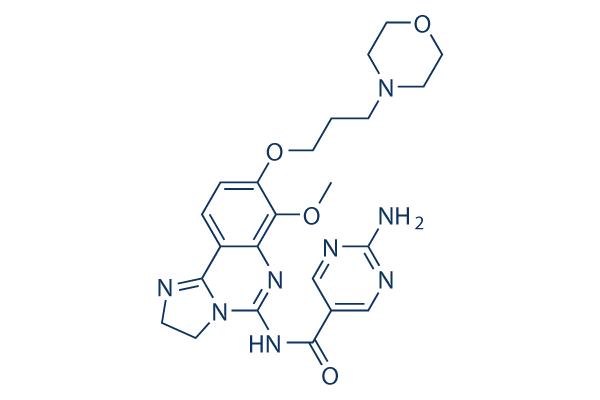
Estructura química
Peso molecular: 480.52
Control de calidad (Quality Control)
Productos que se suelen utilizar junto con Copanlisib (BAY 80-6946)
| Dianas relacionadas | Akt mTOR GSK-3 ATM/ATR DNA-PK AMPK PDPK1 PTEN PI4K PP2A |
|---|---|
| Otros PI3K Inhibidores | GDC-0077 (Inavolisib) SAR405 Quercetin (Sophoretin) LY294002 XL147 analogue Tersolisib (STX-478) Buparlisib (BKM120) 740 Y-P (PDGFR 740Y-P) GO-203 TFA Eganelisib (IPI-549) |
Cultivo celular, tratamiento y concentración de trabajo
(Cell Culture, Treatment & Working Concentration)
| Líneas celulares | Tipo de ensayo | Concentración | Tiempo de incubación | Formulación | Descripción de la actividad | PMID |
|---|---|---|---|---|---|---|
| Huh7 | Growth inhibiton assay | 100 nM | Copanlisib dose-dependently inhibited cell growth in vitro. IC50=47.9 nM. | 30962952 | ||
| HepG2 | Growth inhibiton assay | 100 nM | Copanlisib dose-dependently inhibited cell growth in vitro. IC50=31.6 nM. | 30962952 | ||
| Hep3B | Growth inhibiton assay | IC50=72.4 nM | 30962952 | |||
| PLCPRF5 | Growth inhibiton assay | IC50=283 nM | 30962952 | |||
| Chang | Growth inhibiton assay | IC50=442 nM | 30962952 | |||
| JVM-3 | Function assay | 48 h | inhibits metabolic activity with an IC50 of 2 μM in the XTT assay | 25912635 | ||
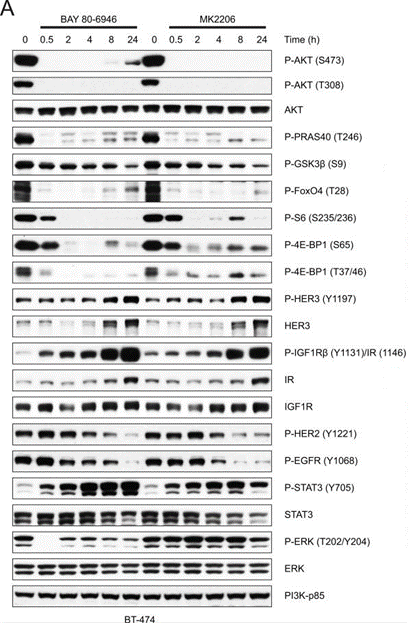
| BT-474 | Function assay | 50 nM | 0.5, 2, 4, 8, 24 h | rapidly inhibits the phosphorylation of AKT (S473, T308) as well as its direct substrates PRAS40 (T246) and GSK3β (S9), and inhibition was sustained for up to 24 hours | 24436048 | |
| SK-BR-3 | Function assay | 0, 1, 2, 4 h | downregulation of P-AKT | 24436048 | ||
| UACC-893 | Function assay | 0, 1, 2, 4 h | downregulation of P-AKT | 24436048 | ||
| HCC-1954 | Function assay | 0, 1, 2, 4 h | downregulation of P-AKT | 24436048 | ||
| MDA-MB-453 | Function assay | 0, 1, 2, 4 h | downregulation of P-AKT | 24436048 | ||
| MDA-MB-361 | Function assay | 0, 1, 2, 4 h | downregulation of P-AKT | 24436048 | ||
| BT-20 | Function assay | 0, 1, 2, 4 h | downregulation of P-AKT | 24436048 | ||
| MCF-7 | Function assay | 0, 1, 2, 4 h | downregulation of P-AKT | 24436048 | ||
| T-47D | Function assay | 0, 1, 2, 4 h | downregulation of P-AKT | 24436048 | ||
| HCC1806 | Function assay | 0, 1, 2, 4 h | downregulation of P-AKT | 24436048 | ||
| NCI-H292 | Function assay | 0, 1, 2, 4 h | downregulation of P-AKT | 24436048 | ||
| NCI-H1650 | Function assay | 0, 1, 2, 4 h | downregulation of P-AKT | 24436048 | ||
| CCRF-SB | Function assay | 0, 1, 2, 4 h | downregulation of P-AKT | 24436048 | ||
| U937 | Function assay | 0, 1, 2, 4 h | downregulation of P-AKT | 24436048 | ||
| SU-DHL-4 | Function assay | 0, 1, 2, 4 h | downregulation of P-AKT | 24436048 | ||
| SU-DHL-5 | Function assay | 0, 1, 2, 4 h | downregulation of P-AKT | 24436048 | ||
| HCT116 | Function assay | 0, 1, 2, 4 h | downregulation of P-AKT | 24436048 | ||
| A549 cells | Function assay | 0, 1, 2, 4 h | downregulation of P-AKT | 24436048 | ||
| SK-MEL-30 | Function assay | 0, 1, 2, 4 h | downregulation of P-AKT | 24436048 | ||
| SK-MEL-2 cells | Function assay | 0, 1, 2, 4 h | downregulation of P-AKT | 24436048 | ||
| NCI-H1703 | Function assay | 0, 1, 2, 4 h | downregulation of P-AKT | 24436048 | ||
| NCI-H661 | Function assay | 0, 1, 2, 4 h | downregulation of P-AKT | 24436048 | ||
| PC9 | Function assay | 0, 1, 2, 4 h | downregulation of P-AKT | 24436048 | ||
| TC32 | qHTS assay | qHTS of pediatric cancer cell lines to identify multiple opportunities for drug repurposing: Primary screen for TC32 cells | 29435139 | |||
| A673 | qHTS assay | qHTS of pediatric cancer cell lines to identify multiple opportunities for drug repurposing: Primary screen for A673 cells | 29435139 | |||
| Saos-2 | qHTS assay | qHTS of pediatric cancer cell lines to identify multiple opportunities for drug repurposing: Primary screen for Saos-2 cells | 29435139 | |||
| RD | qHTS assay | qHTS of pediatric cancer cell lines to identify multiple opportunities for drug repurposing: Primary screen for RD cells | 29435139 | |||
| MG 63 (6-TG R) | qHTS assay | qHTS of pediatric cancer cell lines to identify multiple opportunities for drug repurposing: Primary screen for MG 63 (6-TG R) cells | 29435139 | |||
| OHS-50 | qHTS assay | qHTS of pediatric cancer cell lines to identify multiple opportunities for drug repurposing: Primary screen for OHS-50 cells | 29435139 | |||
| LAN-5 | qHTS assay | qHTS of pediatric cancer cell lines to identify multiple opportunities for drug repurposing: Confirmatory screen for LAN-5 cells | 29435139 | |||
| NB-EBc1 | qHTS assay | qHTS of pediatric cancer cell lines to identify multiple opportunities for drug repurposing: Confirmatory screen for NB-EBc1 cells | 29435139 | |||
| SK-N-SH | qHTS assay | qHTS of pediatric cancer cell lines to identify multiple opportunities for drug repurposing: Confirmatory screen for SK-N-SH cells | 29435139 | |||
| Rh41 | qHTS assay | qHTS of pediatric cancer cell lines to identify multiple opportunities for drug repurposing: Primary screen for Rh41 cells | 29435139 | |||
| A673 | qHTS assay | qHTS of pediatric cancer cell lines to identify multiple opportunities for drug repurposing: Confirmatory screen for A673 cells) | 29435139 | |||
| BT-37 | qHTS assay | qHTS of pediatric cancer cell lines to identify multiple opportunities for drug repurposing: Confirmatory screen for BT-37 cells | 29435139 | |||
| MG 63 (6-TG R) | qHTS assay | qHTS of pediatric cancer cell lines to identify multiple opportunities for drug repurposing: Confirmatory screen for MG 63 (6-TG R) cells | 29435139 | |||
| Rh30 | qHTS assay | qHTS of pediatric cancer cell lines to identify multiple opportunities for drug repurposing: Confirmatory screen for Rh30 cells | 29435139 | |||
| OHS-50 | qHTS assay | qHTS of pediatric cancer cell lines to identify multiple opportunities for drug repurposing: Confirmatory screen for OHS-50 cells | 29435139 | |||
| SJ-GBM2 | qHTS assay | qHTS of pediatric cancer cell lines to identify multiple opportunities for drug repurposing: Primary screen for SJ-GBM2 cells | 29435139 | |||
| SK-N-MC | qHTS assay | qHTS of pediatric cancer cell lines to identify multiple opportunities for drug repurposing: Primary screen for SK-N-MC cells | 29435139 | |||
| NB-EBc1 | qHTS assay | qHTS of pediatric cancer cell lines to identify multiple opportunities for drug repurposing: Primary screen for NB-EBc1 cells | 29435139 | |||
| LAN-5 | qHTS assay | qHTS of pediatric cancer cell lines to identify multiple opportunities for drug repurposing: Primary screen for LAN-5 cells | 29435139 | |||
| Rh18 | qHTS assay | qHTS of pediatric cancer cell lines to identify multiple opportunities for drug repurposing: Primary screen for Rh18 cells | 29435139 | |||
| NB1643 | qHTS assay | qHTS of pediatric cancer cell lines to identify multiple opportunities for drug repurposing: Confirmatory screen for NB1643 cells | 29435139 | |||
| SK-N-MC | qHTS assay | qHTS of pediatric cancer cell lines to identify multiple opportunities for drug repurposing: Confirmatory screen for SK-N-MC cells | 29435139 | |||
| SJ-GBM2 | qHTS assay | qHTS of pediatric cancer cell lines to identify multiple opportunities for drug repurposing: Confirmatory screen for SJ-GBM2 cells | 29435139 | |||
| TC32 | qHTS assay | qHTS of pediatric cancer cell lines to identify multiple opportunities for drug repurposing: Confirmatory screen for TC32 cells | 29435139 | |||
| Rh18 | qHTS assay | qHTS of pediatric cancer cell lines to identify multiple opportunities for drug repurposing: Confirmatory screen for Rh18 cells | 29435139 | |||
| Saos-2 | qHTS assay | qHTS of pediatric cancer cell lines to identify multiple opportunities for drug repurposing: Confirmatory screen for Saos-2 cells | 29435139 | |||
| Haga clic para ver más datos experimentales de líneas celulares | ||||||
Información química, almacenamiento y estabilidad (Chemical Information, Storage & Stability)
| Peso molecular | 480.52 | Fórmula | C23H28N8O4 |
Almacenamiento (Desde la fecha de recepción) | |
|---|---|---|---|---|---|
| Nº CAS | 1032568-63-0 | Descargar SDF | Almacenamiento de soluciones madre |
|
|
| Sinónimos | BAY 80-6946 | Smiles | COC1=C(C=CC2=C3NCCN3C(=NC(=O)C4=CN=C(N=C4)N)N=C21)OCCCN5CCOCC5 | ||
Solubilidad (Solubility)
|
In vitro |
5%TFA : 8 mg/mL
DMSO
: Insoluble
Water : Insoluble |
Calculadora de Molaridad
|
In vivo |
|||||
Calculadora de formulación in vivo (Solución clara)
Paso 1: Introduzca la información a continuación (Recomendado: Un animal adicional para tener en cuenta la pérdida durante el experimento)
Paso 2: Introduzca la formulación in vivo (Esto es solo la calculadora, no la formulación. Por favor, contáctenos primero si no hay una formulación in vivo en la sección de Solubilidad.)
Resultados del cálculo:
Concentración de trabajo: mg/ml;
Método para preparar el líquido maestro de DMSO: mg fármaco predissuelto en μL DMSO ( Concentración del líquido maestro mg/mL, Por favor, contáctenos primero si la concentración excede la solubilidad del DMSO del lote del fármaco. )
Método para preparar la formulación in vivo: Tomar μL DMSO líquido maestro, luego añadirμL PEG300, mezclar y clarificar, luego añadirμL Tween 80, mezclar y clarificar, luego añadir μL ddH2O, mezclar y clarificar.
Método para preparar la formulación in vivo: Tomar μL DMSO líquido maestro, luego añadir μL Aceite de maíz, mezclar y clarificar.
Nota: 1. Por favor, asegúrese de que el líquido esté claro antes de añadir el siguiente disolvente.
2. Asegúrese de añadir el (los) disolvente(s) en orden. Debe asegurarse de que la solución obtenida, en la adición anterior, sea una solución clara antes de proceder a añadir el siguiente disolvente. Se pueden utilizar métodos físicos como el vórtice, el ultrasonido o el baño de agua caliente para ayudar a la disolución.
Mecanismo de acción (Mechanism of Action)
| Targets/IC50/Ki |
PI3Kα
(Cell-free assay) 0.5 nM
PI3Kδ
(Cell-free assay) 0.7 nM
PI3Kβ
(Cell-free assay) 3.7 nM
PI3Kγ
(Cell-free assay) 6.4 nM
|
|---|---|
| In vitro |
In both KPL4 cells and LPA-stimulated PC3 cells, BAY 80-6946 reduces pAKT levels. In a subset of human cancer cell lines with PIK3CA mutations and/or overexpression of HER2, BAY 80-6946 shows antiproliferative activity and induces apoptosis. [1] The combination of HER2-targeted therapies and BAY 80-6946 inhibits growth more effectively than either therapy used alone, and can restore sensitivity to trastuzumab and lapatinib in cells. [2] |
| Ensayo de quinasa |
Ensayos bioquímicos de lipid quinasas
|
|
El efecto de BAY 80-6946 sobre la actividad de PI3Kα, PI3Kβ y PI3Kγ se mide mediante la inhibición de la incorporación de 33P en el fosfatidilinositol (PI) en placas MaxiSorp® de 384 pocillos recubiertas con 2 µg/pocillo de PI y fosfatidilserina (PS) (relación molar 1:1). En cada ensayo de isoforma de PI3K, se utilizan 9 µL de tampón de reacción (50 mM MOPSO, pH 7.0, 100 mM NaCl, 4 mM MgCl2, 0.1% BSA) que contienen 7.5 ng de proteína p110α o p110β truncada en el N-terminal con etiqueta His, o 25 ng de proteína p110γ humana purificada. La reacción se inicia añadiendo 5 µL de una solución de ATP 40 µM que contiene 20 µCi/mL de [33P]-ATP. Después de 2 horas de incubación a temperatura ambiente, la reacción se termina añadiendo 5 µL de una solución de EDTA 25 mM. Las placas se lavan y luego se añaden 25 µL de cóctel de centelleo Ultima Gold™. La radioactividad incorporada en el sustrato de PI inmovilizado se determina con un contador de centelleo líquido BetaPlate.
|
|
| In vivo |
In rat KPL4 or HCT116 tumor xenograft model, BAY 80-6946 (6 mg/kg, i.v.) induces 100% complete tumor regression. In nude mice with Lu7860 erlotinib-resistant, patient-derived NSCLC and MAXF1398 patient-derived luminal breast tumor models, BAY 80-6946 (14 mg/kg, i.v.) also causes tumor growth inhibition. [1] |
Referencias |
|
Aplicaciones (Applications)
| Métodos | Biomarcadores | Imágenes | PMID |
|---|---|---|---|
| Western blot | p-FoxO4(T28) / p-S6(S235/236) / p-4E-BP1(S65) / p-4E-BP1(T37/46) / p-HER3(Y1197) / HER3 / p-IGF1Rβ/ IGF1R / p-HER2 / p-EGFR / p-STAT3 / p-ERK p-AKT / AKT / p-PRAS40(T246) / p-GSK3β(S9) / cleaved caspase-3 / cleaved caspase-7 / PI3K-p85 |
|
24436048 |
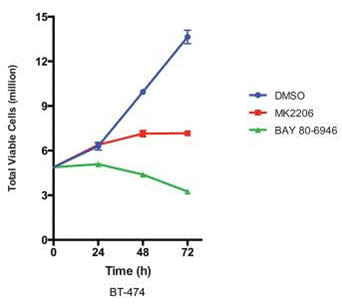
| Growth inhibition assay | Cell viability |
|
24436048 |
Información del ensayo clínico (Clinical Trial Information)
(datos de https://clinicaltrials.gov, actualizado el 2026-05-06)
| Número NCT | Reclutamiento | Condiciones | Patrocinador/Colaboradores | Fecha de inicio | Fases |
|---|---|---|---|---|---|
| NCT03474744 | ACTIVE_NOT_RECRUITING | Marginal Zone Lymphoma |
Christian Buske |
2019-12-15 | PHASE2 |
| NCT03502733 | ACTIVE_NOT_RECRUITING | Lymphoma; Metastatic Malignant Solid Neoplasm; Recurrent Malignant Solid Neoplasm; Unresectable Malignant Solid Neoplasm |
National Cancer Institute (NCI) |
2018-08-14 | PHASE1 |
| NCT04939272 | ACTIVE_NOT_RECRUITING | Recurrent Mantle Cell Lymphoma; Refractory Mantle Cell Lymphoma |
City of Hope Medical Center |
2022-06-29 | PHASE1; PHASE2 |
| NCT04253262 | ACTIVE_NOT_RECRUITING | Metastatic Castration-resistant Prostate Cancer |
Brown University |
2020-04-03 | PHASE1; PHASE2 |
| NCT06218667 | WITHDRAWN | Prostate Cancer |
Memorial Sloan Kettering Cancer Center |
2024-01-11 | PHASE1; PHASE2 |
| NCT02465060 | ACTIVE_NOT_RECRUITING | Advanced Lymphoma; Advanced Malignant Solid Neoplasm; Bladder Carcinoma; Breast Carcinoma; Cervical Carcinoma; Colon Carcinoma; Colorectal Carcinoma; Endometrial Carcinoma; Esophageal Carcinoma; Exocrine Pancreas Carcinoma; Gastric Carcinoma; Glioma; Head and Neck Carcinoma; Hematopoietic and Lymphoid Cell Neoplasm; Kidney Carcinoma; Liver Carcinoma; Lung Carcinoma; Lymphoma; Malignant Uterine Corpus Neoplasm; Malignant Uterine Neoplasm; Melanoma; Multiple Myeloma; Ovarian Carcinoma; Prostate Carcinoma; Rectal Carcinoma; Recurrent Bladder Carcinoma; Recurrent Breast Carcinoma; Recurrent Cervical Carcinoma; Recurrent Colon Carcinoma; Recurrent Colorectal Carcinoma; Recurrent Esophageal Carcinoma; Recurrent Gastric Carcinoma; Recurrent Glioma; Recurrent Head and Neck Carcinoma; Recurrent Liver Carcinoma; Recurrent Lung Carcinoma; Recurrent Lymphoma; Recurrent Malignant Solid Neoplasm; Recurrent Malignant Uterine Corpus Neoplasm; Recurrent Melanoma; Recurrent Multiple Myeloma; Recurrent Ovarian Carcinoma; Recurrent Pancreatic Carcinoma; Recurrent Prostate Carcinoma; Recurrent Rectal Carcinoma; Recurrent Skin Carcinoma; Recurrent Thyroid Gland Carcinoma; Refractory Lymphoma; Refractory Malignant Solid Neoplasm; Refractory Multiple Myeloma; Skin Carcinoma; Thyroid Gland Carcinoma |
National Cancer Institute (NCI) |
2015-08-17 | PHASE2 |

Los productos son solo para uso de investigación. No para uso humano. No vendemos a pacientes.
©Copyright 2013 Selleck Chemicals. Todos los derechos reservados.