
solo para uso en investigación
XL147 analogue PI3K Inhibidor
Cat. No.: S1118
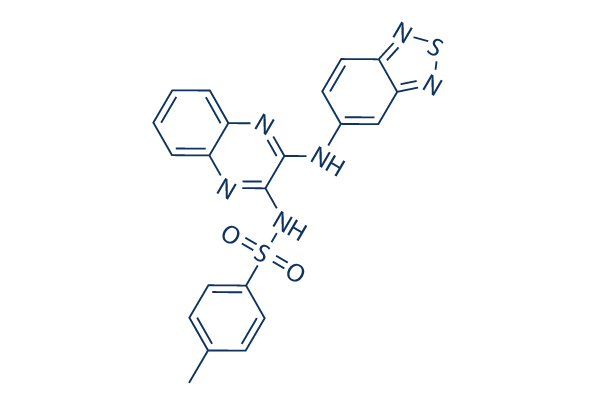
Estructura química
Peso molecular: 448.52
Control de calidad (Quality Control)
| Dianas relacionadas | Akt mTOR GSK-3 ATM/ATR DNA-PK AMPK PDPK1 PTEN PI4K PP2A |
|---|---|
| Otros PI3K Inhibidores | GDC-0077 (Inavolisib) SAR405 Quercetin (Sophoretin) LY294002 Tersolisib (STX-478) Buparlisib (BKM120) 740 Y-P (PDGFR 740Y-P) GO-203 TFA Eganelisib (IPI-549) Paxalisib (GDC-0084) |
Información química, almacenamiento y estabilidad (Chemical Information, Storage & Stability)
| Peso molecular | 448.52 | Fórmula | C21H16N6O2S2 |
Almacenamiento (Desde la fecha de recepción) | |
|---|---|---|---|---|---|
| Nº CAS | 956958-53-5 | Descargar SDF | Almacenamiento de soluciones madre |
|
|
| Sinónimos | SAR245408 | Smiles | CC1=CC=C(C=C1)S(=O)(=O)NC2=NC3=CC=CC=C3N=C2NC4=CC5=NSN=C5C=C4 | ||
Solubilidad (Solubility)
|
In vitro |
DMSO
: 3 mg/mL
(6.68 mM)
Water : Insoluble Ethanol : Insoluble |
Calculadora de Molaridad
|
In vivo |
|||||
Calculadora de formulación in vivo (Solución clara)
Paso 1: Introduzca la información a continuación (Recomendado: Un animal adicional para tener en cuenta la pérdida durante el experimento)
Paso 2: Introduzca la formulación in vivo (Esto es solo la calculadora, no la formulación. Por favor, contáctenos primero si no hay una formulación in vivo en la sección de Solubilidad.)
Resultados del cálculo:
Concentración de trabajo: mg/ml;
Método para preparar el líquido maestro de DMSO: mg fármaco predissuelto en μL DMSO ( Concentración del líquido maestro mg/mL, Por favor, contáctenos primero si la concentración excede la solubilidad del DMSO del lote del fármaco. )
Método para preparar la formulación in vivo: Tomar μL DMSO líquido maestro, luego añadirμL PEG300, mezclar y clarificar, luego añadirμL Tween 80, mezclar y clarificar, luego añadir μL ddH2O, mezclar y clarificar.
Método para preparar la formulación in vivo: Tomar μL DMSO líquido maestro, luego añadir μL Aceite de maíz, mezclar y clarificar.
Nota: 1. Por favor, asegúrese de que el líquido esté claro antes de añadir el siguiente disolvente.
2. Asegúrese de añadir el (los) disolvente(s) en orden. Debe asegurarse de que la solución obtenida, en la adición anterior, sea una solución clara antes de proceder a añadir el siguiente disolvente. Se pueden utilizar métodos físicos como el vórtice, el ultrasonido o el baño de agua caliente para ayudar a la disolución.
Mecanismo de acción (Mechanism of Action)
| Targets/IC50/Ki |
PI3Kγ
(Cell-free assay) 23 nM
PI3Kδ
(Cell-free assay) 36 nM
PI3Kα
(Cell-free assay) 39 nM
PI3Kβ
(Cell-free assay) 383 nM
|
|---|---|
| In vitro |
XL147 analogue inhibits class I PI3K isoforms in an ATP-competitive manner. In a panel of HER2-overexpressing human breast cancer cell lines, treatment with this compound abrogates AKT and S6 phosphorylation but also induces the expression and phosphorylation of HER3 and other RTKs. In HER2+ cells, phosphorylation of HER3 is maintained by the HER2 tyrosine kinase, leading to partial recovery of phosphorylated AKT (pAKT) and thereby limiting the antitumor action of this chemical. In addition, knockdown of HER3 or treatment with the anti-HER2 agents trastuzumab or lapatinib sensitizes HER2+ breast cancer cells to this agent in vitro and in vivo. Treatment with this inhibitor inhibits the monolayer growth of all tested cell lines, including BT474, HCC1937 et al. in a dose-dependent manner. The main effect of this compound is inhibition of cell proliferation. It induces cell death at the concentration of 20 μM. Treatment with this chemical leads to dose-dependent inhibition of PI3K. Consistent with the inhibition of cell proliferation, it induces a reduction in cyclin D1 and pRB and an increase in levels of the CDK inhibitor p27KIPI but no detectable change in levels off total or cleaved poly (ADP-ribose) polymerase (PARP). Treatment with this agent leads to a dose-dependent reduction in pAKTS473/T308 and pS6S240/244. Surprisingly, it also triggers up-regulation of total HER3 and/or pHER3Y1289 levels. In HER2-overexpressing cells, inhibition of PI3K is followed by up-regulation of expression and phosphorylation of multiple receptor tyrosine kinases, including HER3. Knockdown of FoxO1 and FoxO3a transcription factors prevents the induction of HER3, InsR, IGF1R, and FGFR2 mRNAs upon inhibition of PI3K. In HER2+ cells, knockdown of HER3 with siRNA or cotreatment with the HER2 inhibitors trastuzumab or lapatinib enhances XL147-induced cell death and inhibition of pAKT and pS6.
|
| In vivo |
Athymic mice with BT474 xenografts are randomly treated with XL147 analogue, lapatinib, trastuzumab, or this compound plus each HER2 antagonist. Each monotherapy significantly inhibtis tumor growth with trastuzumab being the only agent that induced a complete tumor regression in one of eight mice. Both combinations are superior to the respective drugs given alone. Notably, the combination of trastuzumab and this chemical, but not lapatinib and XL147, induces a complete tumor response in three of eight mice. There is no marked drug-related toxicity in any of the treatment arms. The combination of this compound plus trastuzumab prevents pHER3 more potently than any of the other treatments. In good agreement with differences in tumor growth among treatment arms, nuclear pAKT is lower in tumors treated with XL147 plus lapatinib or this chemical plus trastuzumab compared with tumors treated with single agents. Of all three single drugs, this compound is the only one shown statistically to repress nuclear pAKT levels. There are no detectable changes in cytoplasmic pAKT levels. Combined inhibition of HER2 and PI3K in HER2-dependent xenografts is required to maximally inhibit signaling output of the PI3K/AKT pathway.
|
Referencias |
|
Información del ensayo clínico (Clinical Trial Information)
(datos de https://clinicaltrials.gov, actualizado el 2024-05-22)
| Número NCT | Reclutamiento | Condiciones | Patrocinador/Colaboradores | Fecha de inicio | Fases |
|---|---|---|---|---|---|
| NCT01943838 | Completed | Neoplasm Malignant |
Sanofi |
2013-10 | Phase 1 |
| NCT01436565 | Completed | Solid Tumor Cancers |
Sanofi|Merrimack Pharmaceuticals |
2011-11 | Phase 1 |
| NCT01392924 | Completed | Neoplasm Malignant |
Sanofi |
2011-08 | Phase 1 |
| NCT01357330 | Completed | Solid Tumors |
Sanofi |
2011-05 | Phase 1 |
| NCT01240460 | Completed | Glioblastoma|Astrocytoma Grade IV |
Sanofi |
2011-01 | Phase 1 |

Los productos son solo para uso de investigación. No para uso humano. No vendemos a pacientes.
©Copyright 2013 Selleck Chemicals. Todos los derechos reservados.