
solo para uso en investigación
AICAR (Acadesine) AMPK activador
Cat. No.S1802
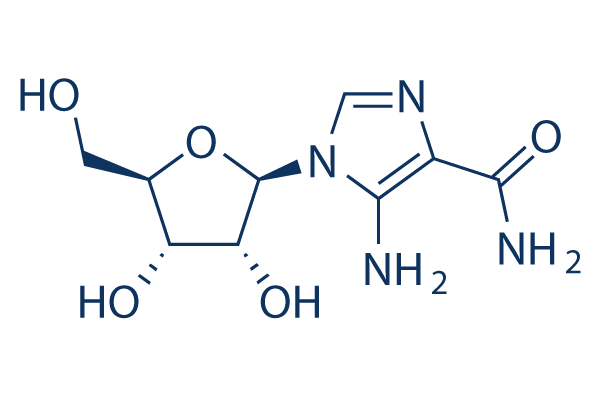
Estructura química
Peso molecular: 258.23
Control de calidad
Productos que se suelen utilizar junto con AICAR (Acadesine)
| Dianas relacionadas | PI3K Akt mTOR GSK-3 ATM/ATR DNA-PK PDPK1 PTEN PP2A PDK |
|---|---|
| Otros AMPK Inhibidores | Dorsomorphin Dihydrochloride Dorsomorphin (Compound C) A-769662 GSK621 WZ4003 Ex229 (Compound 991) Phenformin HCl BAY-3827 HTH-01-015 O-304 |
Cultivo celular, tratamiento y concentración de trabajo
| Líneas celulares | Tipo de ensayo | Concentración | Tiempo de incubación | Formulación | Descripción de la actividad | PMID |
|---|---|---|---|---|---|---|
| 3T3L1 | Function assay | 0.2 mM | 9 days | Increase in AMPKalpha Thr172 phosphorylation in mouse 3T3L1 cells at 0.2 mM after 9 days by Western blot method | 26088335 | |
| 3T3L1 | Function assay | 500 μM | 5 h | Activation of AMPK in mouse 3T3L1 cells assessed as AMPK phosphorylation at 500 uM after 5 hrs by Western blotting analysis | 25262940 | |
| C2C12 | Function assay | 1 mM | 1 hr | Activation of AMPK in mouse C2C12 cells assessed as increase in ACC phosphorylation at Ser79 residues at 1 mM after 1 hr by Western blot analysis | 27887844 | |
| 3T3L1 | Function assay | 2 mM | 4 hrs | Induction of AMPKalpha phosphorylation at Thr172 residue in mouse 3T3L1 cells at 2 mM after 4 hrs by Western blot analysis | 29425817 | |
| C2C12 | Function assay | 0.2 mM | 30 mins | Inhibition of PTP1B in differentiated mouse C2C12 cells assessed as upregulation of ACC phosphorylation at Ser-79 residue at 0.2 mM after 30 mins by Western blot assay | 28951079 | |
| RCC4 | Function assay | 1 mM | 48 hrs | Induction of autophagy in human RCC4 cells assessed as increase in LC3 conversion at 1 mM after 48 hrs by Western blot method | 28325600 | |
| 3T3L1 | Function assay | 0.2 mM | Inhibition of adipogenesis in mouse 3T3L1 cells assessed as reduction in triglyceride content at 0.2 mM by colorimetric assay | 26088335 | ||
| 3T3L1 | Function assay | 0.2 mM | 3 days | Reduction in SCD1 protein expression in mouse 3T3L1 cells at 0.2 mM after 3 days by Western blot method | 26088335 | |
| 3T3L1 | Function assay | 0.2 mM | 3 days | Reduction in SREBP-1c protein expression in mouse 3T3L1 cells at 0.2 mM after 3 days by Western blot method | 26088335 | |
| 3T3L1 | Function assay | 0.2 mM | 9 days | Activation of AMPK in mouse 3T3L1 cells assessed as increase in ACC Ser79 phosphorylation at 0.2 mM after 9 days by Western blot method | 26088335 | |
| 3T3L1 | Function assay | 0.2 mM | 3 days | Reduction in C/EBPalpha protein expression in mouse 3T3L1 cells at 0.2 mM after 3 days by Western blot method | 26088335 | |
| 3T3L1 | Function assay | 0.2 mM | 3 days | Reduction in PPARgamma protein expression in mouse 3T3L1 cells at 0.2 mM after 3 days by Western blot method | 26088335 | |
| 3T3L1 | Function assay | 0.2 mM | 3 days | Reduction in FAS protein expression in mouse 3T3L1 cells at 0.2 mM after 3 days by Western blot method | 26088335 | |
| Haga clic para ver más datos experimentales de líneas celulares | ||||||
Información química, almacenamiento y estabilidad
| Peso molecular | 258.23 | Fórmula | C9H14N4O5 |
Almacenamiento (Desde la fecha de recepción) | |
|---|---|---|---|---|---|
| Nº CAS | 2627-69-2 | Descargar SDF | Almacenamiento de soluciones madre |
|
|
| Sinónimos | NSC105823, AICA Riboside | Smiles | C1=NC(=C(N1C2C(C(C(O2)CO)O)O)N)C(=O)N | ||
Solubilidad
|
In vitro |
DMSO
: 51 mg/mL
(197.49 mM)
Water : 20 mg/mL Ethanol : Insoluble |
Calculadora de Molaridad
|
In vivo |
|||||
Calculadora de formulación in vivo (Solución clara)
Paso 1: Introduzca la información a continuación (Recomendado: Un animal adicional para tener en cuenta la pérdida durante el experimento)
Paso 2: Introduzca la formulación in vivo (Esto es solo la calculadora, no la formulación. Por favor, contáctenos primero si no hay una formulación in vivo en la sección de Solubilidad.)
Resultados del cálculo:
Concentración de trabajo: mg/ml;
Método para preparar el líquido maestro de DMSO: mg fármaco predissuelto en μL DMSO ( Concentración del líquido maestro mg/mL, Por favor, contáctenos primero si la concentración excede la solubilidad del DMSO del lote del fármaco. )
Método para preparar la formulación in vivo: Tomar μL DMSO líquido maestro, luego añadirμL PEG300, mezclar y clarificar, luego añadirμL Tween 80, mezclar y clarificar, luego añadir μL ddH2O, mezclar y clarificar.
Método para preparar la formulación in vivo: Tomar μL DMSO líquido maestro, luego añadir μL Aceite de maíz, mezclar y clarificar.
Nota: 1. Por favor, asegúrese de que el líquido esté claro antes de añadir el siguiente disolvente.
2. Asegúrese de añadir el (los) disolvente(s) en orden. Debe asegurarse de que la solución obtenida, en la adición anterior, sea una solución clara antes de proceder a añadir el siguiente disolvente. Se pueden utilizar métodos físicos como el vórtice, el ultrasonido o el baño de agua caliente para ayudar a la disolución.
Mecanismo de acción
| Características |
A potential first-in-class ARA.
|
|---|---|
| Targets/IC50/Ki |
AMPK
(Cell-free assay) AMPKK
(Cell-free assay) |
| In vitro |
La acadesina (500 μM) aumenta el contenido de ZMP en extractos de hepatocitos aislados después de un tratamiento de hasta 30-40 min, luego se mantiene bastante constante en aproximadamente 4 nmol/g. Este compuesto provoca una activación transitoria de 12 veces la AMPK a los 15 min en hepatocitos de rata y una activación de 2-3 veces la AMPK en adipocitos, sin afectar los niveles de ATP, ADP o AMP. También provoca una inhibición drástica tanto de la síntesis de ácidos grasos como de esteroles en hepatocitos de rata, así como una inactivación drástica de la HMG-CoA reductasa. AICAR induce la apoptosis de células B-CLL de manera dosis-dependiente con una EC50 de 380 μM. A 0,5 mM, disminuye la viabilidad celular de las células B-CLL de 20 pacientes representativos del 68% al 26%, e induce la activación de caspasas y la liberación de citocromo c de las mitocondrias. La captación y fosforilación del compuesto son necesarias para inducir la apoptosis y activar la AMPK en las células B-CLL. Mientras que concentraciones de 2-4 mM solo afectan ligeramente la viabilidad de las células T de pacientes con B-CLL, 0,5 mM reduce notablemente la viabilidad de las células B, pero no de las células T. Desencadena la pérdida del metabolismo celular en K562, LAMA-84 y JURL-MK1 y también es eficaz para matar células K562 resistentes y células Ba/F3 que portan la mutación T315I-BCR-ABL. El efecto de AICAR es abrogado por GF109203X y Ro-32-0432, ambos inhibidores de PKCs clásicas y nuevas y, en consecuencia, desencadena la reubicación y activación de varias isoformas de PKC en células K562. El compuesto inhibe la formación de colonias K562 de forma dosis-dependiente en el día 10, el efecto inhibidor del crecimiento ya se detecta a 0,25 mM y es máximo a 2,5 mM. AICAR provoca una reducción relacionada con la concentración en la expresión de CD18 en neutrófilos estimulados con LPS in vitro. Inhibe significativamente (1 mM) la regulación positiva de CD11b de granulocitos inducida por N-formil-metionil-leucil-fenilalanina en una media del 61% en sangre. |
| In vivo |
La acadesina (50 mg/kg) reduce significativamente la formación de tumores en un modelo de xenoinjerto de ratón de células K562. A 10 mg/kg, este compuesto da como resultado una mayor cantidad de líquido necesario para estabilizar la hemodinámica en cerdos e inhibe la permeabilidad proteica de los capilares pulmonares inducida por LPS, las presiones inspiratorias máximas a volumen corriente constante y la ventilación del espacio muerto. |
Referencias |
|
Aplicaciones
| Métodos | Biomarcadores | Imágenes | PMID |
|---|---|---|---|
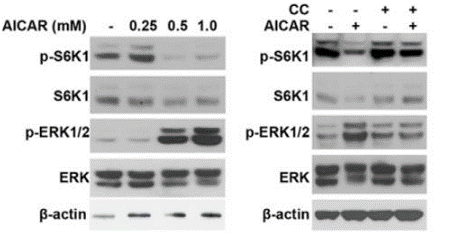
| Western blot | p-S6K1 / S6K1 / p-ERK / ERK p-IRS-1 / IRS-1 / p-AKT / AKT p-AMPK / p-ACC / p-eNOS / eNOS / vWF / VE-cadherin / ICAM-1 Cyclin D1 / p21 / p53 |
|
26528831 |
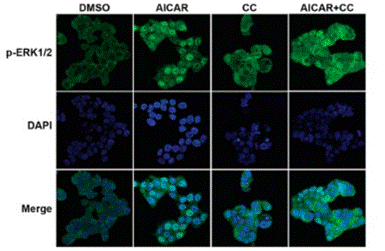
| Immunofluorescence | p-ERK YAZ / TAZ |
|
26528831 |
Soporte técnico
Tel: +1-832-582-8158 Ext:3
Si tiene alguna otra consulta, por favor deje un mensaje.

Los productos son solo para uso de investigación. No para uso humano. No vendemos a pacientes.
©Copyright 2013 Selleck Chemicals. Todos los derechos reservados.