
solo para uso en investigación
Trifluridine (NSC 75520) Thymidylate Synthase inhibidor
Cat. No.S1778
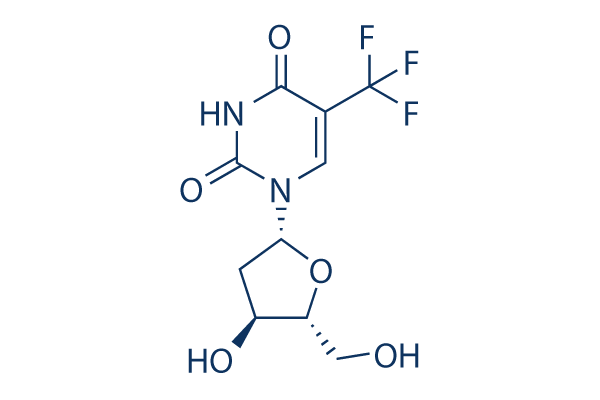
Estructura química
Peso molecular: 296.2
Control de calidad
| Dianas relacionadas | HDAC PARP ATM/ATR DNA-PK WRN DNA/RNA Synthesis Topoisomerase PPAR Sirtuin Casein Kinase |
|---|---|
| Otros Thymidylate Synthase Inhibidores | Raltitrexed |
Información química, almacenamiento y estabilidad
| Peso molecular | 296.2 | Fórmula | C10H11F3N2O5 |
Almacenamiento (Desde la fecha de recepción) | |
|---|---|---|---|---|---|
| Nº CAS | 70-00-8 | Descargar SDF | Almacenamiento de soluciones madre |
|
|
| Sinónimos | NSC 529182, NSC 75520, Viroptic, Trifluorothymidine, TFT | Smiles | C1C(C(OC1N2C=C(C(=O)NC2=O)C(F)(F)F)CO)O | ||
Solubilidad
|
In vitro |
DMSO
: 59 mg/mL
(199.18 mM)
Water : 59 mg/mL Ethanol : 59 mg/mL |
Calculadora de Molaridad
|
In vivo |
|||||
Calculadora de formulación in vivo (Solución clara)
Paso 1: Introduzca la información a continuación (Recomendado: Un animal adicional para tener en cuenta la pérdida durante el experimento)
Paso 2: Introduzca la formulación in vivo (Esto es solo la calculadora, no la formulación. Por favor, contáctenos primero si no hay una formulación in vivo en la sección de Solubilidad.)
Resultados del cálculo:
Concentración de trabajo: mg/ml;
Método para preparar el líquido maestro de DMSO: mg fármaco predissuelto en μL DMSO ( Concentración del líquido maestro mg/mL, Por favor, contáctenos primero si la concentración excede la solubilidad del DMSO del lote del fármaco. )
Método para preparar la formulación in vivo: Tomar μL DMSO líquido maestro, luego añadirμL PEG300, mezclar y clarificar, luego añadirμL Tween 80, mezclar y clarificar, luego añadir μL ddH2O, mezclar y clarificar.
Método para preparar la formulación in vivo: Tomar μL DMSO líquido maestro, luego añadir μL Aceite de maíz, mezclar y clarificar.
Nota: 1. Por favor, asegúrese de que el líquido esté claro antes de añadir el siguiente disolvente.
2. Asegúrese de añadir el (los) disolvente(s) en orden. Debe asegurarse de que la solución obtenida, en la adición anterior, sea una solución clara antes de proceder a añadir el siguiente disolvente. Se pueden utilizar métodos físicos como el vórtice, el ultrasonido o el baño de agua caliente para ayudar a la disolución.
Mecanismo de acción
| Targets/IC50/Ki |
DNA synthesis
|
|---|---|
| In vitro |
Trifluridine (NSC 75520) inhibe las proliferaciones de células de médula ósea de ratón y células de carcinoma colorrectal humano implantadas en ratones nude de forma dosis-dependiente. También inhibe la formación de colonias de células de médula ósea de forma concentración-dependiente. Este compuesto y la 2'-desoxi-5-fluorouridina (FdUrd) se incorporan al ADN con diferentes eficiencias debido a las diferencias en las especificidades de sustrato de TK1 y DUT, causando una abundante incorporación de FTD al ADN. Las células tratadas con FTD muestran morfologías nucleares diferentes en comparación con las células tratadas con FdUrd. Además, inhibe las proliferaciones de células de médula ósea de ratón y células de carcinoma colorrectal humano implantadas en ratones nude de forma dosis-dependiente.
|
| In vivo |
Trifluridine (NSC 75520) tiene significativamente menos hisopos positivos para HSV-1 que los ojos no tratados en los conejos infectados. Este compuesto ha aumentado la actividad antitumoral y se incorpora al ADN de manera más efectiva que la Trifluridine infundida continuamente en ratones. Se acumula gradualmente en el ADN de las células tumorales, de manera independiente de TPI, y retrasa significativamente el crecimiento tumoral y prolonga la supervivencia en ratones, en comparación con el tratamiento con derivados de 5-FU. Además, resulta en títulos virales significativamente más bajos, menos ojos positivos para HSV-1/total durante el período de tratamiento, puntuaciones de queratitis más bajas, menos ojos con queratitis/total y un tiempo más corto hasta la resolución de la queratitis en el modelo ocular de conejo de Nueva Zelanda.
|
Referencias |
|
Información del ensayo clínico
(datos de https://clinicaltrials.gov, actualizado el 2024-05-22)
| Número NCT | Reclutamiento | Condiciones | Patrocinador/Colaboradores | Fecha de inicio | Fases |
|---|---|---|---|---|---|
| NCT06039202 | Not yet recruiting | Metastatic Colorectal Cancer |
Holy Stone Healthcare Co. Ltd |
January 2024 | Phase 2 |
| NCT04944017 | Recruiting | Parkinson''s Disease|Depression |
Yale University|Fox (Michael J.) Foundation for Parkinson''s Research |
November 23 2021 | Phase 2 |
| NCT04554836 | Active not recruiting | Adenocarcinoma of the Colon|Adenocarcinoma of the Rectum |
TheraOp |
December 29 2020 | Phase 2 |
| NCT04166604 | Active not recruiting | Metastatic Colorectal Cancer |
GERCOR - Multidisciplinary Oncology Cooperative Group |
May 20 2020 | Phase 2 |
Soporte técnico
Tel: +1-832-582-8158 Ext:3
Si tiene alguna otra consulta, por favor deje un mensaje.

Los productos son solo para uso de investigación. No para uso humano. No vendemos a pacientes.
©Copyright 2013 Selleck Chemicals. Todos los derechos reservados.