
solo para uso en investigación
Torkinib (PP242) mTOR inhibidor
Cat. No.S2218
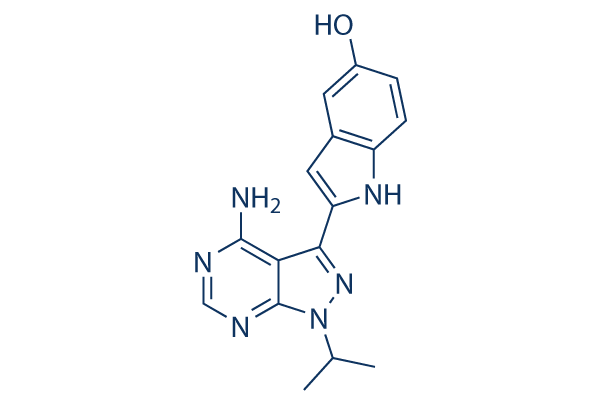
Estructura química
Peso molecular: 308.34
Control de calidad
| Dianas relacionadas | PI3K Akt GSK-3 ATM/ATR DNA-PK AMPK PDPK1 PTEN PP2A PDK |
|---|---|
| Otros mTOR Inhibidores | Torin 1 Torin 2 AZD8055 Ridaforolimus (Deforolimus, MK-8669) Sapanisertib (MLN0128, INK-128) MHY1485 Vistusertib (AZD2014) KU-0063794 OSI-027 WYE-354 |
Cultivo celular, tratamiento y concentración de trabajo
| Líneas celulares | Tipo de ensayo | Concentración | Tiempo de incubación | Formulación | Descripción de la actividad | PMID |
|---|---|---|---|---|---|---|
| HT-p21 | Function Assay | 50-1250 nM | 24 h | DMSO | inhibits phosphorylation of S6 kinase (target of mTORC1) and its downstream target phospho-S6 | |
| U87vIII | Function Assay | 0.04-2.5 μM | 24 h | inhibits mTORC1 and mTORC2 activities | ||
| U87vIII | Function Assay | 2.5/5 μM | 12 h | inhibits gap closing in a dose-dependent manner | ||
| PC12 | Function Assay | 40 nM | induces lysosomal biogenesis and alleviated α-SYN accumulation | |||
| 3T3-L1 | Function Assay | 15 μM | 4 h | suppresses expression of the Egr1 protein | ||
| Rh30 | Function Assay | 1 μM | 2 h | inhibits both mTORC1-mediated phosphorylation of S6K1 and mTORC2-mediated phosphorylation of Akt | ||
| HT29 | Function Assay | 1 μM | 2 h | inhibits both mTORC1-mediated phosphorylation of S6K1 and mTORC2-mediated phosphorylation of Akt | ||
| Rh30 | Function Assay | 1 μM | 2 h | suppresses the basal or IGF-1-stimulated cell adhesion | ||
| HT29 | Function Assay | 1 μM | 2 h | suppresses the basal or IGF-1-stimulated cell adhesion | ||
| U87 | Growth Inhibition Assay | 25 nM | 24 h | increases DUSP10 knocked-down induced cell inhibition | ||
| AGS | Cell Viability Assay | 0-1000 nM | 24/48 h | DMSO | decreases cell viability in time and dose dependent manner | |
| MKN45 | Cell Viability Assay | 0-1000 nM | 24/48 h | DMSO | decreases cell viability in time and dose dependent manner | |
| MKN28 | Cell Viability Assay | 0-1000 nM | 24/48 h | DMSO | decreases cell viability in time and dose dependent manner | |
| KATO3 | Cell Viability Assay | 0-1000 nM | 24/48 h | DMSO | decreases cell viability in time and dose dependent manner | |
| SGC7901 | Cell Viability Assay | 0-1000 nM | 24/48 h | DMSO | decreases cell viability in time and dose dependent manner | |
| N87 | Cell Viability Assay | 0-1000 nM | 24/48 h | DMSO | decreases cell viability in time and dose dependent manner | |
| HMEC | Cell Viability Assay | 0-1000 nM | 24/48 h | DMSO | decreases cell viability in time and dose dependent manner | |
| HUVEC | Cell Viability Assay | 0-1000 nM | 24/48 h | DMSO | decreases cell viability in time and dose dependent manner | |
| MG63 | Function Assay | 50-1000 nM | 0.5 h | dose dependently (50–1000 nM) inhibits phosphorylation of Akt | ||
| U2OS | Function Assay | 50-1000 nM | 0.5 h | dose dependently (50–1000 nM) inhibits phosphorylation of Akt | ||
| Saos-2 | Function Assay | 50-1000 nM | 0.5 h | dose dependently (50–1000 nM) inhibits phosphorylation of Akt | ||
| Saos-2 | Function Assay | 100 nM | 0.5 h | prevents osteosarcoma cell migration | ||
| MG63 | Apoptosis Assay | 100 nM | 36 h | promotes apoptosis | ||
| U2OS | Apoptosis Assay | 100 nM | 36 h | promotes apoptosis | ||
| Saos-2 | Apoptosis Assay | 100 nM | 36 h | promotes apoptosis | ||
| HT1376 | Growth Inhibition Assay | IC50=1.88 ± 1.1 μM | ||||
| T24 | Growth Inhibition Assay | IC50=1.37 ± 0.4 μM | ||||
| UM-UC-3 | Growth Inhibition Assay | IC50=0.63 ±0.1 μM | ||||
| DLD-1 | Cell Viability Assay | 0-1000 nM | 24 h | inhibits the growth in a dose-dependent manner | ||
| Caco2 | Cell Viability Assay | 0-1000 nM | 24 h | inhibits the growth in a dose-dependent manner | ||
| HT29 | Cell Viability Assay | 0-1000 nM | 24 h | inhibits the growth in a dose-dependent manner | ||
| H116 | Cell Viability Assay | 0-1000 nM | 24 h | inhibits the growth in a dose-dependent manner | ||
| Hct-8 | Cell Viability Assay | 0-1000 nM | 24 h | inhibits the growth in a dose-dependent manner | ||
| Colo320 | Cell Viability Assay | 0-1000 nM | 24 h | inhibits the growth in a dose-dependent manner | ||
| Sw948 | Cell Viability Assay | 0-1000 nM | 24 h | inhibits the growth in a dose-dependent manner | ||
| Colo205 | Cell Viability Assay | 0-1000 nM | 24 h | inhibits the growth in a dose-dependent manner | ||
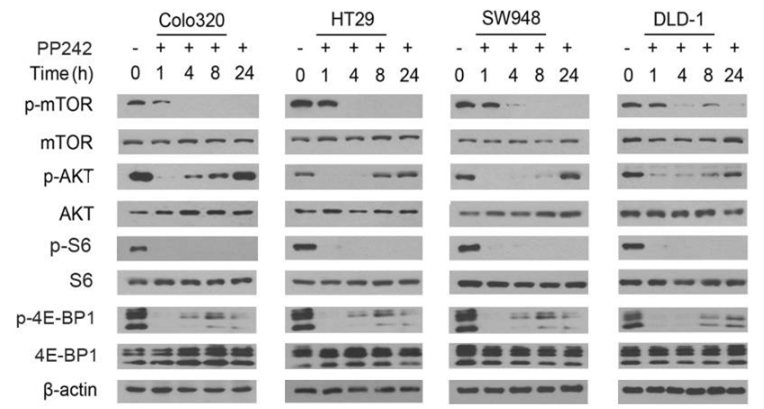
| Colo320 | Function Assay | 1 μM | 0-24 h | abolishes the S6S235/236 but partially reduces the 4E-BP1T36/45 | ||
| HT29 | Function Assay | 1 μM | 0-24 h | abolishes the S6S235/236 but partially reduces the 4E-BP1T36/45 | ||
| Sw948 | Function Assay | 1 μM | 0-24 h | abolishes the S6S235/236 but partially reduces the 4E-BP1T36/45 | ||
| DLD-1 | Function Assay | 1 μM | 0-24 h | abolishes the S6S235/236 but partially reduces the 4E-BP1T36/45 | ||
| SW620 | Growth Inhibition Assay | IC50=7.8 μM | ||||
| SW480 | Growth Inhibition Assay | IC50=4.6 μM | ||||
| SK-CO-1 | Growth Inhibition Assay | IC50=4 μM | ||||
| LS-513 | Growth Inhibition Assay | IC50=3.9 μM | ||||
| SW1116 | Growth Inhibition Assay | IC50=0.84 μM | ||||
| LS-174T | Growth Inhibition Assay | IC50=0.84 μM | ||||
| HCT 116 | Growth Inhibition Assay | IC50=0.41 μM | ||||
| HCT 15 | Growth Inhibition Assay | IC50=0.3 μM | ||||
| COLO 205 | Growth Inhibition Assay | IC50=0.24 μM | ||||
| HT-29 | Growth Inhibition Assay | IC50=0.23 μM | ||||
| COLO 201 | Growth Inhibition Assay | IC50=0.23 μM | ||||
| Caco-2 | Growth Inhibition Assay | IC50=0.22 μM | ||||
| SW48 | Growth Inhibition Assay | IC50=0.09 μM | ||||
| DND-1 | Growth Inhibition Assay | 0.25/0.5/1 μM | DMSO | inhibits cell growth dose dependently | ||
| TMD8 | Growth Inhibition Assay | 0.25/0.5/1 μM | DMSO | inhibits cell growth dose dependently | ||
| Jurkat | Growth Inhibition Assay | 0.25/0.5/1 μM | DMSO | inhibits cell growth dose dependently | ||
| KOPT-K1 | Growth Inhibition Assay | 0.25/0.5/1 μM | DMSO | inhibits cell growth dose dependently | ||
| TMD7 | Growth Inhibition Assay | 0.25/0.5/1 μM | DMSO | inhibits cell growth dose dependently | ||
| THP-1 | Growth Inhibition Assay | 0.25/0.5/1 μM | DMSO | inhibits cell growth dose dependently | ||
| 786-O | Function Assay | 0.1/0.5 μM | 24 h | DMSO | increases E-cadherin mRNA levels dose dependently | |
| 786-O | Function Assay | 0-0.5 μM | 24 h | DMSO | results in a dose dependent increase in E-cadherin protein expression | |
| OCI-AML3 | Apoptosis Assay | 2.5 μM | 72 h | induces apoptosis | ||
| Jurkat | Function Assay | 100/200/400 nM | 18 h | inhibits mTORC1-dependent S6 S235/236 phosphorylation | ||
| p210 BCR-Abl | Function Assay | 100/200/400 nM | 18 h | inhibits mTORC1-dependent S6 S235/236 phosphorylation | ||
| Jurkat | Growth Inhibition Assay | 400nM | 24/48 h | synergize with 17-AAG to suppress cell proliferation | ||
| p210 BCR-Abl | Growth Inhibition Assay | 400nM | 24/48 h | synergize with 17-AAG to suppress cell proliferation | ||
| 8226 | Function Assay | 100-1000 nM | 30 min | DMSO | activates ERK | |
| MM1.S | Function Assay | 100-1000 nM | 30 min | DMSO | activates ERK | |
| 8226 | Function Assay | 0.5 μM | 30 min | DMSO | induces activation of RAF and phosphorylation of MEK | |
| MM1.S | Function Assay | 0.5 μM | 30 min | DMSO | induces activation of RAF and phosphorylation of MEK | |
| MCF-7 | Function Assay | 50/200/500 nM | 30 min | dose-dependently (50–500 nM) suppresses phosphorylation of Akt | ||
| T47D | Function Assay | 50/200/500 nM | 30 min | dose-dependently (50–500 nM) suppresses phosphorylation of Akt | ||
| MDA-MB-231 | Function Assay | 50/200/500 nM | 30 min | dose-dependently (50–500 nM) suppresses phosphorylation of Akt | ||
| Bcap-37 | Function Assay | 50/200/500 nM | 30 min | dose-dependently (50–500 nM) suppresses phosphorylation of Akt | ||
| MCF-7 | Apoptosis Assay | 200 nM | 36 h | DMSO | induces apoptosis | |
| MDA-MB-231 | Apoptosis Assay | 200 nM | 36 h | DMSO | induces apoptosis | |
| Bcap-37 | Apoptosis Assay | 200 nM | 36 h | DMSO | induces apoptosis | |
| LS174T | Function Assay | 10/100/1000 nM | 6 h | DMSO | inhibits mTORC1 activity by the dephosphorylation of S6 ribosomal protein | |
| DLD-1 | Function Assay | 10/100/1000 nM | 6 h | DMSO | inhibits mTORC1 activity by the dephosphorylation of S6 ribosomal protein | |
| SW480 | Function Assay | 10/100/1000 nM | 6 h | DMSO | inhibits mTORC1 activity by the dephosphorylation of S6 ribosomal protein | |
| SW-48 | Growth Inhibition Assay | IC50=0.1 μM | ||||
| HCT-15 | Growth Inhibition Assay | IC50=0.3 μM | ||||
| HCT 116 | Growth Inhibition Assay | IC50=0.6 μM | ||||
| SW620-R | Growth Inhibition Assay | IC50=1.3 μM | ||||
| SK-CO-1 | Growth Inhibition Assay | IC50=2.1 μM | ||||
| SW620 | Growth Inhibition Assay | IC50=11 μM | ||||
| BaF3 | Growth Inhibition Assay | GI50=1.449 μM | ||||
| NIH 3T3 | Function Assay | 2 μM | 18 h | inhibits mTORC2 phosphorylation of Akt on Ser473 and mTORC1 phosphorylation of 4E-BP1 on Thr37/46 | ||
| HCT15 | Function Assay | 0.5/2 μM | 4 h | prevents S6K1 phosphorylation of ribosomal protein S6 at Ser240/244 and mTORC2 phosphorylation of Akt at Ser473 | ||
| SW620 | Function Assay | 0.5/2 μM | 4 h | blocks all three mTOR outputs | ||
| Haga clic para ver más datos experimentales de líneas celulares | ||||||
Información química, almacenamiento y estabilidad
| Peso molecular | 308.34 | Fórmula | C16H16N6O |
Almacenamiento (Desde la fecha de recepción) | |
|---|---|---|---|---|---|
| Nº CAS | 1092351-67-1 | Descargar SDF | Almacenamiento de soluciones madre |
|
|
| Sinónimos | N/A | Smiles | CC(C)N1C2=NC=NC(=C2C(=N1)C3=CC4=C(N3)C=CC(=C4)O)N | ||
Solubilidad
|
In vitro |
DMSO
: 61 mg/mL
(197.83 mM)
Water : Insoluble Ethanol : Insoluble |
Calculadora de Molaridad
|
In vivo |
|||||
Calculadora de formulación in vivo (Solución clara)
Paso 1: Introduzca la información a continuación (Recomendado: Un animal adicional para tener en cuenta la pérdida durante el experimento)
Paso 2: Introduzca la formulación in vivo (Esto es solo la calculadora, no la formulación. Por favor, contáctenos primero si no hay una formulación in vivo en la sección de Solubilidad.)
Resultados del cálculo:
Concentración de trabajo: mg/ml;
Método para preparar el líquido maestro de DMSO: mg fármaco predissuelto en μL DMSO ( Concentración del líquido maestro mg/mL, Por favor, contáctenos primero si la concentración excede la solubilidad del DMSO del lote del fármaco. )
Método para preparar la formulación in vivo: Tomar μL DMSO líquido maestro, luego añadirμL PEG300, mezclar y clarificar, luego añadirμL Tween 80, mezclar y clarificar, luego añadir μL ddH2O, mezclar y clarificar.
Método para preparar la formulación in vivo: Tomar μL DMSO líquido maestro, luego añadir μL Aceite de maíz, mezclar y clarificar.
Nota: 1. Por favor, asegúrese de que el líquido esté claro antes de añadir el siguiente disolvente.
2. Asegúrese de añadir el (los) disolvente(s) en orden. Debe asegurarse de que la solución obtenida, en la adición anterior, sea una solución clara antes de proceder a añadir el siguiente disolvente. Se pueden utilizar métodos físicos como el vórtice, el ultrasonido o el baño de agua caliente para ayudar a la disolución.
Mecanismo de acción
| Características |
One of the first selective inhibitors that targets ATP domain of mTOR.
|
|---|---|
| Targets/IC50/Ki |
mTOR
(Cell-free assay) 8 nM
p110δ
(Cell-free assay) 0.10 μM
DNA-PK
(Cell-free assay) 0.41 μM
PDGFR
(Cell-free assay) 0.41 μM
|
| In vitro |
PP242 exhibe una potente selectividad para mTOR sobre otras quinasas de la familia PI3K como p110α, p110β, p110γ, p110δ y DNA-PK con IC50 de 1,96 μM, 2,2 μM, 1,27 μM, 0,102 μM y 0,408 μM, respectivamente. Este compuesto muestra cierta actividad inhibidora contra Ret, PKCα, PKCβ y JAK2, mientras que exhibe una notable selectividad contra otras 215 proteínas quinasas. A diferencia de la rapamicina, este inhibidor inhibe tanto mTORC1 como mTORC2. En células BT549, este tratamiento químico (0,04-10 μM) inhibe la fosforilación de Akt, el sustrato de mTOR p70S6K y su objetivo descendente S6 de una manera dependiente de la dosis. Inhibe potentemente la PKCα con un IC50 de 49 nM. Bajas concentraciones de este compuesto inhiben la fosforilación de Akt S473 y concentraciones más altas inhiben parcialmente Akt T308-P además de S473-P. Como este agente es un inhibidor de mTORC1 más efectivo que la rapamicina, inhibe la proliferación de MEF primarios y la fosforilación de 4EBP1 en T36/45 y S65, más potentemente que la rapamicina. Este compuesto, pero no la rapamicina, inhibe potentemente la traducción dependiente de la caperuza, al causar un mayor nivel de unión entre 4EBP1 y eIF4E que la rapamicina. Inhibe potentemente la proliferación de células de médula ósea murina transformadas con p190, SUP-B15 y K562 con GI50 de 12 nM, 90 nM y 85 nM, respectivamente. Este inhibidor también inhibe el crecimiento de líneas celulares de tumores sólidos como SKOV3, PC3, 786-O y U87 con GI50 de 0,49 μM, 0,19 μM, 2,13 μM y 1,57 μM, respectivamente. También es más eficaz que la rapamicina para lograr la citoreducción y la apoptosis en células de mieloma múltiple (MM).
|
| Ensayo de quinasa |
Ensayo de quinasa mTOR (FRAP1) in vitro
|
|
mTOR recombinante se incuba con este compuesto en diluciones de 2 veces en un rango de concentración de 50-0,001 μM en un ensayo que contiene 50 mM HEPES, pH 7,5, 1 mM EGTA, 10 mM MgCl2, 0,01 % Tween, 10 μM ATP (2,5 μCi de γ-32P-ATP) y 3 μg/mL de BSA. Se utiliza PHAS-1/4EBP1 recombinante de rata (2 mg/mL) como sustrato. Las reacciones se terminan por goteo sobre nitrocelulosa, que se lava con 1 M NaCl/1 % de ácido fosfórico (aproximadamente 6 veces, 5-10 minutos cada una). Las hojas se secan y la radioactividad transferida se cuantifica mediante fosforimágenes. El valor de IC50 se calcula ajustando los datos a una curva de dosis-respuesta sigmoidal utilizando el paquete de software Prism.
|
|
| In vivo |
La administración de PP242 es capaz de inhibir completamente la fosforilación de Akt en S473 y T308 en la grasa y el hígado de ratones. Este compuesto solo inhibe parcialmente la fosforilación de Akt en el músculo esquelético y es más eficaz para inhibir la fosforilación de T308 que la de S473, a pesar de ser capaz de inhibir completamente la fosforilación de 4EBP1 y S6. La administración oral de este químico retrasa potentemente el inicio de la leucemia en el modelo de ratones e induce la regresión de la leucemia al inhibir la activación de mTORC2 y mTORC1, lo que se correlaciona con la pérdida del tamaño celular. Este tratamiento inhibe potentemente el crecimiento de células 8226 en ratones.
|
Referencias |
|
Aplicaciones
| Métodos | Biomarcadores | Imágenes | PMID |
|---|---|---|---|
| Western blot | p-mTOR / mTOR / p-AKT / AKT / p-S6 / S6 / p-4E-BP1 / 4E-BP-1 |
|
23991179 |
| Growth inhibition assay | Cell viability |

|
23991179 |
Soporte técnico
Tel: +1-832-582-8158 Ext:3
Si tiene alguna otra consulta, por favor deje un mensaje.
Preguntas frecuentes
Pregunta 1:
Do you have any suggestions about potential candidates for vehicles that we could use for in vivo studies of it?
Respuesta:
In the recommended solvent (30% PEG400 + 0.5% Tween80 + 5% Propylene glycol), it is a suspension, and this formulation is for oral gavage. For IV injection, this compound can be dissolved in 2% DMSO+30% PEG 300+5% Tween 80+ddH2O at 5mg/ml as a clear solution.

Los productos son solo para uso de investigación. No para uso humano. No vendemos a pacientes.
©Copyright 2013 Selleck Chemicals. Todos los derechos reservados.