
solo para uso en investigación
KU-0063794 mTOR inhibidor
Cat. No.S1226
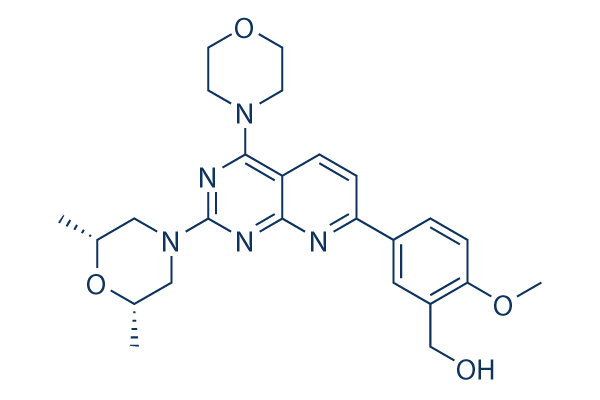
Estructura química
Peso molecular: 465.54
Control de calidad
| Dianas relacionadas | PI3K Akt GSK-3 ATM/ATR DNA-PK AMPK PDPK1 PTEN PP2A PDK |
|---|---|
| Otros mTOR Inhibidores | Torin 1 Torin 2 AZD8055 Ridaforolimus (Deforolimus, MK-8669) Sapanisertib (MLN0128, INK-128) Torkinib (PP242) MHY1485 Vistusertib (AZD2014) OSI-027 WYE-354 |
Cultivo celular, tratamiento y concentración de trabajo
| Líneas celulares | Tipo de ensayo | Concentración | Tiempo de incubación | Formulación | Descripción de la actividad | PMID |
|---|---|---|---|---|---|---|
| HepG2 | Cell Viability Assay | 0.1–50 μM | 72 h | decreases cell viability in a dose dependent manner | 26278819 | |
| HepG2 | Colony Formation Assay | 1–50 μM | 10 d | decreases the number of viable HepG2 colonies significantly | 26278819 | |
| HepG2 | Apoptosis Assay | 0.1–50 μM | 48 h | induces apoptosis in a dose dependent manner | 26278819 | |
| HepG2 | Function Assay | 5/10 μM | 24 h | dramatically inhibits phosphorylation of AKT at Ser-473 | 26278819 | |
| HepG2 | Function Assay | 5/10 μM | 24 h | downregulates the levels HIF1α and cyclin D1 | 26278819 | |
| HepG2 | Function Assay | 0.1–50 μM | 24 h | induces p62 downregulation, Beclin-1 expression and LC3B-I to LC3B-II conversion in a dose dependent manner | 26278819 | |
| HepG3 | Function Assay | 0.1–50 μM | 48 h | induces cell autophagy in a dose dependent manner | 26278819 | |
| AGS | Growth Inhibition Assay | IC50=15.0 ± 2.91 μM | 24597478 | |||
| HGC27 | Growth Inhibition Assay | IC50=15.0 ± 4.82 μM | 24597478 | |||
| MKN45 | Growth Inhibition Assay | IC50=0.82 ± 0.01 μM | 24597478 | |||
| NUGC4 | Growth Inhibition Assay | IC50=2.93 ± 0.31 μM | 24597478 | |||
| PC9 | Growth Inhibition Assay | 72 h | IC50=10.15±0.62 nM | 23874880 | ||
| PC9GR | Growth Inhibition Assay | 72 h | IC50=6.21±1.30 nM | 23874880 | ||
| H1650 | Growth Inhibition Assay | 72 h | IC50=7.61±0.62 nM | 23874880 | ||
| H1975 | Growth Inhibition Assay | 72 h | IC50=11.15±0.93 nM | 23874880 | ||
| PC9 | Function Assay | 10.15 nM | 72 h | inhibits mTOR phosphorylation status | 23874880 | |
| PC9GR | Function Assay | 6.21 nM | 72 h | inhibits mTOR phosphorylation status | 23874880 | |
| H1650 | Function Assay | 7.61 nM | 72 h | inhibits mTOR phosphorylation status | 23874880 | |
| H1975 | Function Assay | 11.15 nM | 72 h | inhibits mTOR phosphorylation status | 23874880 | |
| PC9 | Function Assay | 10.15 nM | 72 h | inhibits phosphorylation of p70S6K | 23874880 | |
| PC9GR | Function Assay | 6.21 nM | 72 h | inhibits phosphorylation of p70S6K | 23874880 | |
| H1650 | Function Assay | 7.61 nM | 72 h | inhibits phosphorylation of p70S6K | 23874880 | |
| H1975 | Function Assay | 11.15 nM | 72 h | inhibits phosphorylation of p70S6K | 23874880 | |
| LNCaP | Cell Viability Assay | 0-10 μM | 24 h | decreases cell viability in a dose dependent manner | 23840605 | |
| PC-3 | Cell Viability Assay | 0-10 μM | 24 h | decreases cell viability in a dose dependent manner | 23840605 | |
| MDA-MB-468 | Cell Viability Assay | 0-10 μM | 24 h | decreases cell viability in a dose dependent manner | 23840605 | |
| LNCaP | Function Assay | 200–800 nM | 24 h | decreases the phosphorylation level of p70S6K in a dose dependent manner | 23840605 | |
| PC-3 | Function Assay | 200–800 nM | 24 h | decreases the phosphorylation level of p70S6K in a dose dependent manner | 23840605 | |
| MDA-MB-468 | Function Assay | 200–800 nM | 24 h | decreases the phosphorylation level of p70S6K in a dose dependent manner | 23840605 | |
| Caki-1 | Function Assay | 100-2000 nM | 10-180 min | DMSO | inhibits both mTORC1 and mTORC2 as indicated by the decrease in phosphorylation of downstream effectors | 23349989 |
| 786-O | Function Assay | 100-2000 nM | 10-180 min | DMSO | inhibits both mTORC1 and mTORC2 as indicated by the decrease in phosphorylation of downstream effectors | 23349989 |
| Caki-1 | Cell Viability Assay | 300-4000 nM | 24-96 h | DMSO | suppresses the cell viability in both time and dose dependent manner | 23349989 |
| 786-O | Cell Viability Assay | 300-4000 nM | 24-96 h | DMSO | suppresses the cell viability in both time and dose dependent manner | 23349989 |
| Caki-1 | Function Assay | 2 µM | 72 h | DMSO | induces G1 cell cycle arrest and autophagy | 23349989 |
| 786-O | Function Assay | 2 µM | 72 h | DMSO | induces G1 cell cycle arrest and autophagy | 23349989 |
| HEK293 | Function assay | 2 hrs | Inhibition of recombinant FLAG-tagged mTOR expressed in HEK293 cells using biotinylated p70S6K substrate after 2 hrs by alphascreen competition assay, IC50=0.003μM | 19762236 | ||
| HBCx-10 | Function assay | 5 mg/kg | Potentiation of irinotecan-induced tumor regression against human HBCx-10 cells xenografted in immunocompromised mouse at 5 mg/kg, po qd administered on days 1 to 3 of weekly cycle | 19762236 | ||
| U87MG | Function assay | 2 hrs | Inhibition of mTORC1 in human U87MG cells assessed as phosphorylated S6 ribosomal protein (Ser235/236) level after 2 hrs by Western blotting, IC50=0.1μM | 19762236 | ||
| U87MG | Function assay | 2 hrs | Inhibition of mTORC2 in human U87MG cells assessed as phosphorylated AKT (Ser473) level after 2 hrs by Western blotting, IC50=0.15μM | 19762236 | ||
| T47D | Antiproliferative assay | 120 hrs | Antiproliferative activity against human T47D cells after 120 hrs by SRB assay, GI50=0.35μM | 19762236 | ||
| HEK293 | Function assay | Inhibition of recombinant FLAG-tagged mTOR (1362 to 2549) (unknown origin) expressed in HEK293 cells, IC50=0.0025μM | 23375793 | |||
| MDA-MB-468 | Function assay | 2 hrs | Inhibition of mTORC2 in human MDA-MB-468 cells assessed as reduction of AKT phosphorylation at Ser473 after 2 hrs, IC50=0.24μM | 23375793 | ||
| MDA-MB-468 | Function assay | 2 hrs | Inhibition of mTORC1 in human MDA-MB-468 cells assessed as reduction of pS6 phosphorylation at Ser235/236 after 2 hrs, IC50=0.66μM | 23375793 | ||
| HEK293 | Function assay | 30 mins | Inhibition of mTORC1 in HEK293 cells using GST-tagged S6K1 or Akt1 as substrate after 30 mins by immunoblotting assay, IC50=0.01μM | 29211480 | ||
| PC3 | Function assay | 100 mg/kg | Inhibition of Akt phosphorylation at Ser473 in PTEN-deficient human PC3 cells xenograft mouse model at 100 mg/kg, po single dose measured up to 8 hrs | 29211480 | ||
| PC3 | Antitumor assay | 30 mg/kg | Antitumor activity against human PC3 cells xenograft mouse model assessed as inhibition of tumor growth at 30 mg/kg, po bid in presence of 1-aminobenzotriazole | 29211480 | ||
| PC3 | Antitumor assay | 60 mg/kg | Antitumor activity against human PC3 cells xenograft mouse model assessed as inhibition of tumor growth at 60 mg/kg, po bid in presence of 1-aminobenzotriazole | 29211480 | ||
| HEK293 | Function assay | 30 mins | Inhibition of mTORC2 in HEK293 cells using GST-tagged S6K1 or Akt1 as substrate after 30 mins by immunoblotting assay, IC50=0.01μM | 29211480 | ||
| SW620 | Function assay | 20 mg/kg | Potentiation of irinotecan-induced tumor regression against human SW620 cells xenografted in immunocompromised mouse at 20 mg/kg, po qd administered on days 2 to 4 of weekly cycle | 29211480 | ||
| SJ-GBM2 | qHTS assay | qHTS of pediatric cancer cell lines to identify multiple opportunities for drug repurposing: Primary screen for SJ-GBM2 cells | 29435139 | |||
| A673 | qHTS assay | qHTS of pediatric cancer cell lines to identify multiple opportunities for drug repurposing: Primary screen for A673 cells | 29435139 | |||
| SK-N-MC | qHTS assay | qHTS of pediatric cancer cell lines to identify multiple opportunities for drug repurposing: Primary screen for SK-N-MC cells | 29435139 | |||
| BT-37 | qHTS assay | qHTS of pediatric cancer cell lines to identify multiple opportunities for drug repurposing: Primary screen for BT-37 cells | 29435139 | |||
| NB-EBc1 | qHTS assay | qHTS of pediatric cancer cell lines to identify multiple opportunities for drug repurposing: Primary screen for NB-EBc1 cells | 29435139 | |||
| OHS-50 | qHTS assay | qHTS of pediatric cancer cell lines to identify multiple opportunities for drug repurposing: Primary screen for OHS-50 cells | 29435139 | |||
| MG 63 (6-TG R) | qHTS assay | qHTS of pediatric cancer cell lines to identify multiple opportunities for drug repurposing: Primary screen for MG 63 (6-TG R) cells | 29435139 | |||
| Rh41 | qHTS assay | qHTS of pediatric cancer cell lines to identify multiple opportunities for drug repurposing: Primary screen for Rh41 cells | 29435139 | |||
| A673 | qHTS assay | qHTS of pediatric cancer cell lines to identify multiple opportunities for drug repurposing: Confirmatory screen for A673 cells) | 29435139 | |||
| BT-12 | qHTS assay | qHTS of pediatric cancer cell lines to identify multiple opportunities for drug repurposing: Confirmatory screen for BT-12 cells | 29435139 | |||
| DAOY | qHTS assay | qHTS of pediatric cancer cell lines to identify multiple opportunities for drug repurposing: Confirmatory screen for DAOY cells | 29435139 | |||
| SJ-GBM2 | qHTS assay | qHTS of pediatric cancer cell lines to identify multiple opportunities for drug repurposing: Confirmatory screen for SJ-GBM2 cells | 29435139 | |||
| U-2 OS | qHTS assay | qHTS of pediatric cancer cell lines to identify multiple opportunities for drug repurposing: Confirmatory screen for U-2 OS cells | 29435139 | |||
| Rh41 | qHTS assay | qHTS of pediatric cancer cell lines to identify multiple opportunities for drug repurposing: Confirmatory screen for Rh41 cells | 29435139 | |||
| RD | qHTS assay | qHTS of pediatric cancer cell lines to identify multiple opportunities for drug repurposing: Confirmatory screen for RD cells | 29435139 | |||
| Rh18 | qHTS assay | qHTS of pediatric cancer cell lines to identify multiple opportunities for drug repurposing: Confirmatory screen for Rh18 cells | 29435139 | |||
| Rh30 | qHTS assay | qHTS of pediatric cancer cell lines to identify multiple opportunities for drug repurposing: Confirmatory screen for Rh30 cells | 29435139 | |||
| SK-N-SH | qHTS assay | qHTS of pediatric cancer cell lines to identify multiple opportunities for drug repurposing: Confirmatory screen for SK-N-SH cells | 29435139 | |||
| Haga clic para ver más datos experimentales de líneas celulares | ||||||
Información química, almacenamiento y estabilidad
| Peso molecular | 465.54 | Fórmula | C25H31N5O4 |
Almacenamiento (Desde la fecha de recepción) | |
|---|---|---|---|---|---|
| Nº CAS | 938440-64-3 | Descargar SDF | Almacenamiento de soluciones madre |
|
|
| Sinónimos | N/A | Smiles | CC1CN(CC(O1)C)C2=NC3=C(C=CC(=N3)C4=CC(=C(C=C4)OC)CO)C(=N2)N5CCOCC5 | ||
Solubilidad
|
In vitro |
DMSO
: 16 mg/mL
(34.36 mM)
Ethanol : 5 mg/mL Water : Insoluble |
Calculadora de Molaridad
|
In vivo |
|||||
Calculadora de formulación in vivo (Solución clara)
Paso 1: Introduzca la información a continuación (Recomendado: Un animal adicional para tener en cuenta la pérdida durante el experimento)
Paso 2: Introduzca la formulación in vivo (Esto es solo la calculadora, no la formulación. Por favor, contáctenos primero si no hay una formulación in vivo en la sección de Solubilidad.)
Resultados del cálculo:
Concentración de trabajo: mg/ml;
Método para preparar el líquido maestro de DMSO: mg fármaco predissuelto en μL DMSO ( Concentración del líquido maestro mg/mL, Por favor, contáctenos primero si la concentración excede la solubilidad del DMSO del lote del fármaco. )
Método para preparar la formulación in vivo: Tomar μL DMSO líquido maestro, luego añadirμL PEG300, mezclar y clarificar, luego añadirμL Tween 80, mezclar y clarificar, luego añadir μL ddH2O, mezclar y clarificar.
Método para preparar la formulación in vivo: Tomar μL DMSO líquido maestro, luego añadir μL Aceite de maíz, mezclar y clarificar.
Nota: 1. Por favor, asegúrese de que el líquido esté claro antes de añadir el siguiente disolvente.
2. Asegúrese de añadir el (los) disolvente(s) en orden. Debe asegurarse de que la solución obtenida, en la adición anterior, sea una solución clara antes de proceder a añadir el siguiente disolvente. Se pueden utilizar métodos físicos como el vórtice, el ultrasonido o el baño de agua caliente para ayudar a la disolución.
Mecanismo de acción
| Targets/IC50/Ki |
mTORC1
(Cell-free assay) ~10 nM
mTORC2
(Cell-free assay) ~10 nM
|
|---|---|
| In vitro |
En comparación con el inhibidor de mTOR PP242, KU-0063794 exhibe una mayor especificidad para mTOR, siendo inactivo contra PI3Ks u otras 76 quinasas. En células HEK-293, este compuesto a 30 nM es suficiente para eliminar rápidamente la actividad de S6K1 al bloquear la fosforilación del motivo hidrofóbico (Thr389) y, posteriormente, la fosforilación del residuo del bucle T (Thr229). En el caso de la estimulación con IGF1 de células HEK-293 privadas de suero, se necesitan 300 nM de este compuesto para inhibir la actividad de S6K1 en ~90%. Este químico a 100-300 nM también inhibe completamente la fosforilación de S6K1 y la proteína S6 inducida por aminoácidos. Similar a S6K1, inhibe la fosforilación de mTORC1 en Ser2448 y mTORC2 en Ser2481 de manera dependiente de la dosis y el tiempo. En presencia de suero o tras la estimulación con IGF1, este compuesto induce una inhibición dependiente de la dosis de la actividad y fosforilación de Akt en Ser473 e inesperadamente en Thr308, así como la fosforilación de los sustratos de Akt PRAS40 en Thr246, GSK3α/GSK3β en Ser21/Ser9 y Foxo-1/3a en Thr24/Thr32. Este compuesto, pero no la rapamicina, inhibe la actividad de SGK1 y la fosforilación de Ser422, así como su sustrato fisiológico NDGR1 de manera dependiente de la dosis, en la misma medida que la fosforilación de S6K1 y Akt, mientras que no inhibe la fosforilación de ERK o RSK inducida por éster de forbol y la activación de RSK. En comparación con la rapamicina, este químico exhibe una potencia más significativa para inducir la desfosforilación completa de 4E-BP1 en Thr37, Thr46 y Ser65. Inhibe el crecimiento celular tanto de MEFs de tipo salvaje como deficientes en mLST8 e induce una detención del ciclo celular en G1, de manera más significativa que la rapamicina. |
| Ensayo de quinasa |
Ensayos de quinasas de complejos mTOR
|
|
Las células HEK-293 se lisan frescas en tampón de lisis Hepes. El lisado (1-4 mg) se pre-clarifica incubando con 5-20 μL de Proteína G-Sepharose conjugada a IgG preinmune. Los extractos de lisado se incuban luego con 5-20 μL de Proteína G-Sepharose conjugada a 5-20 μg de anticuerpo anti-Rictor o anti-Raptor, o IgG preinmune. Todos los anticuerpos están conjugados covalentemente a Proteína G-Sepharose. Las inmunoprecipitaciones se realizan durante 1 hora a 4 °C en una plataforma vibratoria. Los inmunoprecipitados se lavan cuatro veces con tampón de lisis Hepes, seguido de dos lavados con tampón de quinasa Hepes. Para los inmunoprecipitados de Raptor utilizados para fosforilar S6K1, para los dos pasos de lavado iniciales el tampón incluye 0.5 M de NaCl para asegurar una actividad quinasa óptima. La GST-Akt1 se aísla de células HEK-293 privadas de suero incubadas con PI-103 (1 μM durante 1 hora). La GST-S6K1 se purifica de células HEK-293 privadas de suero incubadas con rapamicina (0.1 μM durante 1 hora). Las reacciones de mTOR se inician añadiendo 0.1 mM de ATP y 10 mM de MgCl2 en presencia de varias concentraciones de KU-0063794 y GST-Akt1 (0.5 μg) o GST-S6K1 (0.5 μg). Las reacciones se realizan durante 30 minutos a 30 °C en una plataforma vibratoria y se detienen añadiendo tampón de muestra SDS. Las mezclas de reacción se filtran a través de un filtro Spin-X de 0.22 μm de tamaño de poro y las muestras se someten a electroforesis y análisis de inmunotransferencia con los anticuerpos indicados.
|
|
| In vivo |
Ku0063794 inhibe el crecimiento tumoral y la señalización de mTOR en un modelo preclínico de carcinoma de células renales. Sin embargo, este compuesto no fue más eficaz en el estudio animal. Una posible explicación de la falta de una mayor actividad in vivo para este químico. |
Referencias |
|
Aplicaciones
| Métodos | Biomarcadores | Imágenes | PMID |
|---|---|---|---|
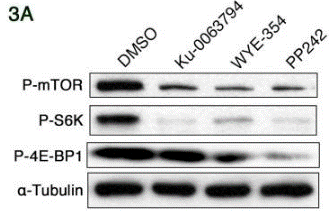
| Western blot | p-mTOR p-S6K / S6K / p-4E-BP1 / E7 / E6 / p53 |
|
24262658 |
Soporte técnico
Tel: +1-832-582-8158 Ext:3
Si tiene alguna otra consulta, por favor deje un mensaje.

Los productos son solo para uso de investigación. No para uso humano. No vendemos a pacientes.
©Copyright 2013 Selleck Chemicals. Todos los derechos reservados.