
solo para uso en investigación
Eltrombopag Olamine TpoR agonista
Cat. No.S2229
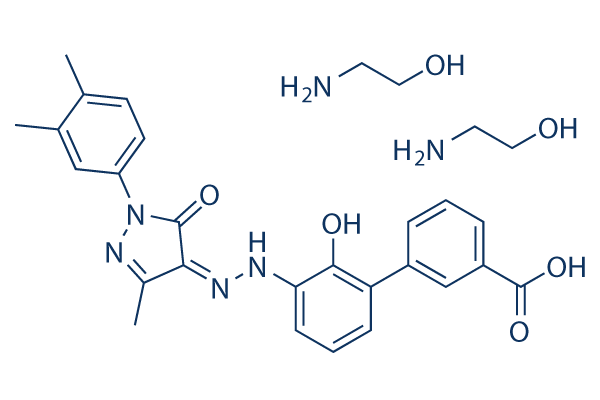
Estructura química
Peso molecular: 564.63
Control de calidad
| Dianas relacionadas | PD-1/PD-L1 CXCR STING AhR Immunology & Inflammation related CD markers Interleukins Anti-infection Antioxidant COX |
|---|---|
| Otros TpoR Inhibidores | Butyzamide |
Información química, almacenamiento y estabilidad
| Peso molecular | 564.63 | Fórmula | C29H36N6O6 |
Almacenamiento (Desde la fecha de recepción) | |
|---|---|---|---|---|---|
| Nº CAS | 496775-62-3 | Descargar SDF | Almacenamiento de soluciones madre |
|
|
| Sinónimos | SB497115,SB-497115-GR | Smiles | CC1=C(C=C(C=C1)N2C(=O)C(=C(N2)C)N=NC3=CC=CC(=C3O)C4=CC(=CC=C4)C(=O)O)C.C(CO)N.C(CO)N | ||
Solubilidad
|
In vitro |
DMSO
: 89 mg/mL
(157.62 mM)
Water : Insoluble Ethanol : Insoluble |
Calculadora de Molaridad
|
In vivo |
|||||
Calculadora de formulación in vivo (Solución clara)
Paso 1: Introduzca la información a continuación (Recomendado: Un animal adicional para tener en cuenta la pérdida durante el experimento)
Paso 2: Introduzca la formulación in vivo (Esto es solo la calculadora, no la formulación. Por favor, contáctenos primero si no hay una formulación in vivo en la sección de Solubilidad.)
Resultados del cálculo:
Concentración de trabajo: mg/ml;
Método para preparar el líquido maestro de DMSO: mg fármaco predissuelto en μL DMSO ( Concentración del líquido maestro mg/mL, Por favor, contáctenos primero si la concentración excede la solubilidad del DMSO del lote del fármaco. )
Método para preparar la formulación in vivo: Tomar μL DMSO líquido maestro, luego añadirμL PEG300, mezclar y clarificar, luego añadirμL Tween 80, mezclar y clarificar, luego añadir μL ddH2O, mezclar y clarificar.
Método para preparar la formulación in vivo: Tomar μL DMSO líquido maestro, luego añadir μL Aceite de maíz, mezclar y clarificar.
Nota: 1. Por favor, asegúrese de que el líquido esté claro antes de añadir el siguiente disolvente.
2. Asegúrese de añadir el (los) disolvente(s) en orden. Debe asegurarse de que la solución obtenida, en la adición anterior, sea una solución clara antes de proceder a añadir el siguiente disolvente. Se pueden utilizar métodos físicos como el vórtice, el ultrasonido o el baño de agua caliente para ayudar a la disolución.
Mecanismo de acción
| Targets/IC50/Ki |
thrombopoietin receptor
|
|---|---|
| In vitro |
Eltrombopag demuestra una concentración efectiva media máxima (EC50) de 0,27 μM en células BAF3 murinas transfectadas con el gen reportero luciferasa bajo la dirección del promotor IRF-1 activado por STAT y el TpoR humano (BAF3/IRF-1/hTpoR). Eltrombopag activa el receptor mediante la asociación con iones metálicos (es decir, Zn2+) y aminoácidos específicos dentro de los dominios transmembrana y yuxtamembrana del TpoR. Eltrombopag (30 μM) resulta en la activación de STAT5 en células N2C-Tpo, según lo detectado con un anticuerpo anti-fosfo-STAT5 en Western blots. Eltrombopag estimula la proliferación después de una incubación de 2 días con una EC50 de 0,03 μM en un ensayo de BrdU realizado en células BAF3/hTpoR. Eltrombopag también induce la diferenciación de células madre hematopoyéticas en células progenitoras de megacariocitos comprometidas. Eltrombopag aumenta la diferenciación de células CD34+ de médula ósea en megacariocitos CD41+ de manera dosis-dependiente con una EC50 de 0,1 μM. Eltrombopag inhibe la proliferación de células N2C-Tpo y células HEL92.1.7 con IC50 de 20,7 μg/mL y 2,3 μg/mL. Eltrombopag (20 μg/mL) conduce a una disminución de la tasa de división celular, un bloqueo en la fase G(1) del ciclo celular y un aumento de la diferenciación en células de leucemia humanas y murinas. Eltrombopag (5 μg/mL) muestra signos claros de diferenciación, cambios significativos en la organización del contenido nuclear y un aumento en la relación citoplasma/núcleo en células HL60. Eltrombopag (5 μg/mL) causa un aumento en CD11b, lo que es consistente con un estado de pre-macrófago en células U937, y también causa un aumento en CD11b en células URE. Eltrombopag conduce a una reducción del hierro intracelular libre en células leucémicas de manera dosis-dependiente en células HL60. |
| In vivo |
Eltrombopag (10 mg/kg por día) aumenta el recuento de plaquetas más de dos veces aproximadamente 1 semana después de la última dosis para un chimpancé y aproximadamente 1,5 veces para los otros dos chimpancés. Eltrombopag (1 mg/mL) prolonga la supervivencia en modelos de ratón de leucemia. |
Referencias |
|
Información del ensayo clínico
(datos de https://clinicaltrials.gov, actualizado el 2024-05-22)
| Número NCT | Reclutamiento | Condiciones | Patrocinador/Colaboradores | Fecha de inicio | Fases |
|---|---|---|---|---|---|
| NCT01550185 | Terminated | Adult Acute Basophilic Leukemia|Adult Acute Eosinophilic Leukemia|Adult Acute Megakaryoblastic Leukemia (M7)|Adult Acute Minimally Differentiated Myeloid Leukemia (M0)|Adult Acute Monoblastic Leukemia (M5a)|Adult Acute Monocytic Leukemia (M5b)|Adult Acute Myeloblastic Leukemia With Maturation (M2)|Adult Acute Myeloblastic Leukemia Without Maturation (M1)|Adult Acute Myeloid Leukemia With 11q23 (MLL) Abnormalities|Adult Acute Myeloid Leukemia With Del(5q)|Adult Acute Myeloid Leukemia With Inv(16)(p13;q22)|Adult Acute Myeloid Leukemia With t(16;16)(p13;q22)|Adult Acute Myeloid Leukemia With t(8;21)(q22;q22)|Adult Acute Myelomonocytic Leukemia (M4)|Adult Erythroleukemia (M6a)|Adult Pure Erythroid Leukemia (M6b)|Recurrent Adult Acute Myeloid Leukemia |
Roswell Park Cancer Institute|GlaxoSmithKline |
May 2012 | Phase 1 |
| NCT01416311 | Completed | Purpura Thrombocytopaenic Idiopathic |
Novartis Pharmaceuticals|Novartis |
December 21 2010 | -- |
Soporte técnico
Tel: +1-832-582-8158 Ext:3
Si tiene alguna otra consulta, por favor deje un mensaje.

Los productos son solo para uso de investigación. No para uso humano. No vendemos a pacientes.
©Copyright 2013 Selleck Chemicals. Todos los derechos reservados.