
solo para uso en investigación
Latrepirdine 2HCl GluR antagonista
Cat. No.S1245
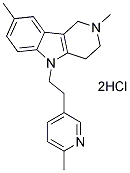
Estructura química
Peso molecular: 392.37
Control de calidad
Información química, almacenamiento y estabilidad
| Peso molecular | 392.37 | Fórmula | C21H25N3.2HCl |
Almacenamiento (Desde la fecha de recepción) | |
|---|---|---|---|---|---|
| Nº CAS | 97657-92-6 | -- | Almacenamiento de soluciones madre |
|
|
| Sinónimos | N/A | Smiles | CC1=CC2=C(C=C1)N(C3=C2CN(CC3)C)CCC4=CN=C(C=C4)C.Cl.Cl | ||
Solubilidad
|
In vitro |
DMSO
: 78 mg/mL
(198.79 mM)
Ethanol : 26 mg/mL Water : Insoluble |
Calculadora de Molaridad
|
In vivo |
|||||
Calculadora de formulación in vivo (Solución clara)
Paso 1: Introduzca la información a continuación (Recomendado: Un animal adicional para tener en cuenta la pérdida durante el experimento)
Paso 2: Introduzca la formulación in vivo (Esto es solo la calculadora, no la formulación. Por favor, contáctenos primero si no hay una formulación in vivo en la sección de Solubilidad.)
Resultados del cálculo:
Concentración de trabajo: mg/ml;
Método para preparar el líquido maestro de DMSO: mg fármaco predissuelto en μL DMSO ( Concentración del líquido maestro mg/mL, Por favor, contáctenos primero si la concentración excede la solubilidad del DMSO del lote del fármaco. )
Método para preparar la formulación in vivo: Tomar μL DMSO líquido maestro, luego añadirμL PEG300, mezclar y clarificar, luego añadirμL Tween 80, mezclar y clarificar, luego añadir μL ddH2O, mezclar y clarificar.
Método para preparar la formulación in vivo: Tomar μL DMSO líquido maestro, luego añadir μL Aceite de maíz, mezclar y clarificar.
Nota: 1. Por favor, asegúrese de que el líquido esté claro antes de añadir el siguiente disolvente.
2. Asegúrese de añadir el (los) disolvente(s) en orden. Debe asegurarse de que la solución obtenida, en la adición anterior, sea una solución clara antes de proceder a añadir el siguiente disolvente. Se pueden utilizar métodos físicos como el vórtice, el ultrasonido o el baño de agua caliente para ayudar a la disolución.
Mecanismo de acción
| Targets/IC50/Ki |
GluR
Histamine receptor
5-HT
|
|---|---|
| In vitro |
La Latrepirdina aumenta la actividad de la succinato deshidrogenasa (ensayo MTT), el potencial de membrana mitocondrial (DeltaPsim) y los niveles de ATP celular en neuronas corticales primarias de ratón y células de neuroblastoma humano (SH-SY5Y). La Latrepirdina mejora la función mitocondrial tanto en ausencia como en presencia de estrés y las células tratadas con Dimebon están parcialmente protegidas para mantener la viabilidad celular. La Latrepirdina conduce a una autofagia mejorada dependiente de mTOR y Atg5 en células de mamíferos cultivadas. La latrepirdina estimula la autofagia dependiente de MTOR y ATG5, lo que lleva a la reducción de los niveles intracelulares de metabolitos de APP, incluyendo Aβ en células cultivadas. La Latrepirdina estimula la degradación de α-syn en neuronas SH-SY5Y diferenciadas, y en el cerebro de ratón después de la administración crónica, en paralelo con la elevación de los niveles de marcadores de actividad autofágica. La Latrepirdina aumenta los niveles intracelulares de ATP y la translocación del transportador de glucosa 3 a la membrana plasmática en neuronas primarias.
|
| In vivo |
El tratamiento con Latrepirdina en ratones transgénicos TgCRND8 se asocia con una mejora en el comportamiento de aprendizaje y con una reducción en la acumulación de Aβ42 y α-sinucleína. La administración de Latrepirdina resulta en un aumento de los niveles de los biomarcadores que se cree que se correlacionan con la activación de la autofagia en los cerebros de ratones TgCRND8 (APP K670M, N671L, V717F) o de tipo salvaje, y ese tratamiento se asocia con la anulación del déficit conductual, la reducción de la neuropatología Aβ y la prevención del fallo autofágico entre los ratones TgCRND8.
|
Referencias |
|
Soporte técnico
Tel: +1-832-582-8158 Ext:3
Si tiene alguna otra consulta, por favor deje un mensaje.

Los productos son solo para uso de investigación. No para uso humano. No vendemos a pacientes.
©Copyright 2013 Selleck Chemicals. Todos los derechos reservados.