
solo para uso en investigación
pomaglumetad (LY404039) GluR agonista
Cat. No.S6001
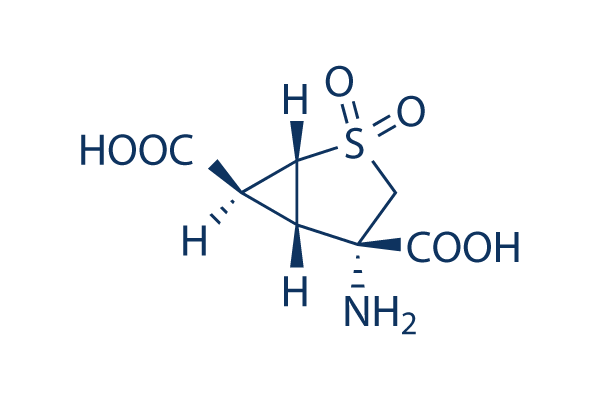
Estructura química
Peso molecular: 235.22
Control de calidad
Información química, almacenamiento y estabilidad
| Peso molecular | 235.22 | Fórmula | C7H9NO6S |
Almacenamiento (Desde la fecha de recepción) | |
|---|---|---|---|---|---|
| Nº CAS | 635318-11-5 | Descargar SDF | Almacenamiento de soluciones madre |
|
|
| Sinónimos | N/A | Smiles | C1C(C2C(C2S1(=O)=O)C(=O)O)(C(=O)O)N | ||
Solubilidad
|
In vitro |
5%TFA : 3.06 mg/mL
DMSO
: 0.5 mg/mL
(2.12 mM)
Water : Insoluble |
Calculadora de Molaridad
|
In vivo |
|||||
Calculadora de formulación in vivo (Solución clara)
Paso 1: Introduzca la información a continuación (Recomendado: Un animal adicional para tener en cuenta la pérdida durante el experimento)
Paso 2: Introduzca la formulación in vivo (Esto es solo la calculadora, no la formulación. Por favor, contáctenos primero si no hay una formulación in vivo en la sección de Solubilidad.)
Resultados del cálculo:
Concentración de trabajo: mg/ml;
Método para preparar el líquido maestro de DMSO: mg fármaco predissuelto en μL DMSO ( Concentración del líquido maestro mg/mL, Por favor, contáctenos primero si la concentración excede la solubilidad del DMSO del lote del fármaco. )
Método para preparar la formulación in vivo: Tomar μL DMSO líquido maestro, luego añadirμL PEG300, mezclar y clarificar, luego añadirμL Tween 80, mezclar y clarificar, luego añadir μL ddH2O, mezclar y clarificar.
Método para preparar la formulación in vivo: Tomar μL DMSO líquido maestro, luego añadir μL Aceite de maíz, mezclar y clarificar.
Nota: 1. Por favor, asegúrese de que el líquido esté claro antes de añadir el siguiente disolvente.
2. Asegúrese de añadir el (los) disolvente(s) en orden. Debe asegurarse de que la solución obtenida, en la adición anterior, sea una solución clara antes de proceder a añadir el siguiente disolvente. Se pueden utilizar métodos físicos como el vórtice, el ultrasonido o el baño de agua caliente para ayudar a la disolución.
Mecanismo de acción
| Características |
Under investigation as an exciting new medicine that may herald the arrival of third-generation antipsychotic drugs.
|
|---|---|
| Targets/IC50/Ki |
Rat neurons expressing native mGlu2/3
88 nM(Ki)
Recombinant human mGlu3
92 nM(Ki)
Recombinant human mGlu2
149 nM(Ki)
|
| In vitro |
Pomaglumetad (LY404039) exhibe una baja afinidad de unión a los receptores mGlu del grupo III, incluidos mGlu6, mGlu7 y mGlu8, con un valor de Ki superior a 5 μM, y muestra poca afinidad por los receptores de glutamato ionotrópicos, los subtipos de transportadores de glutamato, las monoaminas y otros receptores. Inhibe potentemente la formación de cAMP estimulada por forskolina en células que expresan los receptores mGlu2 y mGlu3 humanos. Este compuesto suprime la actividad excitatoria evocada eléctricamente en el estriado y la liberación de L-glutamato inducida por serotonina en la corteza prefrontal. Podría modular la actividad glutamatérgica en las áreas límbicas y del prosencéfalo relevantes para los trastornos psiquiátricos y podría carecer de los efectos secundarios negativos asociados con los antipsicóticos y ansiolíticos actuales.
|
| In vivo |
Pomaglumetad (LY404039) demuestra una mayor exposición plasmática y una mejor biodisponibilidad oral, y puede ser valioso en el tratamiento de trastornos neuropsiquiátricos, incluyendo la ansiedad y la psicosis. En animales de tipo salvaje, este compuesto revierte significativamente el aumento de las deambulaciones, la distancia recorrida y el tiempo reducido de reposo inducidos por la d-anfetamina (AMP). Revierte los comportamientos evocados por la fenciclidina (PCP) a 10 mg/kg. Los efectos antipsicóticos de LY404039 sobre la activación conductual evocada por PCP y AMP están ausentes en ratones deficientes en receptores mGlu2 y mGlu2/3, pero no en ratones deficientes en receptores mGlu3. En contraste, la clozapina y la risperidona inhiben los comportamientos evocados por PCP tanto en ratones de tipo salvaje como en ratones deficientes en receptores mGlu2/3. Reduce la respuesta al EtOH en la prueba de recuperación espontánea pavloviana (PSR) y reduce la expresión de un efecto de privación de alcohol (ADE) durante la recaída, pero no afecta la respuesta al EtOH en condiciones de mantenimiento. Este compuesto inhibe la expresión de la búsqueda de alcohol y el comportamiento de recaída sin alterar el comportamiento de autoadministración de alcohol. Además, atenúa la hiperlocomoción inducida por anfetamina y fenciclidina. Podría inhibir la respuesta de evitación condicionada y también reduce el sobresalto potenciado por el miedo en ratas y el entierro de canicas en ratones. Es importante destacar que no produce efectos sedantes ni deterioro motor en la tarea de evitación condicionada. También aumenta la liberación/recambio de dopamina y serotonina en la corteza prefrontal.
|
Referencias |
|
Información del ensayo clínico
(datos de https://clinicaltrials.gov, actualizado el 2024-05-22)
| Número NCT | Reclutamiento | Condiciones | Patrocinador/Colaboradores | Fecha de inicio | Fases |
|---|---|---|---|---|---|
| NCT01659177 | Withdrawn | Healthy Participants |
Denovo Biopharma LLC |
August 2012 | Phase 1 |
| NCT01637142 | Completed | Healthy Participants |
Denovo Biopharma LLC |
July 2012 | Phase 1 |
| NCT01609218 | Completed | Healthy Volunteer Study |
Denovo Biopharma LLC |
June 2012 | Phase 1 |
| NCT01475136 | Completed | Hepatic Insufficiency |
Denovo Biopharma LLC |
November 2011 | Phase 1 |
Soporte técnico
Tel: +1-832-582-8158 Ext:3
Si tiene alguna otra consulta, por favor deje un mensaje.

Los productos son solo para uso de investigación. No para uso humano. No vendemos a pacientes.
©Copyright 2013 Selleck Chemicals. Todos los derechos reservados.