
solo para uso en investigación
MPEP GluR antagonista
Cat. No.S2809
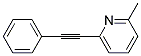
Estructura química
Peso molecular: 193.24
Control de calidad
- Citado en Nature Medicine por su máxima calidad
- COA
- NMR
- HPLC
- SDS
- Hoja de datos
Información química, almacenamiento y estabilidad
| Peso molecular | 193.24 | Fórmula | C14H11N |
Almacenamiento (Desde la fecha de recepción) | |
|---|---|---|---|---|---|
| Nº CAS | 96206-92-7 | Descargar SDF | Almacenamiento de soluciones madre |
|
|
| Sinónimos | N/A | Smiles | CC1=NC(=CC=C1)C#CC2=CC=CC=C2 | ||
Solubilidad
|
In vitro |
DMSO
: 39 mg/mL
(201.82 mM)
Ethanol : 39 mg/mL Water : Insoluble |
Calculadora de Molaridad
|
In vivo |
|||||
Calculadora de formulación in vivo (Solución clara)
Paso 1: Introduzca la información a continuación (Recomendado: Un animal adicional para tener en cuenta la pérdida durante el experimento)
Paso 2: Introduzca la formulación in vivo (Esto es solo la calculadora, no la formulación. Por favor, contáctenos primero si no hay una formulación in vivo en la sección de Solubilidad.)
Resultados del cálculo:
Concentración de trabajo: mg/ml;
Método para preparar el líquido maestro de DMSO: mg fármaco predissuelto en μL DMSO ( Concentración del líquido maestro mg/mL, Por favor, contáctenos primero si la concentración excede la solubilidad del DMSO del lote del fármaco. )
Método para preparar la formulación in vivo: Tomar μL DMSO líquido maestro, luego añadirμL PEG300, mezclar y clarificar, luego añadirμL Tween 80, mezclar y clarificar, luego añadir μL ddH2O, mezclar y clarificar.
Método para preparar la formulación in vivo: Tomar μL DMSO líquido maestro, luego añadir μL Aceite de maíz, mezclar y clarificar.
Nota: 1. Por favor, asegúrese de que el líquido esté claro antes de añadir el siguiente disolvente.
2. Asegúrese de añadir el (los) disolvente(s) en orden. Debe asegurarse de que la solución obtenida, en la adición anterior, sea una solución clara antes de proceder a añadir el siguiente disolvente. Se pueden utilizar métodos físicos como el vórtice, el ultrasonido o el baño de agua caliente para ayudar a la disolución.
Mecanismo de acción
| Características |
Inactive against other group I/II/III metabotropic glutamate receptors.
|
|---|---|
| Targets/IC50/Ki |
mGluR5
36 nM
|
| In vitro |
MPEP no tiene una actividad agonista o antagonista apreciable en el receptor mGlu1b humano recombinante estrechamente relacionado, expresado en células CHO-K1, ni en un purinorreceptor expresado endógenamente en células L(tk-) hasta concentraciones de 100 μM. Además, este compuesto no muestra una actividad agonista o antagonista apreciable en ensayos de acumulación de cAMP o de unión de [35S]-GTPγS en los receptores metabotrópicos humanos recombinantes de los grupos II y III (mGlu2, -3, -4a, -6, -7b, -8a humanos), así como en los subtipos de receptores NMDA humanos (NMDAR1A/2A, -1A/2B), AMPA de rata (GluR3) y kainato humano (GluR6). En cortes de hipocampo, estriado y corteza neonatal de rata, pero no de cerebelo, inhibe la hidrólisis de PI estimulada por DHPG con IC50 de 8.0 nM, 20.5 nM y 17.9 nM, respectivamente. Este compuesto químico modula positivamente el hmGluR4 en un sistema de expresión recombinante, y el efecto depende completamente de la activación del agonista ortostérico L-AP4.
|
| In vivo |
Cuando se aplica microiontoforéticamente en el cerebro de ratas, MPEP reduce las excitaciones inducidas por DHPG pero no las excitaciones inducidas por AMPA. Después de la administración intravenosa, este compuesto produce una inhibición dosis-dependiente de las excitaciones inducidas por DHPG pero no por AMPA, con un rápido inicio de acción. La administración oral de esta sustancia química también exhibe una excelente actividad antihiperalgésica en los modelos de dolor inflamatorio de adyuvante completo de Freund y trementina. Este (1-30 mg/kg) induce efectos ansiolíticos en la prueba de bebida en conflicto y la prueba de laberinto elevado en cruz en ratas, así como en la prueba de cuatro placas en ratones. Este compuesto (1-20 mg/kg) acorta el tiempo de inmovilidad en una prueba de suspensión de la cola en ratones, pero es inactivo en la prueba de desesperación conductual en ratas. No tiene efecto sobre la actividad locomotora o la coordinación motora. Esta sustancia química reduce significativamente las entradas y la duración del cuadrado central en fmr1, pero no en el tipo salvaje. En las pruebas de campo abierto, reduce el comportamiento en el campo central de fmr1tm1Cgr a uno indistinguible del tipo salvaje. Produce una reducción significativa de la actividad locomotora total en tres de los cuatro grupos probados, tanto a 10 mg/kg como a 30 mg/kg.
|
Referencias |
|
Soporte técnico
Tel: +1-832-582-8158 Ext:3
Si tiene alguna otra consulta, por favor deje un mensaje.

Los productos son solo para uso de investigación. No para uso humano. No vendemos a pacientes.
©Copyright 2013 Selleck Chemicals. Todos los derechos reservados.