
solo para uso en investigación
Cutamesine Dihydrochloride Sigma Receptor agonista
Cat. No.S2917
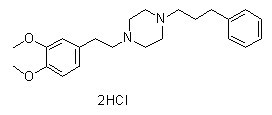
Estructura química
Peso molecular: 441.43
Control de calidad
- Citado en Nature Medicine por su máxima calidad
- COA
- HPLC
- SDS
- Hoja de datos
| Dianas relacionadas | CXCR Hedgehog/Smoothened PKA Adrenergic Receptor AChR 5-HT Receptor Histamine Receptor Dopamine Receptor Ras KRas |
|---|---|
| Otros Sigma Receptor Inhibidores | BD-1047 dihydrobromide S1RA Siramesine HCl PRE-084 hydrochloride Ditolylguanidine 4-IBP BD1063 2HCL Anavex 2-73 HCl Carbetapentane WQ 1 |
Información química, almacenamiento y estabilidad
| Peso molecular | 441.43 | Fórmula | C23H32N2O2.2HCl |
Almacenamiento (Desde la fecha de recepción) | |
|---|---|---|---|---|---|
| Nº CAS | 165377-44-6 | Descargar SDF | Almacenamiento de soluciones madre |
|
|
| Sinónimos | SA4503 dihydrochloride, AGY94806 dihydrochloride | Smiles | Cl.Cl.COC1=C(OC)C=C(CCN2CCN(CCCC3=CC=CC=C3)CC2)C=C1 | ||
Solubilidad
|
In vitro |
Water : 88 mg/mL
DMSO
: 22 mg/mL
(49.83 mM)
Ethanol : 11 mg/mL |
Calculadora de Molaridad
|
In vivo |
|||||
Calculadora de formulación in vivo (Solución clara)
Paso 1: Introduzca la información a continuación (Recomendado: Un animal adicional para tener en cuenta la pérdida durante el experimento)
Paso 2: Introduzca la formulación in vivo (Esto es solo la calculadora, no la formulación. Por favor, contáctenos primero si no hay una formulación in vivo en la sección de Solubilidad.)
Resultados del cálculo:
Concentración de trabajo: mg/ml;
Método para preparar el líquido maestro de DMSO: mg fármaco predissuelto en μL DMSO ( Concentración del líquido maestro mg/mL, Por favor, contáctenos primero si la concentración excede la solubilidad del DMSO del lote del fármaco. )
Método para preparar la formulación in vivo: Tomar μL DMSO líquido maestro, luego añadirμL PEG300, mezclar y clarificar, luego añadirμL Tween 80, mezclar y clarificar, luego añadir μL ddH2O, mezclar y clarificar.
Método para preparar la formulación in vivo: Tomar μL DMSO líquido maestro, luego añadir μL Aceite de maíz, mezclar y clarificar.
Nota: 1. Por favor, asegúrese de que el líquido esté claro antes de añadir el siguiente disolvente.
2. Asegúrese de añadir el (los) disolvente(s) en orden. Debe asegurarse de que la solución obtenida, en la adición anterior, sea una solución clara antes de proceder a añadir el siguiente disolvente. Se pueden utilizar métodos físicos como el vórtice, el ultrasonido o el baño de agua caliente para ayudar a la disolución.
Mecanismo de acción
| Targets/IC50/Ki |
Sigma-1 receptor
17.4 mM
|
|---|---|
| In vitro |
SA 4503 tiene afinidades de unión débiles para los receptores sigma 1 adrenérgicos, dopamina D, serotonina (5-HT)1A, 5-HT2, histamina H, muscarínicos M1 y muscarínicos M2 a una concentración de 10 μM. El GTP debilita la inhibición de la unión de (+)-[3H]pentazocina inducida por SA 4503 en membranas cerebrales de rata. SA 4503 inhibe la unión específica de (+)-[3H]pentazocina de manera competitiva. |
| In vivo |
SA 4503 (0,03 mg/kg-1 mg/kg s.c.) atenúa los déficits de memoria inducidos por dizocilpina (0,15 mg/kg i.p.) y L-NAME (100 mg/kg i.p.) siguiendo una curva en forma de campana tanto en el laberinto en Y para la memoria de trabajo espacial como en la prueba de evitación pasiva de tipo step-down en ratones. La progesterona (2 mg/kg s.c.) bloquea los efectos de SA 4503 en los modelos de amnesia por dizocilpina y L-NAME, de acuerdo con la supuesta interacción entre neuroesteroides y Sigma1 receptores. SA 4503 (100 nM-300 nM) aumenta la liberación de acetilcolina evocada eléctricamente en rebanadas de hipocampo pero no de estriado de ratas. Concentraciones por debajo de 100 nM no alteran la liberación de acetilcolina evocada eléctricamente en ninguna de las dos áreas cerebrales. SA 4503 (1 mg/kg i.p. bid) produce una disminución y un aumento significativos en el número de neuronas DA de la SNC y VTA espontáneamente activas en ratas. SA 4503 (1 mg/kg i.p. repetida) produce un aumento significativo en el número de neuronas DA de la VTA espontáneamente activas. La administración repetida de SA 4503 produce una mayor alteración del patrón de disparo de la VTA espontáneamente activa en comparación con las neuronas DA de la SNC. El tratamiento repetido con SA 4503 (0,3 mg/kg) mejora los déficits conductuales en ratas con bulbectomía olfativa que se asemejan a síntomas de depresión en la prueba de campo abierto, la prueba de comportamiento sexual y la prueba de condicionamiento de miedo contextual y con señales. SA 4503 muestra ventajas sobre la desipramina en la prueba de comportamiento sexual. SA 4503 también revierte la disminución en la expresión de proteínas de la subunidad NR1 del NMDA receptor, pero no de NR2A o NR2B, en la corteza prefrontal, el hipocampo y la amígdala de ratas con bulbectomía olfativa. |
Referencias |
|
Soporte técnico
Tel: +1-832-582-8158 Ext:3
Si tiene alguna otra consulta, por favor deje un mensaje.

Los productos son solo para uso de investigación. No para uso humano. No vendemos a pacientes.
©Copyright 2013 Selleck Chemicals. Todos los derechos reservados.