
solo para uso en investigación
Tenofovir Reverse Transcriptase inhibidor
Cat. No.S1401
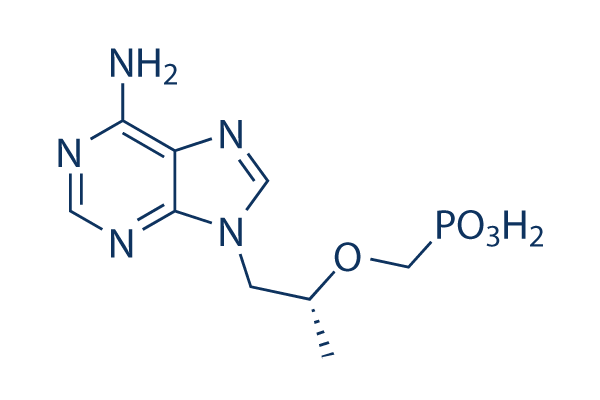
Estructura química
Peso molecular: 287.21
Control de calidad
| Dianas relacionadas | Integrase Bacterial Antibiotics Anti-infection Fungal Antiviral COVID-19 Parasite HIV HCV Protease |
|---|---|
| Otros Reverse Transcriptase Inhibidores | Dapivirine (TMC120) Fangchinoline Salicylanilide 3'-Fluoro-3'-deoxythymidine (Alovudine) Ulonivirine Lersivirine (UK-453061) Bifendate 4-Chloro-2-(trifluoroacetyl)aniline hydrochloride |
Cultivo celular, tratamiento y concentración de trabajo
| Líneas celulares | Tipo de ensayo | Concentración | Tiempo de incubación | Formulación | Descripción de la actividad | PMID |
|---|---|---|---|---|---|---|
| human MT2 cells | Function assay | 5 days | Antiviral activity against HIV1 3B infected in human MT2 cells assessed as inhibition of virus-induced cytopathic effect after 5 days by XTT assay, EC50=0.013 μM | |||
| human H9 cells | Function assay | Antiviral activity against HIV1 clade F isolate 2338 infected in human H9 cells assessed as inhibition of viral replication, EC50=0.04 μM | ||||
| C3H/3T3 cells | Function assay | 6 days | Inhibition of murine sarcoma virus-induced transformation of mouse embryo fibroblast C3H/3T3 cells after 6 days, EC50=0.23 μM | |||
| CEM (human leukemia) cells | Function assay | Antiviral activity against HIV-1 (IIIB) in CEM (human leukemia) cells, EC50=1.2 μM | ||||
| MT-4 cells | Function assay | In vitro antiviral activity against HIV-2 in MT-4 cells, EC50=1.4 μM | ||||
| human bone marrow cells | Cytotoxicity assay | 24 h | Cytotoxicity against human bone marrow cells after 24 hrs by BFU-E assay, CC50=3.5 μM | |||
| C8166 cells | Function assay | 4 days | Antiviral activity against 100 TCID50 wild-type Human immunodeficiency virus type 2 ROD infected in C8166 cells assessed as inhibition of syncytia formation after 4 days by microscopic analysis, EC50=7.1 μM | |||
| mouse L1210 cells | Cytotoxicity assay | 48 h | Cytostatic activity against mouse L1210 cells after 48 hrs by coulter counting analysis, IC50=11 μM | |||
| human HepG2 cells | Function assay | 9 days | Antiviral activity against Hepatitis B virus infected human HepG2 cells after 9 days by MTT assay, IC50=12.3 μM | |||
| human HeLa cells | Cytotoxicity assay | 72 h | Cytostatic activity against human HeLa cells after 72 hrs by coulter counting analysis, IC50=17 μM | |||
| CHO cells | Cytotoxicity assay | 120 h | Cytotoxicity against CHO cells after 120 hrs by Cell-Titer Glo assay, CC50=21 μM | |||
| MDCK2 cells | Function assay | 10 μM | Inhibition of human MRP3 expressed in MDCK2 cells assessed as increase in intracellular CMF fluorescence at 10 uM by CMFDA assay | |||
| human HepG2 cells | Cytotoxicity assay | 14 days | Cytotoxicity against human HepG2 cells assessed as inhibition of cellular DNA replication after 14 days | |||
| Haga clic para ver más datos experimentales de líneas celulares | ||||||
Información química, almacenamiento y estabilidad
| Peso molecular | 287.21 | Fórmula | C9H14N5O4P |
Almacenamiento (Desde la fecha de recepción) | |
|---|---|---|---|---|---|
| Nº CAS | 147127-20-6 | Descargar SDF | Almacenamiento de soluciones madre |
|
|
| Sinónimos | GS-1278 | Smiles | CC(CN1C=NC2=C(N=CN=C21)N)OCP(=O)(O)O | ||
Solubilidad
|
In vitro |
DMSO
: 4 mg/mL
(13.92 mM)
Water : 2 mg/mL Ethanol : Insoluble |
Calculadora de Molaridad
|
In vivo |
|||||
Calculadora de formulación in vivo (Solución clara)
Paso 1: Introduzca la información a continuación (Recomendado: Un animal adicional para tener en cuenta la pérdida durante el experimento)
Paso 2: Introduzca la formulación in vivo (Esto es solo la calculadora, no la formulación. Por favor, contáctenos primero si no hay una formulación in vivo en la sección de Solubilidad.)
Resultados del cálculo:
Concentración de trabajo: mg/ml;
Método para preparar el líquido maestro de DMSO: mg fármaco predissuelto en μL DMSO ( Concentración del líquido maestro mg/mL, Por favor, contáctenos primero si la concentración excede la solubilidad del DMSO del lote del fármaco. )
Método para preparar la formulación in vivo: Tomar μL DMSO líquido maestro, luego añadirμL PEG300, mezclar y clarificar, luego añadirμL Tween 80, mezclar y clarificar, luego añadir μL ddH2O, mezclar y clarificar.
Método para preparar la formulación in vivo: Tomar μL DMSO líquido maestro, luego añadir μL Aceite de maíz, mezclar y clarificar.
Nota: 1. Por favor, asegúrese de que el líquido esté claro antes de añadir el siguiente disolvente.
2. Asegúrese de añadir el (los) disolvente(s) en orden. Debe asegurarse de que la solución obtenida, en la adición anterior, sea una solución clara antes de proceder a añadir el siguiente disolvente. Se pueden utilizar métodos físicos como el vórtice, el ultrasonido o el baño de agua caliente para ayudar a la disolución.
Mecanismo de acción
| Características |
Tenofovir disoproxil fumarate is the prodrug form of tenofovir.
|
|---|---|
| Targets/IC50/Ki |
Reverse transcriptase
|
| In vitro |
Tenofovir reduce el efecto citopático viral de HIV-1(IIIB), HIV-2(ROD) y HIV(EHO) con EC50 de 1,15 μg/mL, 1,12 μg/mL y 1,05 μg/mL en células MT-4. Este compuesto también reduce el efecto citopático viral de SIV(mac251), SIV(B670), SHIV(89.6) y SHIV(RTSHIV). Es excepcionalmente activo contra el VIH resistente a multinucleósidos que expresa la mutación Q151M, pero muestra una susceptibilidad reducida a las mutaciones por inserción T69S. Este químico inhibe la actividad del virus de la hepatitis B (VHB) en células HepG2 2.2.15, HepAD38 y HepAD79. Él (4 μM) inhibe completamente el crecimiento de HIVIIIB en células MT-2. Este compuesto inhibe la síntesis de ADN de parada fuerte de cadena negativa con IC50 de 9 µM para RT de tipo salvaje, 6 µM para RT M184V y 50 µM para RT K65R.
|
| In vivo |
Tenofovir (30 mg/kg) previene completamente la infección por SIV en todos los macacos sin toxicidad. Este compuesto reduce los niveles de ARN viral plasmático a indetectables, con disminuciones paralelas en la infectividad del plasma y las células infecciosas en las células mononucleares de sangre periférica y el líquido cefalorraquídeo (LCR) y la estabilización del número de células T CD4+. Abroga completamente la infección por VIH a través de la exposición intravaginal en macacos de cola de cerdo.
|
Referencias |
|
Soporte técnico
Tel: +1-832-582-8158 Ext:3
Si tiene alguna otra consulta, por favor deje un mensaje.

Los productos son solo para uso de investigación. No para uso humano. No vendemos a pacientes.
©Copyright 2013 Selleck Chemicals. Todos los derechos reservados.