
solo para uso en investigación
Ritonavir HIV Protease Inhibidor
Cat. No.: S1185
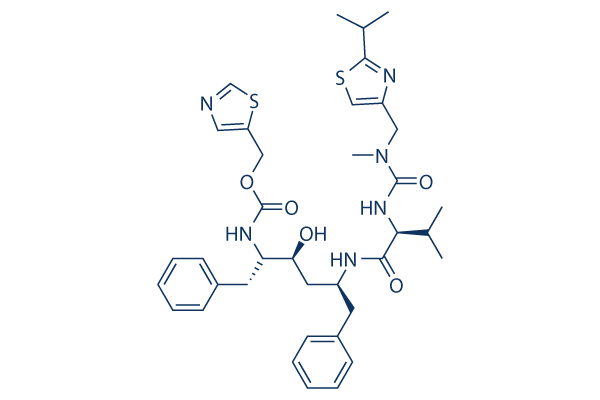
Estructura química
Peso molecular: 720.94
Control de calidad (Quality Control)
| Dianas relacionadas | HDAC Caspase Proteasome Secretase MMP HCV Protease Cysteine Protease Tyrosinase DPP Serine Protease |
|---|---|
| Otros HIV Protease Inhibidores | Pepstatin A Limonin Temsavir (BMS-626529) Dextran sulfate sodium (DSS) Bevirimat NBD-556 GS-6207 (Lenacapavir) Rosamultin Mericitabine Azvudine |
Información química, almacenamiento y estabilidad (Chemical Information, Storage & Stability)
| Peso molecular | 720.94 | Fórmula | C37H48N6O5S2 |
Almacenamiento (Desde la fecha de recepción) | |
|---|---|---|---|---|---|
| Nº CAS | 155213-67-5 | Descargar SDF | Almacenamiento de soluciones madre |
|
|
| Sinónimos | ABT-538,A 84538, RTV | Smiles | CC(C)C(NC(=O)N(C)CC1=CSC(=N1)C(C)C)C(=O)NC(CC(O)C(CC2=CC=CC=C2)NC(=O)OCC3=CN=CS3)CC4=CC=CC=C4 | ||
Solubilidad (Solubility)
|
In vitro |
DMSO
: 100 mg/mL
(138.7 mM)
Ethanol : 100 mg/mL Water : Insoluble |
Calculadora de Molaridad
|
In vivo |
|||||
Calculadora de formulación in vivo (Solución clara)
Paso 1: Introduzca la información a continuación (Recomendado: Un animal adicional para tener en cuenta la pérdida durante el experimento)
Paso 2: Introduzca la formulación in vivo (Esto es solo la calculadora, no la formulación. Por favor, contáctenos primero si no hay una formulación in vivo en la sección de Solubilidad.)
Resultados del cálculo:
Concentración de trabajo: mg/ml;
Método para preparar el líquido maestro de DMSO: mg fármaco predissuelto en μL DMSO ( Concentración del líquido maestro mg/mL, Por favor, contáctenos primero si la concentración excede la solubilidad del DMSO del lote del fármaco. )
Método para preparar la formulación in vivo: Tomar μL DMSO líquido maestro, luego añadirμL PEG300, mezclar y clarificar, luego añadirμL Tween 80, mezclar y clarificar, luego añadir μL ddH2O, mezclar y clarificar.
Método para preparar la formulación in vivo: Tomar μL DMSO líquido maestro, luego añadir μL Aceite de maíz, mezclar y clarificar.
Nota: 1. Por favor, asegúrese de que el líquido esté claro antes de añadir el siguiente disolvente.
2. Asegúrese de añadir el (los) disolvente(s) en orden. Debe asegurarse de que la solución obtenida, en la adición anterior, sea una solución clara antes de proceder a añadir el siguiente disolvente. Se pueden utilizar métodos físicos como el vórtice, el ultrasonido o el baño de agua caliente para ayudar a la disolución.
Mecanismo de acción (Mechanism of Action)
| Targets/IC50/Ki |
CYP3A4
HIV
|
|---|---|
| In vitro |
Ritonavir is a very potent inhibitor of CYP3A4 mediated testosterone 6β-hydroxylation with mean Ki of 19 nM and also inhibits tolbutamide hydroxylation with IC50 of 4.2 μM. This compound is found to be a potent inhibitor of CYP3A-mediated biotransformations (nifedipine oxidation with IC50 of 0.07 mM, 17alpha-ethynylestradiol 2-hydroxylation with IC50 of 2 mM; terfenadine hydroxylation with IC50 of 0.14 mM). It is also found to be an inhibitor of the reactions mediated by CYP2D6 (IC50 = 2.5 mM) and CYP2C9/10 (IC50 = 8.0 mM). This agent results in an increase in cell viability in uninfected human PBMC cultures. It markedly decreases the susceptibility of PBMCs to apoptosis correlated with lower levels of caspase-1 expression, decreases in annexin V staining, and reduces caspase-3 activity in uninfected human PBMC cultures. The compound inhibits induction of tumor necrosis factor (TNF) production by PBMCs and monocytes in a time- and dose-dependent manner at nontoxic concentrations. It inhibits p-glycoprotein-mediated extrusion of saquinavir with an IC50 of 0.2 μM, indicating a high affinity of ritonavir for p-glycoprotein. This chemical inhibits human liver microsomal metabolism of ABT-378 potently with Ki of 13 nM. When combined with ABT-378 (at 3:1 and 29:1 ratios), it inhibits CYP3A (IC50 = 1.1 and 4.6 μM), albeit less potently than Ritonavir (IC50 = 0.14 μM). |
Referencias |
|
Información del ensayo clínico (Clinical Trial Information)
(datos de https://clinicaltrials.gov, actualizado el 2026-06-10)
| Número NCT | Reclutamiento | Condiciones | Patrocinador/Colaboradores | Fecha de inicio | Fases |
|---|---|---|---|---|---|
| NCT06337032 | RECRUITING | HIV-1-infection |
Gilead Sciences |
2024-08-27 | PHASE4 |
| NCT07792096 | NOT_YET_RECRUITING | HIV Infection |
University College, London |
2026-11 | PHASE3 |
| NCT04381936 | RECRUITING | Pneumonia |
University of Oxford |
2020-03-19 | PHASE3 |
| NCT02140255 | RECRUITING | HIV Infection |
National Institute of Allergy and Infectious Diseases (NIAID) |
2015-01-23 | PHASE1; PHASE2 |
| NCT07601074 | RECRUITING | Human Papilloma Virus (HPV); High-risk Human Papillomavirus Infection |
Daré Bioscience, Inc. |
2026-07-17 | PHASE2 |
| NCT05334004 | RECRUITING | High-Grade Anal Intraepithelial Neoplasia |
University of Wisconsin, Madison |
2023-12-19 | PHASE1 |

Los productos son solo para uso de investigación. No para uso humano. No vendemos a pacientes.
©Copyright 2013 Selleck Chemicals. Todos los derechos reservados.