
solo para uso en investigación
BTZ043 Racemate Bacterial químico
Cat. No.S1097
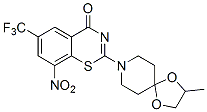
Estructura química
Peso molecular: 431.39
Control de calidad
| Dianas relacionadas | Integrase Antibiotics Anti-infection Fungal Antiviral COVID-19 Parasite Reverse Transcriptase HIV HCV Protease |
|---|---|
| Otros Bacterial Inhibidores | Berberine Teicoplanin Pefloxacin Mesylate Ornidazole Furagin Proanthocyanidins Trigonelline Hydrochloride Skatole Solithromycin Berberine Sulfate |
Información química, almacenamiento y estabilidad
| Peso molecular | 431.39 | Fórmula | C17H16F3N3O5S |
Almacenamiento (Desde la fecha de recepción) | |
|---|---|---|---|---|---|
| Nº CAS | 957217-65-1 | Descargar SDF | Almacenamiento de soluciones madre |
|
|
| Sinónimos | N/A | Smiles | CC1COC2(O1)CCN(CC2)C3=NC(=O)C4=C(S3)C(=CC(=C4)C(F)(F)F)[N+](=O)[O-] | ||
Solubilidad
|
In vitro |
DMSO
: 22 mg/mL
(50.99 mM)
Water : Insoluble Ethanol : Insoluble |
Calculadora de Molaridad
|
In vivo |
|||||
Calculadora de formulación in vivo (Solución clara)
Paso 1: Introduzca la información a continuación (Recomendado: Un animal adicional para tener en cuenta la pérdida durante el experimento)
Paso 2: Introduzca la formulación in vivo (Esto es solo la calculadora, no la formulación. Por favor, contáctenos primero si no hay una formulación in vivo en la sección de Solubilidad.)
Resultados del cálculo:
Concentración de trabajo: mg/ml;
Método para preparar el líquido maestro de DMSO: mg fármaco predissuelto en μL DMSO ( Concentración del líquido maestro mg/mL, Por favor, contáctenos primero si la concentración excede la solubilidad del DMSO del lote del fármaco. )
Método para preparar la formulación in vivo: Tomar μL DMSO líquido maestro, luego añadirμL PEG300, mezclar y clarificar, luego añadirμL Tween 80, mezclar y clarificar, luego añadir μL ddH2O, mezclar y clarificar.
Método para preparar la formulación in vivo: Tomar μL DMSO líquido maestro, luego añadir μL Aceite de maíz, mezclar y clarificar.
Nota: 1. Por favor, asegúrese de que el líquido esté claro antes de añadir el siguiente disolvente.
2. Asegúrese de añadir el (los) disolvente(s) en orden. Debe asegurarse de que la solución obtenida, en la adición anterior, sea una solución clara antes de proceder a añadir el siguiente disolvente. Se pueden utilizar métodos físicos como el vórtice, el ultrasonido o el baño de agua caliente para ayudar a la disolución.
Mecanismo de acción
| Características |
Greater activity against M. tuberculosis than EMB.
|
|---|---|
| Targets/IC50/Ki |
DprE1
|
| In vitro |
Al dirigirse a la decaprenilfosforil-β-D-ribosa 2'-epimerasa, BTZ043 anula la formación de arabinosa decaprenilfosforilada, lo que lleva a la lisis celular y la muerte de Mycobacterium tuberculosis. BTZ043 muestra una actividad similar contra todos los aislados clínicos de M. tuberculosis, incluidas las cepas multidrogorresistentes y extremadamente drogorresistentes. BTZ043 muestra una actividad significativa contra M. tuberculosis H37Rv y Mycobacterium smegmatis con una CMI de 1 ng/mL (2,3 nM) y 4 ng/mL (9,2 nM), respectivamente, que es más potente que la de los fármacos antituberculosos (TB) existentes, isoniazida (INH) y etambutol (EMB) con una CMI de 0,02-0,2 μg/mL y 1-5 μg/mL, respectivamente. BTZ043 es menos eficaz en dos sistemas modelo diferentes (auxotrofia y inanición) que involucran M. tuberculosis metabólicamente inerte, lo que indica que BTZ043 bloquea un paso en el metabolismo activo similar a la isoniazida (INH). El tratamiento con BTZ043 en células de M. smegmatis disminuye la tasa de crecimiento rápidamente, seguido de una hinchazón de los polos y lisis de las células después de unas pocas horas, lo que es similar pero retrasado en M. tuberculosis. BTZ043 (1/4 CMI 0,375 ng/mL) en combinación con TMC207 (1/4 CMI 20 ng/mL) tiene un efecto cida más fuerte sobre M. tuberculosis pero no sobre el mutante de M. tuberculosis resistente a BTZ que TMC207 solo a una concentración de 80 ng/mL.
|
| In vivo |
En un modelo de ratón de tuberculosis crónica, la administración de BTZ043 a 37,5 mg/kg o 300 mg/kg durante 4 semanas reduce la carga bacteriana en los pulmones y el bazo en 1 y 2 logs, respectivamente.
|
Referencias |
|
Soporte técnico
Tel: +1-832-582-8158 Ext:3
Si tiene alguna otra consulta, por favor deje un mensaje.

Los productos son solo para uso de investigación. No para uso humano. No vendemos a pacientes.
©Copyright 2013 Selleck Chemicals. Todos los derechos reservados.