
solo para uso en investigación
Quinolinic acid NMDAR agonista
Cat. No.S3624
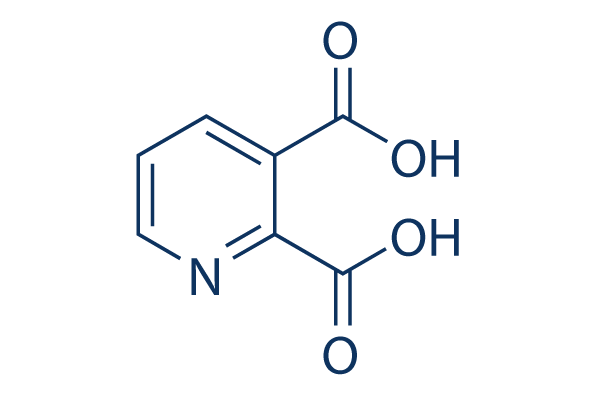
Estructura química
Peso molecular: 167.12
Control de calidad
- Citado en Nature Medicine por su máxima calidad
- COA
- HPLC
- SDS
- Hoja de datos
Información química, almacenamiento y estabilidad
| Peso molecular | 167.12 | Fórmula | C7H5NO4 |
Almacenamiento (Desde la fecha de recepción) | |
|---|---|---|---|---|---|
| Nº CAS | 89-00-9 | Descargar SDF | Almacenamiento de soluciones madre |
|
|
| Sinónimos | pyridine-2,3-dicarboxylic acid, QUIN | Smiles | C1=CC(=C(N=C1)C(=O)O)C(=O)O | ||
Solubilidad
|
In vitro |
DMSO
: 25 mg/mL
(149.59 mM)
Water : 3 mg/mL Ethanol : Insoluble |
Calculadora de Molaridad
|
In vivo |
|||||
Calculadora de formulación in vivo (Solución clara)
Paso 1: Introduzca la información a continuación (Recomendado: Un animal adicional para tener en cuenta la pérdida durante el experimento)
Paso 2: Introduzca la formulación in vivo (Esto es solo la calculadora, no la formulación. Por favor, contáctenos primero si no hay una formulación in vivo en la sección de Solubilidad.)
Resultados del cálculo:
Concentración de trabajo: mg/ml;
Método para preparar el líquido maestro de DMSO: mg fármaco predissuelto en μL DMSO ( Concentración del líquido maestro mg/mL, Por favor, contáctenos primero si la concentración excede la solubilidad del DMSO del lote del fármaco. )
Método para preparar la formulación in vivo: Tomar μL DMSO líquido maestro, luego añadirμL PEG300, mezclar y clarificar, luego añadirμL Tween 80, mezclar y clarificar, luego añadir μL ddH2O, mezclar y clarificar.
Método para preparar la formulación in vivo: Tomar μL DMSO líquido maestro, luego añadir μL Aceite de maíz, mezclar y clarificar.
Nota: 1. Por favor, asegúrese de que el líquido esté claro antes de añadir el siguiente disolvente.
2. Asegúrese de añadir el (los) disolvente(s) en orden. Debe asegurarse de que la solución obtenida, en la adición anterior, sea una solución clara antes de proceder a añadir el siguiente disolvente. Se pueden utilizar métodos físicos como el vórtice, el ultrasonido o el baño de agua caliente para ayudar a la disolución.
Mecanismo de acción
| Targets/IC50/Ki |
NMDAR
|
|---|---|
| In vitro |
QUIN es un agonista del receptor N-metil-D-aspartato (NMDA) y tiene una alta potencia in vivo como excitotoxina. Aunque QUIN tiene un sistema de captación, su enzima de degradación neuronal se satura rápidamente, y el resto de QUIN extracelular puede seguir estimulando el receptor NMDA. QUIN (10 μM) previene la excitotoxicidad inducida por glutamato en cultivos primarios de neuronas granulares cerebelosas de rata; sin embargo, cultivos organotípicos maduros del sistema corticostriatal de rata o del núcleo caudado expuestos crónicamente a 100 nM de QUIN durante hasta 7 semanas muestran degeneración focal caracterizada por la presencia de vacuolas en el neurópilo, dendritas hinchadas, elementos postsinápticos ocasionalmente hinchados y neuronas degeneradas. El tratamiento in vitro de neuronas fetales humanas primarias con QUIN conduce a un aumento sustancial de la fosforilación de tau en múltiples posiciones. El aumento de la fosforilación de tau inducida por QUIN se atribuye a una disminución en la expresión y actividad de las principales fosfatasas de tau. QUIN puede inhibir la monoaminooxidasa B (MAO-B) en las mitocondrias sinaptosomales del cerebro humano y también puede ser un potente inhibidor de la fosfoenolpiruvato carboxiquinasa (EC 4.1.1.32) del citoplasma del hígado de rata, una enzima importante en la vía de la gluconeogénesis que convierte el oxalacetato en fosfoenolpiruvato. QUIN puede aumentar la producción de radicales libres induciendo la actividad de NOS en astrocitos y neuronas, lo que lleva a estrés oxidativo, aumentando tanto la actividad de la poli(ADP-ribosa) polimerasa (PARP) como la actividad de la lactato deshidrogenasa (LDH) extracelular.
|
| In vivo |
El ácido quinolínico (QUIN), un metabolito neuroactivo de la vía de la quinurenina, se presenta normalmente en concentraciones nanomolares en el cerebro humano y el líquido cefalorraquídeo (LCR) y a menudo está implicado en la patogénesis de una variedad de enfermedades neurológicas humanas. La concentración de QUIN varía entre diferentes regiones cerebrales, con la corteza cerebral conteniendo aproximadamente 1,8 nmol/g de peso húmedo; casi 2 veces más que la encontrada en el hipocampo (1 nmol/g de peso húmedo). La administración intraarterial de concentraciones micromolares o milimolares de QUIN resulta en acumulaciones insignificantes de este metabolito en el cerebro, sugiriendo que el sistema nervioso central (SNC) parece estar bien protegido por la barrera hematoencefálica (BBB) de la QUIN periférica. QUIN también puede aumentar la liberación de glutamato e inhibir su recaptación por los astrocitos, aumentando así su concentración en los microambientes, causando neurotoxicidad y también limitando el reciclaje de glutamato a glutamina en los astrocitos al disminuir la actividad de la glutamina sintetasa. La inyección intraestriatal de QUIN provoca una disminución de la respiración celular y de los niveles de ATP.
|
Referencias |
|
Información del ensayo clínico
(datos de https://clinicaltrials.gov, actualizado el 2024-05-22)
| Número NCT | Reclutamiento | Condiciones | Patrocinador/Colaboradores | Fecha de inicio | Fases |
|---|---|---|---|---|---|
| NCT05513807 | Not yet recruiting | Delayed Graft Function |
Assistance Publique - Hôpitaux de Paris|Institut National de la Santé Et de la Recherche Médicale France|Centre National de la Recherche Scientifique France |
November 2022 | Phase 3 |
| NCT05718310 | Recruiting | Migraine|Migraine Disorders|Pain |
IRCCS National Neurological Institute C. Mondino Foundation|University of Pavia |
November 1 2022 | Not Applicable |
| NCT05969990 | Recruiting | Migraine in Children |
Qilu Hospital of Shandong University |
January 1 2022 | -- |
| NCT04342975 | Completed | AKI |
Mayo Clinic|Elysium Health |
December 1 2020 | Phase 2 |
Soporte técnico
Tel: +1-832-582-8158 Ext:3
Si tiene alguna otra consulta, por favor deje un mensaje.

Los productos son solo para uso de investigación. No para uso humano. No vendemos a pacientes.
©Copyright 2013 Selleck Chemicals. Todos los derechos reservados.