
solo para uso en investigación
Caffeic Acid Phenethyl Ester NF-κB inhibidor
Cat. No.S7414
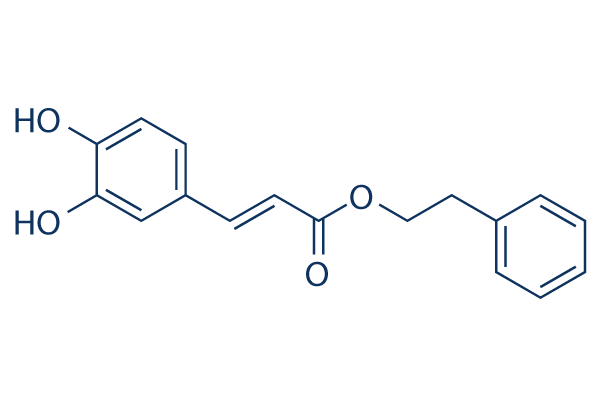
Estructura química
Peso molecular: 284.31
Control de calidad
| Dianas relacionadas | HDAC Antioxidant ROS IκB/IKK Nrf2 AP-1 MALT NOD |
|---|---|
| Otros NF-κB Inhibidores | DCZ0415 Omaveloxolone (RTA-408) BAY 11-7082 (BAY 11-7821) JSH-23 QNZ (EVP4593) SC75741 DHA (Dihydroartemisinin) Withaferin A (WFA) Andrographolide Evodiamine |
Cultivo celular, tratamiento y concentración de trabajo
| Líneas celulares | Tipo de ensayo | Concentración | Tiempo de incubación | Formulación | Descripción de la actividad | PMID |
|---|---|---|---|---|---|---|
| mouse RAW264.7 cells | Function assay | 24 h | Inhibition of LPS-induced nitric oxide production in mouse RAW264.7 cells assessed as nitrite accumulation administered 1 hr before LPS challenge and measured after 24 hrs by Griess reagent assay, EC50=0.193 μM | |||
| mouse 26-L5 cells | Proliferation assay | 72 h | Antiproliferative activity against mouse 26-L5 cells after 72 hrs by MTT assay, EC50=0.3 μM | |||
| human HeLa cells | Proliferation assay | 72 h | Antiproliferative activity against human HeLa cells after 72 hrs by MTT assay, EC50=2.36 μM | |||
| human Bewo cells | Function assay | Antitumor activity against human Bewo cells assessed as inhibition of cell growth by MTT assay, IC50=2.96 μM | ||||
| mouse J774.1 cells | Function assay | 24 h | Inhibition of LPS-induced NO production in mouse J774.1 cells after 24 hrs by Griess reagent assay, IC50=4.8 μM | |||
| human Bel7402 cells | Cytotoxic assay | Cytotoxicity against human Bel7402 cells by MTT assay, IC50=5.5 μM | ||||
| human LNCAP cells | Function assay | 24 h | Antiandrogenic activity in human LNCAP cells assessed as reduction in DHT-stimulated PSA release after 24 hrs by ELISA, IC50=6.2 nM | |||
| mouse BV2 cells | Function assay | 24 h | Inhibition of nitric oxide production in LPS-stimulated mouse BV2 cells treated 3 hrs before LPS addition measured after 24 hrs by Griess assay, IC50=6.4 μM | |||
| mouse B16-BL6 cells | Proliferation assay | 72 h | Antiproliferative activity against mouse B16-BL6 cells after 72 hrs by MTT assay, EC50=6.79 μM | |||
| HUVEC cells | Cytotoxic assay | 18 h | Cytoprotective activity against H2O2-induced oxidative stress in HUVEC cells after 18 hrs by Cell-Titer Blue assay | |||
| human HT1080 cells | Proliferation assay | 72 h | Antiproliferative activity against human HT1080 cells after 72 hrs by MTT assay, EC50=9.5 μM | |||
| human HL60 cells | Cytotoxic assay | 72 h | Cytotoxicity against human HL60 cells after 72 hrs by MTT assay, IC50=9.8 μM | |||
| human LS 174T cells | Cytotoxic assay | 72 h | Cytotoxicity against human LS 174T cells after 72 hrs by MTT assay, IC60=9.9 μM | |||
| human SGC7901 cells | Function assay | Antitumor activity against human SGC7901 cells assessed as inhibition of cell growth by MTT assay, IC50=14.26 μM | ||||
| human Bel7404 cells | Cytotoxic assay | 72 h | Cytotoxicity against human Bel7404 cells after 72 hrs by MTT assay, IC50=14.5 μM | |||
| human BGC823 cells | Cytotoxic assay | 72 h | Cytotoxicity against human BGC823 cells after 72 hrs by MTT assay, IC50=19.3 μM | |||
| human HO8910 cells | Cytotoxic assay | 72 h | Cytotoxicity against human HO8910 cells after 72 hrs by MTT assay, IC50=25.5 μM | |||
| human MCF7 cells | Cytotoxic assay | Cytotoxicity against human MCF7 cells by MTT assay, IC50=26.7 μM | ||||
| human A549 cells | Cytotoxic assay | 72 h | Cytotoxicity against human A549 cells after 72 hrs by MTT assay, IC50=26.8 μM | |||
| human LNCAP cells | Cytotoxic assay | 24 h | Cytotoxicity against human LNCAP cells assessed as reduction in cell viability after 24 hrs by WST-1 assay, IC50=33.7 μM | |||
| human HeLa cells | Function assay | Antitumor activity against human HeLa cells assessed as inhibition of cell growth by MTT assay, IC50=37.98 μM | ||||
| human HepG2 cells | Function assay | Antitumor activity against human HepG2 cells assessed as inhibition of cell growth by MTT assay, IC50=40.87 μM | ||||
| human ECA109 cells | Cytotoxic assay | 72 h | Cytotoxicity against human ECA109 cells after 72 hrs by MTT assay, IC50=42.6 μM | |||
| human BCG823 cells | Cytotoxic assay | Cytotoxicity against human BCG823 cells by MTT assay, IC50=44.6 μM | ||||
| human KB cells | Cytotoxic assay | 72 h | Cytotoxicity against human KB cells after 72 hrs by MTT assay, IC50=45.2 μM | |||
| human K562 cells | Cytotoxic assay | 72 h | Cytotoxicity against human K562 cells after 72 hrs by MTT assay, IC50=46 μM | |||
| rat VSMC | Function assay | 5 μM | 30 mins | Decrease in intracellular ROS level in PDGF-stimulated rat VSMC at 5 uM pretreated with compound for 30 mins measured after up to 23 hrs of post stimulation using H2DCF by flow cytometric analysis | ||
| rat PC12 cells | Function assay | 2.5 μM | 3 h | Neuroprotective activity against H2O2-induced damage in rat PC12 cells assessed as cell viability at 2.5 uM preincubated for 3 hrs followed by H2O2 challenge measured after 5 hrs by MTT assay | ||
| Haga clic para ver más datos experimentales de líneas celulares | ||||||
Información química, almacenamiento y estabilidad
| Peso molecular | 284.31 | Fórmula | C17H16O4 |
Almacenamiento (Desde la fecha de recepción) | |
|---|---|---|---|---|---|
| Nº CAS | 104594-70-9 | Descargar SDF | Almacenamiento de soluciones madre |
|
|
| Sinónimos | CAPE, Phenylethyl Caffeate | Smiles | C1=CC=C(C=C1)CCOC(=O)C=CC2=CC(=C(C=C2)O)O | ||
Solubilidad
|
In vitro |
DMSO
: 56 mg/mL
(196.96 mM)
Ethanol : 56 mg/mL Water : Insoluble |
Calculadora de Molaridad
|
In vivo |
|||||
Calculadora de formulación in vivo (Solución clara)
Paso 1: Introduzca la información a continuación (Recomendado: Un animal adicional para tener en cuenta la pérdida durante el experimento)
Paso 2: Introduzca la formulación in vivo (Esto es solo la calculadora, no la formulación. Por favor, contáctenos primero si no hay una formulación in vivo en la sección de Solubilidad.)
Resultados del cálculo:
Concentración de trabajo: mg/ml;
Método para preparar el líquido maestro de DMSO: mg fármaco predissuelto en μL DMSO ( Concentración del líquido maestro mg/mL, Por favor, contáctenos primero si la concentración excede la solubilidad del DMSO del lote del fármaco. )
Método para preparar la formulación in vivo: Tomar μL DMSO líquido maestro, luego añadirμL PEG300, mezclar y clarificar, luego añadirμL Tween 80, mezclar y clarificar, luego añadir μL ddH2O, mezclar y clarificar.
Método para preparar la formulación in vivo: Tomar μL DMSO líquido maestro, luego añadir μL Aceite de maíz, mezclar y clarificar.
Nota: 1. Por favor, asegúrese de que el líquido esté claro antes de añadir el siguiente disolvente.
2. Asegúrese de añadir el (los) disolvente(s) en orden. Debe asegurarse de que la solución obtenida, en la adición anterior, sea una solución clara antes de proceder a añadir el siguiente disolvente. Se pueden utilizar métodos físicos como el vórtice, el ultrasonido o el baño de agua caliente para ayudar a la disolución.
Mecanismo de acción
| Targets/IC50/Ki |
NF-κB
|
|---|---|
| In vitro |
El Caffeic acid phenethyl ester bloquea la activación de NF-κB inducida por éster de forbol, ceramida, ácido okadaico y peróxido de hidrógeno al prevenir la translocación de la subunidad p65 de NF-κB al núcleo. En una serie de líneas celulares tumorales, el Caffeic acid phenethyl ester muestra una prometedora actividad antiproliferativa con EC50 de 1,76, 3,16, 13,7 y 44,0 μM contra las líneas celulares de colon murino 26-L5, melanoma murino B16-BL6, fibrosarcoma humano HT-1080 y adenocarcinoma pulmonar humano A549, respectivamente. El Caffeic acid phenethyl ester, como potente antioxidante, ejerce su efecto antiapoptótico en células granulares cerebelosas al bloquear la formación de ROS e inhibir la actividad de la caspasa. Además, el Caffeic acid phenethyl ester atenúa el fenotipo proinflamatorio de las HSC estimuladas por LPS y la sensibilización de las HSC inducida por LPS a las citocinas fibrogénicas mediante la inhibición de la señalización de NF-κB.
|
| In vivo |
In vivo, el Caffeic acid phenethyl ester (10 mg/kg, i.p.) inhibe el crecimiento y la angiogénesis de tumores primarios en ratones C57BL/6 y BALB/c inoculados con células de carcinoma pulmonar de Lewis, carcinoma de colon y melanoma. El Caffeic acid phenethyl ester (5, 10, 20 mg/kg) también muestra efectos inmunomoduladores in vivo al disminuir el peso del timo y/o la celularidad del timo y el bazo.
|
Referencias |
|
Aplicaciones
| Métodos | Biomarcadores | Imágenes | PMID |
|---|---|---|---|
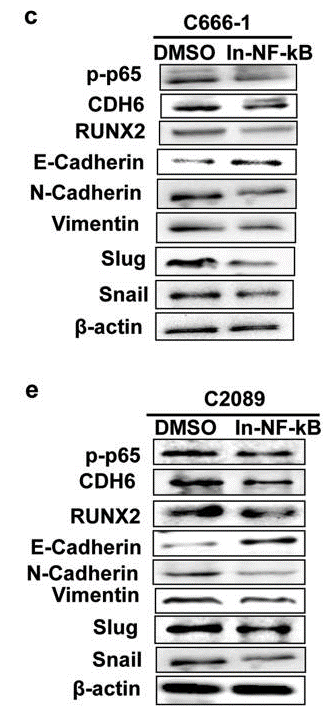
| Western blot | p-p65 / CDH6 / RUNX2 / E-cadherin / N-cadherin / Vimentin / Slug / Snail Nrf2 AKT / AKT1 / AKT2 / AKT3 / p-AKT / FOXO1 / FOXO3a / p-FOXO1 / p-FOXO3a / Skp2 / p27(Kip) / Cyclin D1 / Rb / p-Rb |
|
29284791 |
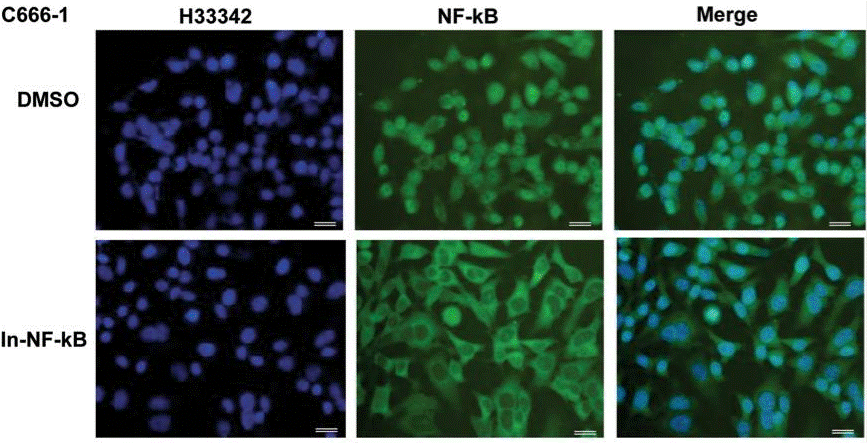
| Immunofluorescence | NF-κB |
|
29284791 |
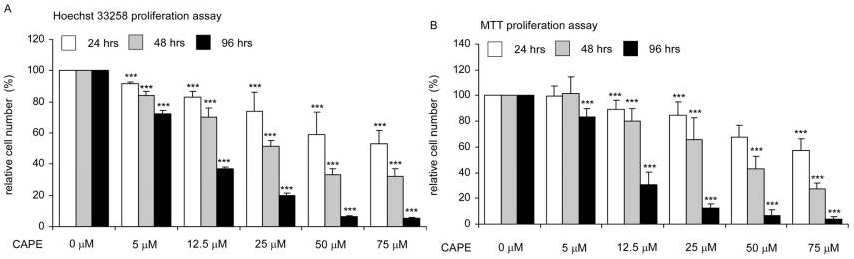
| Growth inhibition assay | Cell number |
|
23615471 |
Información del ensayo clínico
(datos de https://clinicaltrials.gov, actualizado el 2024-05-22)
| Número NCT | Reclutamiento | Condiciones | Patrocinador/Colaboradores | Fecha de inicio | Fases |
|---|---|---|---|---|---|
| NCT05726708 | Recruiting | Autism Spectrum Disorder |
Centre Hospitalier Universitaire Vaudois |
October 24 2023 | Not Applicable |
| NCT05934019 | Recruiting | Mental Health Issue|Transdiagnostic Mechanisms|Adolescent Psychology|Prevention|Online Intervention|Psychological Intervention|Mental Disorder in Adolescence Subclinical |
University of Bern |
June 9 2023 | Not Applicable |
Soporte técnico
Tel: +1-832-582-8158 Ext:3
Si tiene alguna otra consulta, por favor deje un mensaje.

Los productos son solo para uso de investigación. No para uso humano. No vendemos a pacientes.
©Copyright 2013 Selleck Chemicals. Todos los derechos reservados.