
Datos técnicos
| Fórmula | C17H16O4 |
||||||
| Peso molecular | 284.31 | Número CAS | 104594-70-9 | ||||
| Solubilidad (25°C)* | In vitro | DMSO | 57 mg/mL (200.48 mM) | ||||
| Ethanol | 57 mg/mL (200.48 mM) | ||||||
| Water | Insoluble | ||||||
| In vivo (Agregue los solventes al producto individualmente y en orden.) |
|
||||||
|
* <1 mg/ml significa ligeramente soluble o insoluble. * Tenga en cuenta que Selleck prueba la solubilidad de todos los compuestos internamente, y la solubilidad real puede diferir ligeramente de los valores publicados. Esto es normal y se debe a ligeras variaciones entre lotes. * Envío a temperatura ambiente (Las pruebas de estabilidad demuestran que este producto se puede enviar sin medidas de refrigeración.) |
|||||||
Preparación de soluciones madre
Actividad biológica
| Descripción | El Caffeic acid phenethyl ester (CAPE, Phenylethyl Caffeate) es un potente y específico inhibidor de la activación de NF-κB, y también presenta actividades antioxidantes, inmunomoduladoras y antiinflamatorias. | |
|---|---|---|
| Objetivos |
|
|
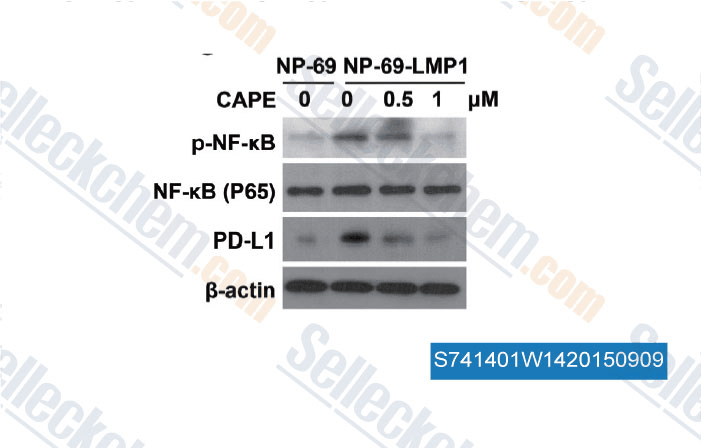
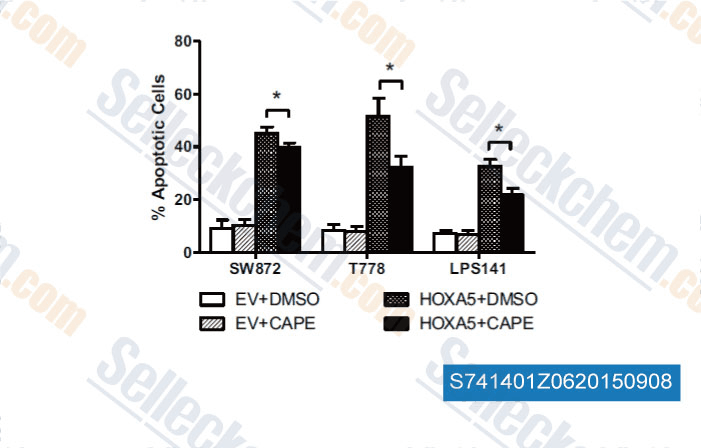
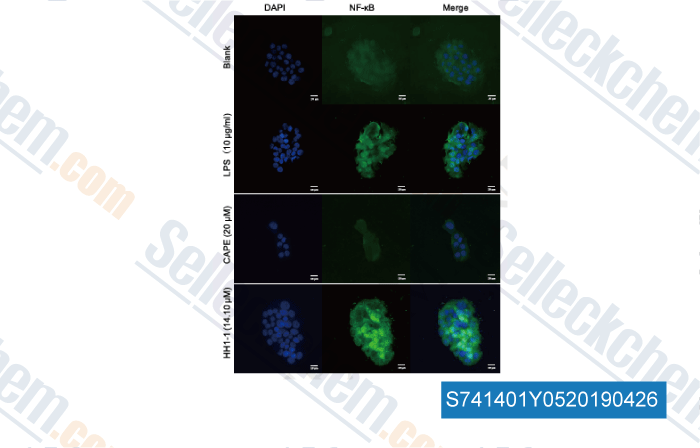
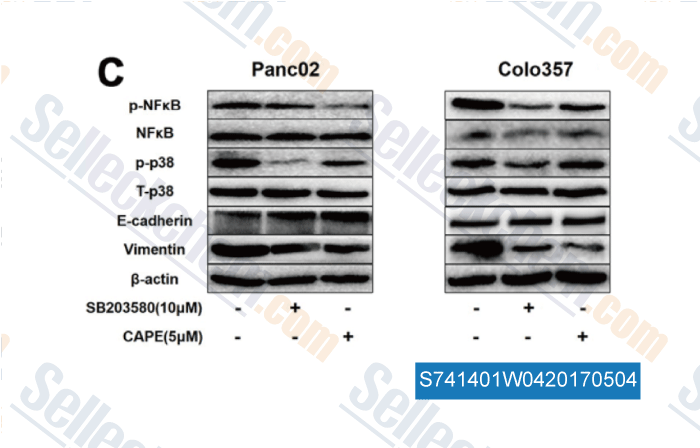
| In vitro | El Caffeic acid phenethyl ester bloquea la activación de NF-κB inducida por éster de forbol, ceramida, ácido okadaico y peróxido de hidrógeno al prevenir la translocación de la subunidad p65 de NF-κB al núcleo. En una serie de líneas celulares tumorales, el Caffeic acid phenethyl ester muestra una prometedora actividad antiproliferativa con EC50 de 1,76, 3,16, 13,7 y 44,0 μM contra las líneas celulares de colon murino 26-L5, melanoma murino B16-BL6, fibrosarcoma humano HT-1080 y adenocarcinoma pulmonar humano A549, respectivamente. El Caffeic acid phenethyl ester, como potente antioxidante, ejerce su efecto antiapoptótico en células granulares cerebelosas al bloquear la formación de ROS e inhibir la actividad de la caspasa. Además, el Caffeic acid phenethyl ester atenúa el fenotipo proinflamatorio de las HSC estimuladas por LPS y la sensibilización de las HSC inducida por LPS a las citocinas fibrogénicas mediante la inhibición de la señalización de NF-κB. | |
| In vivo | In vivo, el Caffeic acid phenethyl ester (10 mg/kg, i.p.) inhibe el crecimiento y la angiogénesis de tumores primarios en ratones C57BL/6 y BALB/c inoculados con células de carcinoma pulmonar de Lewis, carcinoma de colon y melanoma. El Caffeic acid phenethyl ester (5, 10, 20 mg/kg) también muestra efectos inmunomoduladores in vivo al disminuir el peso del timo y/o la celularidad del timo y el bazo. |
Protocolo (de referencia)
| Ensayo celular: |
|
|---|---|
| Estudio en animales: |
|
Referencias
|
Validación de productos por parte del cliente
-
Datos de [ , , Oncotarget, 2014, 5(23): 12189-202 ]
-
Datos de [ , , Sci Rep, 2015, 5: 12580 ]
-
Datos de [ , , Carbohydr Polym, 2018, 202:134-142 ]
-
Datos de [ , , Oncotarget, 2016, 7(25):38539-38550 ]
Sellecks Caffeic Acid Phenethyl Ester Ha sido citado por 56 Publicaciones
| Caffeic acid phenethyl ester protects renal tubular epithelial cells against ferroptosis in diabetic kidney disease via restoring PINK1-mediated mitophagy [ Mol Med, 2025, 31(1):264] | PubMed: 40702453 |
| Growth differentiation factor 15 is a glucose-downregulated gene acting as the cross talk between stroma and cancer cells of the human bladder [ Am J Physiol Cell Physiol, 2025, 328(2):C557-C573] | PubMed: 39804805 |
| Caffeic Acid Phenethyl Ester Protects Neurons Against Oxidative Stress and Neurodegeneration During Traumatic Brain Injury [ Biomolecules, 2025, 15(1)80] | PubMed: 39858474 |
| Osteopontin deficiency promotes cartilaginous endplate degeneration by enhancing the NF-κB signaling to recruit macrophages and activate the NLRP3 inflammasome [ Bone Res, 2024, 12(1):53] | PubMed: 39242551 |
| Calpain-2 mediates SARS-CoV-2 entry via regulating ACE2 levels [ mBio, 2024, e0228723.] | PubMed: 38349185 |
| Clarithromycin Modulates Neutrophilic Inflammation Induced by Prevotella intermedia in Human Airway Epithelial Cells [ Antibiotics (Basel), 2024, 13(9)909] | PubMed: 39335081 |
| CAPE activates AMPK and Foxo3 signaling to induce growth inhibition and ferroptosis in triple-negative breast cancer [ PLoS One, 2024, 19(12):e0315037] | PubMed: 39729481 |
| Caffeic acid phenethyl ester restores mitochondrial homeostasis against peritoneal fibrosis induced by peritoneal dialysis through the AMPK/SIRT1 pathway [ Ren Fail, 2024, 46(1):2350235] | PubMed: 38721924 |
| Caffeic Acid Phenethyl Ester Suppresses Oxidative Stress and Regulates M1/M2 Microglia Polarization via Sirt6/Nrf2 Pathway to Mitigate Cognitive Impairment in Aged Mice following Anesthesia and Surgery [ Antioxidants (Basel), 2023, 12(3)714] | PubMed: 36978961 |
| Caffeic acid phenethyl ester suppresses metastasis of breast cancer cells by inactivating FGFR1 via MD2 [ PLoS One, 2023, 18(7):e0289031] | PubMed: 37490511 |
POLÍTICA DE DEVOLUCIÓN
La Política de Devolución Incondicional de Selleck Chemical garantiza una experiencia de compra en línea fluida para nuestros clientes. Si no está satisfecho con su compra de alguna manera, puede devolver cualquier artículo(s) dentro de los 7 días posteriores a su recepción. En caso de problemas de calidad del producto, ya sean problemas relacionados con el protocolo o con el producto, puede devolver cualquier artículo(s) dentro de los 365 días a partir de la fecha de compra original. Siga las instrucciones a continuación al devolver productos.
ENVÍO Y ALMACENAMIENTO
Los productos Selleck se transportan a temperatura ambiente. Si recibe el producto a temperatura ambiente, tenga la seguridad de que el Departamento de Inspección de Calidad de Selleck ha realizado experimentos para verificar que la colocación a temperatura normal durante un mes no afectará la actividad biológica de los productos en polvo. Después de la recogida, guarde el producto de acuerdo con los requisitos descritos en la hoja de datos. La mayoría de los productos Selleck son estables en las condiciones recomendadas.
NO PARA USO HUMANO, DIAGNÓSTICO VETERINARIO O TERAPÉUTICO.