
solo para uso en investigación
Thalidomide E3 ligase Ligand Químico
Cat. No.: S1193
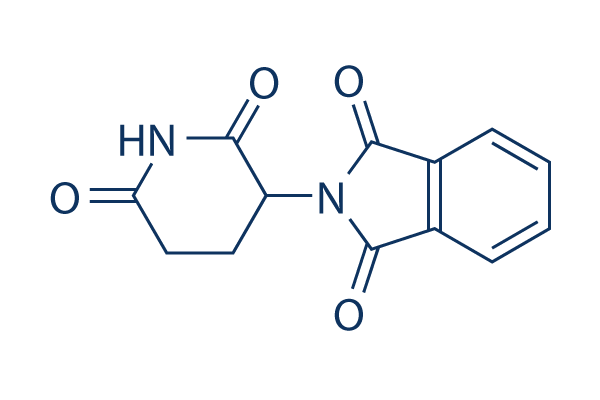
Estructura química
Peso molecular: 258.23
Control de calidad (Quality Control)
| Dianas relacionadas | Proteasome E1 Activating E3 Ligase DUB SUMO p97 E2 conjugating |
|---|---|
| Otros E3 ligase Ligand Inhibidores | CC-99282 |
Cultivo celular, tratamiento y concentración de trabajo
(Cell Culture, Treatment & Working Concentration)
| Líneas celulares | Tipo de ensayo | Concentración | Tiempo de incubación | Formulación | Descripción de la actividad | PMID |
|---|---|---|---|---|---|---|
| HeLa | Function assay | Inhibition of IL-1-alpha-induced NF-kappaB activation in HeLa cells assessed as blocking of p50/p65 nuclear translocation, IC50=2.04μM | 17845850 | |||
| RAW264.7 | Antiinflammatory assay | 10 uM | 3 hrs | Antiinflammatory activity in mouse LPS-activated RAW264.7 cells assessed as ROS scavenging activity at 10 uM pretreated for 3 hrs before LPS challenge measured by decrease in fluorescent intensity by confocal microscopy | 18723357 | |
| RAW264.7 | Function assay | 1 uM | 3 hrs | Reduction in iNOS expression in LPS-activated mouse RAW264.7 cells at 1 uM pretreated for 3 hrs before LPS challenge assessed after 24 hrs by Western blot | 18723357 | |
| RAW264.7 | Function assay | 10 uM | 3 hrs | Reduction in iNOS expression in LPS-activated mouse RAW264.7 cells at 10 uM pretreated for 3 hrs before LPS challenge assessed after 24 hrs by Western blot | 18723357 | |
| RAW264.7 | Function assay | 10 uM | 3 hrs | Reduction in pERK1/2 expression in LPS-activated mouse RAW264.7 cells at 10 uM pretreated for 3 hrs before LPS challenge assessed after 24 hrs by Western blot | 18723357 | |
| Ehrlich ascites carcinoma cells | Toxicity assay | 1.25 mM/kg | 7 days | Toxicity in Swiss albino mouse bearing mouse Ehrlich ascites carcinoma cells assessed as focal degeneration of hepatocytes treated after 7 days post-tumor implantation at 1.25 mM/kg, sc for 5 days by histopathological analysis | 18951804 | |
| Ehrlich ascites carcinoma cells | Toxicity assay | 1.25 mM/kg | 7 days | Toxicity in Swiss albino mouse bearing mouse Ehrlich ascites carcinoma cells assessed as focal necrosis of hepatocytes treated after 7 days post-tumor implantation at 1.25 mM/kg, sc for 5 days by histopathological analysis | 18951804 | |
| BTI-TN-5B1-4 | Function assay | 30 mins | Binding affinity to human CRBN (1 to 442 residues)/N-terminal 6His-tagged human DDB1 (1 to 1140 residues) expressed in baculovirus infected BTI-TN-5B1-4 insect cells after 30 mins by cy5 probe based fluorescence polarization assay, Kd=0.25μM | 31117518 | ||
| Haga clic para ver más datos experimentales de líneas celulares | ||||||
Información química, almacenamiento y estabilidad (Chemical Information, Storage & Stability)
| Peso molecular | 258.23 | Fórmula | C13H10N2O4 |
Almacenamiento (Desde la fecha de recepción) | |
|---|---|---|---|---|---|
| Nº CAS | 50-35-1 | Descargar SDF | Almacenamiento de soluciones madre |
|
|
| Sinónimos | K17 | Smiles | C1CC(=O)NC(=O)C1N2C(=O)C3=CC=CC=C3C2=O | ||
Solubilidad (Solubility)
|
In vitro |
DMSO
: 150 mg/mL
(580.87 mM)
Calentado con baño de agua a 60°C;
Ultrasonido;
Water : Insoluble Ethanol : Insoluble |
Calculadora de Molaridad
|
In vivo |
|||||
Calculadora de formulación in vivo (Solución clara)
Paso 1: Introduzca la información a continuación (Recomendado: Un animal adicional para tener en cuenta la pérdida durante el experimento)
Paso 2: Introduzca la formulación in vivo (Esto es solo la calculadora, no la formulación. Por favor, contáctenos primero si no hay una formulación in vivo en la sección de Solubilidad.)
Resultados del cálculo:
Concentración de trabajo: mg/ml;
Método para preparar el líquido maestro de DMSO: mg fármaco predissuelto en μL DMSO ( Concentración del líquido maestro mg/mL, Por favor, contáctenos primero si la concentración excede la solubilidad del DMSO del lote del fármaco. )
Método para preparar la formulación in vivo: Tomar μL DMSO líquido maestro, luego añadirμL PEG300, mezclar y clarificar, luego añadirμL Tween 80, mezclar y clarificar, luego añadir μL ddH2O, mezclar y clarificar.
Método para preparar la formulación in vivo: Tomar μL DMSO líquido maestro, luego añadir μL Aceite de maíz, mezclar y clarificar.
Nota: 1. Por favor, asegúrese de que el líquido esté claro antes de añadir el siguiente disolvente.
2. Asegúrese de añadir el (los) disolvente(s) en orden. Debe asegurarse de que la solución obtenida, en la adición anterior, sea una solución clara antes de proceder a añadir el siguiente disolvente. Se pueden utilizar métodos físicos como el vórtice, el ultrasonido o el baño de agua caliente para ayudar a la disolución.
Mecanismo de acción (Mechanism of Action)
| Targets/IC50/Ki |
E3 Ligase
(Cell-free assay) TNF-alpha
(Cell-free assay) |
|---|---|
| In vitro |
Thalidomide must be metabolized by the liver to form an epoxide that may be the active teratogenic metabolite. This compound selectively inhibits the production of human monocyte tumor necrosis factor alpha (TNF-alpha) when human monocytes are triggered with lipopolysaccharide and other agonists in culture. It exerts its inhibitory action on tumor necrosis factor alpha by enhancing mRNA degradation. This chemical acts directly, by inducing apoptosis or G1 growth arrest, in MM cell lines and in patient MM cells that are resistant to melphalan, doxorubicin, and dexamethasone (Dex). It enhances the anti-MM activity of Dex and, conversely, are inhibited by interleukin 6. This agent is a potent costimulator of primary human T cells in vitro, synergizing with stimulation via the T cell receptor complex to increase interleukin 2-mediated T cell proliferation and interferon gamma production. It also increases the primary CD8+ cytotoxic T cell response induced by allogeneic dendritic cells in the absence of CD4+ T cells. |
| In vivo |
Thalidomide (200 mg/kg) results in an inhibition of the area of vascularized cornea of rabbits that ranged from 30% to 51% in three experiments with a median inhibition of 36%. |
Referencias |
|
Aplicaciones (Applications)
| Métodos | Biomarcadores | Imágenes | PMID |
|---|---|---|---|
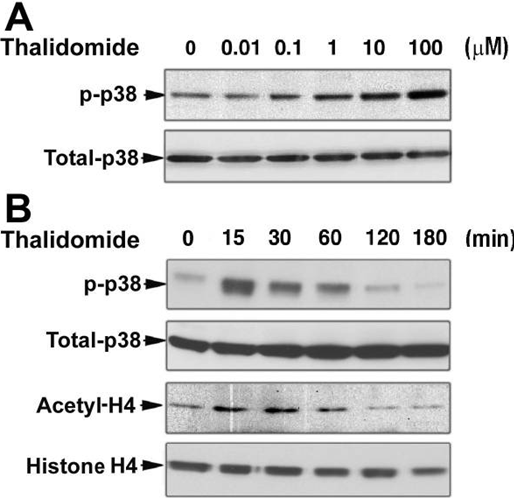
| Western blot | p-p38 / p38 / Acetyl-H4 |
|
17620452 |
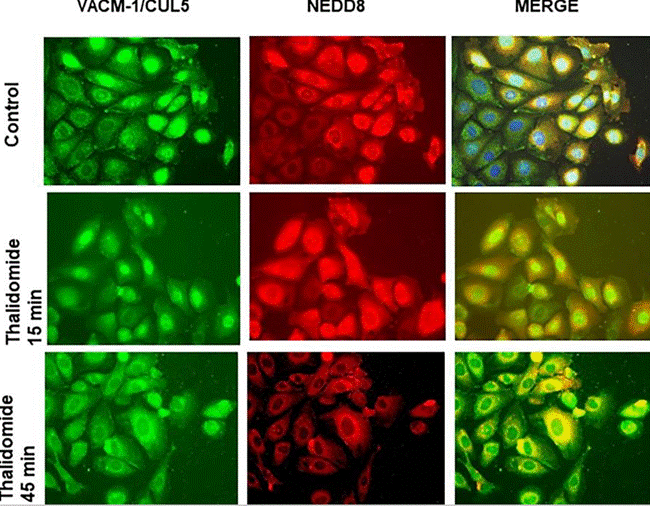
| Immunofluorescence | VCAM-1/CUL5 / NEDD8 bFGF |
|
29746508 |
Información del ensayo clínico (Clinical Trial Information)
(datos de https://clinicaltrials.gov, actualizado el 2025-12-30)
| Número NCT | Reclutamiento | Condiciones | Patrocinador/Colaboradores | Fecha de inicio | Fases |
|---|---|---|---|---|---|
| NCT07309419 | NOT_YET_RECRUITING | Hepatocellular Carcinoma |
Shanghai Zhongshan Hospital |
2025-12-22 | PHASE2; PHASE3 |
| NCT01356290 | RECRUITING | Medulloblastoma Recurrent; Ependymoma Recurrent; ATRT Recurrent; Rare CNS Tumor Recurrent |
Medical University of Vienna |
2014-04 | PHASE2 |
| NCT07671534 | RECRUITING | Solid Tumor Cancer |
Sarcoma Oncology Research Center, LLC |
2026-06 | PHASE2 |
| NCT06617182 | RECRUITING | Radiation Enteritis |
Yongquan Shi |
2024-09-30 | PHASE2 |
| NCT07746245 | NOT_YET_RECRUITING | Peripheral T-Cell Lymphoma |
The First Affiliated Hospital with Nanjing Medical University |
2026-08-01 | PHASE2 |
| NCT07195799 | RECRUITING | Non-Hodgkin Lymphoma |
The First Affiliated Hospital with Nanjing Medical University |
2024-12-31 | PHASE2 |

Los productos son solo para uso de investigación. No para uso humano. No vendemos a pacientes.
©Copyright 2013 Selleck Chemicals. Todos los derechos reservados.