
solo para uso en investigación
Ramelteon MT Receptor agonista
Cat. No.S1259
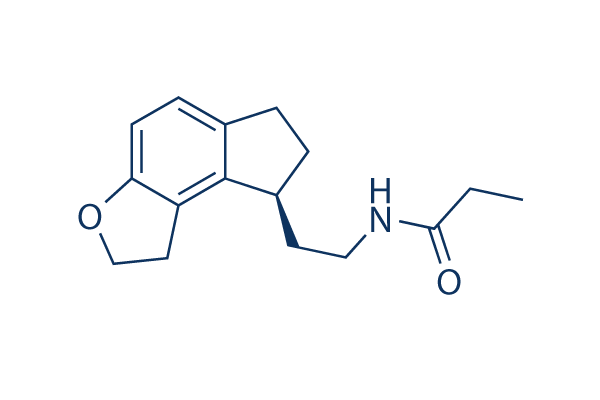
Estructura química
Peso molecular: 259.34
Control de calidad
| Dianas relacionadas | CXCR Hedgehog/Smoothened PKA Adrenergic Receptor AChR 5-HT Receptor Histamine Receptor Dopamine Receptor Ras KRas |
|---|---|
| Otros MT Receptor Inhibidores | Melatonin Luzindole |
Información química, almacenamiento y estabilidad
| Peso molecular | 259.34 | Fórmula | C16H21NO2 |
Almacenamiento (Desde la fecha de recepción) | |
|---|---|---|---|---|---|
| Nº CAS | 196597-26-9 | Descargar SDF | Almacenamiento de soluciones madre |
|
|
| Sinónimos | TAK-375 | Smiles | CCC(=O)NCCC1CCC2=C1C3=C(C=C2)OCC3 | ||
Solubilidad
|
In vitro |
DMSO
: 51 mg/mL
(196.65 mM)
Ethanol : 51 mg/mL Water : Insoluble |
Calculadora de Molaridad
|
In vivo |
|||||
Calculadora de formulación in vivo (Solución clara)
Paso 1: Introduzca la información a continuación (Recomendado: Un animal adicional para tener en cuenta la pérdida durante el experimento)
Paso 2: Introduzca la formulación in vivo (Esto es solo la calculadora, no la formulación. Por favor, contáctenos primero si no hay una formulación in vivo en la sección de Solubilidad.)
Resultados del cálculo:
Concentración de trabajo: mg/ml;
Método para preparar el líquido maestro de DMSO: mg fármaco predissuelto en μL DMSO ( Concentración del líquido maestro mg/mL, Por favor, contáctenos primero si la concentración excede la solubilidad del DMSO del lote del fármaco. )
Método para preparar la formulación in vivo: Tomar μL DMSO líquido maestro, luego añadirμL PEG300, mezclar y clarificar, luego añadirμL Tween 80, mezclar y clarificar, luego añadir μL ddH2O, mezclar y clarificar.
Método para preparar la formulación in vivo: Tomar μL DMSO líquido maestro, luego añadir μL Aceite de maíz, mezclar y clarificar.
Nota: 1. Por favor, asegúrese de que el líquido esté claro antes de añadir el siguiente disolvente.
2. Asegúrese de añadir el (los) disolvente(s) en orden. Debe asegurarse de que la solución obtenida, en la adición anterior, sea una solución clara antes de proceder a añadir el siguiente disolvente. Se pueden utilizar métodos físicos como el vórtice, el ultrasonido o el baño de agua caliente para ayudar a la disolución.
Mecanismo de acción
| Características |
A tricyclic synthetic analog of melatonin.
|
|---|---|
| Targets/IC50/Ki |
MT1 receptor
(Cell-free assay) 14 pM(Ki)
MT receptor (chicken)
(Cell-free assay) 23.1 pM(Ki)
MT2 receptor
(Cell-free assay) 112 pM(Ki)
|
| In vitro |
Ramelteon inhibe la producción de cAMP estimulada por forskolina con una IC50 de 21,2 pM en células CHO. Este compuesto tiene alta afinidad con los receptores MT1 y MT2 humanos recombinantes con pKi de 10,05 y 9,70, respectivamente. Inhibe la agregación de gránulos de pigmento de melanóforos de Xenopus laevis con un pEC50 de 11,48. Este químico (1 nM) aumenta la fosforilación de ERK1/2 no solo en células granulares cerebelosas MT1/MT2, sino también en células granulares cerebelosas que expresan solo uno de los dos receptores de melatonina. 4P-PDOT bloquea la acción estimuladora de este compuesto (1 nM) en células granulares cerebelosas MT1 KO, mientras que la luzindol atenúa la acción de este químico (1 nM) en células granulares cerebelosas MT2 KO. Este (100 μM) induce cualquier dispersión de pigmento mientras que la melatonina dispersa completamente los melanóforos agregados a 10 μM.
|
| In vivo |
Ramelteon (10 mg/kg, i/p) reduce significativamente la latencia del sueño NREM en ratas y también produce un aumento de corta duración en la duración del sueño de movimientos oculares no rápidos (NREM), pero el espectro de potencia NREM no se altera. Este compuesto (0,1 mg/kg y 1 mg/kg, p.o.) acelera el reentrenamiento del ritmo de actividad de la rueda de carrera al nuevo ciclo de luz-oscuridad en ratas sin afectar el aprendizaje o la memoria. Este (0,03 mg/kg y 0,3 mg/kg, p.o.) acorta significativamente la latencia al inicio del sueño y aumenta significativamente la duración total del sueño en monos en libre movimiento sin afectar el comportamiento general de los monos.
|
Referencias |
|
Información del ensayo clínico
(datos de https://clinicaltrials.gov, actualizado el 2024-05-22)
| Número NCT | Reclutamiento | Condiciones | Patrocinador/Colaboradores | Fecha de inicio | Fases |
|---|---|---|---|---|---|
| NCT03931070 | Completed | Delirium |
Rhode Island Hospital |
May 9 2019 | Phase 4 |
| NCT02560324 | Completed | Tobacco Use Disorder |
University of Pennsylvania|National Institute on Drug Abuse (NIDA)|National Institutes of Health (NIH) |
September 2015 | Phase 2 |
| NCT02969343 | Completed | Central Line-Associated Bloodstream Infection (CLABSI)|Venous Thromboembolism|Patient Fall|Catheter-Associated Infection|Severe Hypoglycemia|Opioid-Related Severe Adverse Drug Event|Hospital Acquired Pressure Ulcer|Adverse Drug Event|Severe Hospital Acquired Delerium|Rapid Response Related to Arrhythmia |
Brigham and Women''s Hospital|Northeastern University |
April 2015 | Not Applicable |
| NCT00568789 | Completed | Insomnia |
Takeda |
June 2006 | Phase 4 |
Soporte técnico
Tel: +1-832-582-8158 Ext:3
Si tiene alguna otra consulta, por favor deje un mensaje.

Los productos son solo para uso de investigación. No para uso humano. No vendemos a pacientes.
©Copyright 2013 Selleck Chemicals. Todos los derechos reservados.