
solo para uso en investigación
Neomycin sulfate Antineoplastic and Immunosuppressive Antibiotics inhibidor
Cat. No.S2568
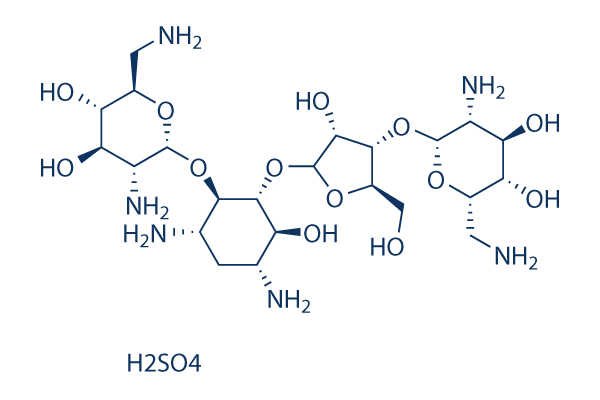
Estructura química
Peso molecular: 712.72
Control de calidad
- Citado en Nature Medicine por su calidad de primer nivel
- COA
- NMR
-
¿Por qué el microanálisis?
- Ficha técnica
- SDS
- Citado en Nature Medicine por su calidad de primer nivel
- COA
- NMR
- Ficha técnica
- SDS
- Citado en Nature Medicine por su calidad de primer nivel
- COA
- NMR
- Ficha técnica
- SDS
- Citado en Nature Medicine por su calidad de primer nivel
- COA
- Ficha técnica
- SDS
| Dianas relacionadas | Integrase Bacterial Antibiotics Anti-infection Fungal Antiviral COVID-19 Parasite Reverse Transcriptase HIV |
|---|---|
| Otros Antineoplastic and Immunosuppressive Antibiotics Inhibidores | Staurosporine (STS) Cyclosporin A Oligomycin A (MCH 32) Puromycin Dihydrochloride Nigericin sodium salt Geldanamycin (NSC 122750) Honokiol Streptozotocin (STZ) Sodium Monensin (NSC 343257) Cephalomannine |
Información química, almacenamiento y estabilidad
| Peso molecular | 712.72 | Fórmula | C23H46N6O13.H2SO4 |
Almacenamiento (Desde la fecha de recepción) | |
|---|---|---|---|---|---|
| Nº CAS | 28002-70-2 ,1405-10-3 | Descargar SDF | Almacenamiento de soluciones madre |
|
|
| Sinónimos | Framycin sulfate | Smiles | C1C(C(C(C(C1N)OC2C(C(C(C(O2)CN)O)O)N)OC3C(C(C(O3)CO)OC4C(C(C(C(O4)CN)O)O)N)O)O)N.OS(=O)(=O)O | ||
Solubilidad
|
In vitro |
Water : 100 mg/mL
DMSO
: Insoluble
Ethanol : Insoluble |
Calculadora de Molaridad
|
In vivo |
|||||
Calculadora de formulación in vivo (Solución clara)
Paso 1: Introduzca la información a continuación (Recomendado: Un animal adicional para tener en cuenta la pérdida durante el experimento)
Paso 2: Introduzca la formulación in vivo (Esto es solo la calculadora, no la formulación. Por favor, contáctenos primero si no hay una formulación in vivo en la sección de Solubilidad.)
Resultados del cálculo:
Concentración de trabajo: mg/ml;
Método para preparar el líquido maestro de DMSO: mg fármaco predissuelto en μL DMSO ( Concentración del líquido maestro mg/mL, Por favor, contáctenos primero si la concentración excede la solubilidad del DMSO del lote del fármaco. )
Método para preparar la formulación in vivo: Tomar μL DMSO líquido maestro, luego añadirμL PEG300, mezclar y clarificar, luego añadirμL Tween 80, mezclar y clarificar, luego añadir μL ddH2O, mezclar y clarificar.
Método para preparar la formulación in vivo: Tomar μL DMSO líquido maestro, luego añadir μL Aceite de maíz, mezclar y clarificar.
Nota: 1. Por favor, asegúrese de que el líquido esté claro antes de añadir el siguiente disolvente.
2. Asegúrese de añadir el (los) disolvente(s) en orden. Debe asegurarse de que la solución obtenida, en la adición anterior, sea una solución clara antes de proceder a añadir el siguiente disolvente. Se pueden utilizar métodos físicos como el vórtice, el ultrasonido o el baño de agua caliente para ayudar a la disolución.
Mecanismo de acción
| In vitro |
La neomicina interactúa preferentemente con el complejo ribozima-sustrato y esta interacción conduce a una reducción en la tasa de escisión al estabilizar el estado fundamental del complejo y desestabilizar el estado de transición del paso de escisión. La neomicina provoca un cambio conformacional en la estructura de la región transactivadora (TAR) que puede detectarse mediante espectroscopia de dicroísmo circular. La neomicina actúa como un inhibidor no competitivo que puede unirse al complejo Tat-TAR y aumentar la constante de velocidad (koff) para la disociación del péptido del ARN. La neomicina es el aminoglucósido (ligando de surco) más eficaz para estabilizar una triple hélice de ADN. La neomicina estabiliza los triplex TAT, así como los triplex de ADN de bases mixtas, mejor que los ligandos conocidos del surco menor del ADN (que generalmente desestabilizan el triplex) y las poliaminas. La neomicina muestra una preferencia por la estabilización de los tripletes TAT, pero también puede acomodar los tripletes CGC(+). La neomicina induce un bloqueo parcial dependiente de la concentración y del voltaje tanto desde la cara citosólica como luminal del canal. La neomicina tiene mayor afinidad por el sitio de interacción luminal que por el citosólico: las constantes de disociación de voltaje cero (Kb(0)) son respectivamente 210,20 nM y 589,70 nM para el bloqueo luminal y citosólico. La neomicina también exhibe un alivio del bloqueo dependiente del voltaje a potenciales de mantenimiento >+60 mV. |
Referencias |
|
|---|
Información del ensayo clínico
(datos de https://clinicaltrials.gov, actualizado el 2024-05-22)
| Número NCT | Reclutamiento | Condiciones | Patrocinador/Colaboradores | Fecha de inicio | Fases |
|---|---|---|---|---|---|
| NCT05593601 | Recruiting | Colonization Asymptomatic |
Mahidol University |
November 24 2022 | Phase 4 |
| NCT00795951 | Completed | Dermatitis Contact |
Allerderm |
November 2008 | Phase 4 |
| NCT00058617 | Completed | Epstein-Barr Virus-Related Hodgkin Lymphoma|Epstein-Barr Virus-Related Non-Hodgkin Lymphoma|EBV Positive Plasma Cell Neoplasm |
Baylor College of Medicine|The Methodist Hospital Research Institute|Center for Cell and Gene Therapy Baylor College of Medicine |
January 1996 | Phase 1 |
Soporte técnico
Tel: +1-832-582-8158 Ext:3
Si tiene alguna otra consulta, por favor deje un mensaje.

Los productos son solo para uso de investigación. No para uso humano. No vendemos a pacientes.
©Copyright 2013 Selleck Chemicals. Todos los derechos reservados.