
solo para uso en investigación
Hygromycin B Antibiótico
Cat. No.S2908
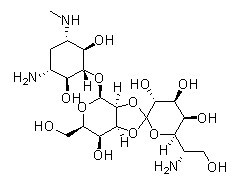
Estructura química
Peso molecular: 527.52
Control de calidad
- Citado en Nature Medicine por su calidad de primer nivel
- COA
- NMR
- Ficha técnica
- SDS
- Citado en Nature Medicine por su calidad de primer nivel
- COA
- Ficha técnica
- SDS
- Citado en Nature Medicine por su calidad de primer nivel
- COA
- NMR
- Ficha técnica
- SDS
- Citado en Nature Medicine por su calidad de primer nivel
- COA
- NMR
- Ficha técnica
- SDS
- Citado en Nature Medicine por su calidad de primer nivel
- COA
- NMR
- Ficha técnica
- SDS
| Dianas relacionadas | Integrase Bacterial Antibiotics Anti-infection Fungal Antiviral COVID-19 Parasite Reverse Transcriptase HIV |
|---|---|
| Otros Antineoplastic and Immunosuppressive Antibiotics Inhibidores | Staurosporine (STS) Cyclosporin A Oligomycin A (MCH 32) Puromycin Dihydrochloride Nigericin sodium salt Geldanamycin (NSC 122750) Honokiol Streptozotocin (STZ) Sodium Monensin (NSC 343257) Cephalomannine |
Información química, almacenamiento y estabilidad
| Peso molecular | 527.52 | Fórmula | C20H37N3O13 |
Almacenamiento (Desde la fecha de recepción) | |
|---|---|---|---|---|---|
| Nº CAS | 31282-04-9 | Descargar SDF | Almacenamiento de soluciones madre |
|
|
| Sinónimos | Hygrovetine | Smiles | CNC1CC(C(C(C1O)OC2C3C(C(C(O2)CO)O)OC4(O3)C(C(C(C(O4)C(CO)N)O)O)O)O)N | ||
Solubilidad
|
In vitro |
Water : 100 mg/mL
DMSO
: Insoluble
Ethanol : Insoluble |
Calculadora de Molaridad
|
In vivo |
|||||
Calculadora de formulación in vivo (Solución clara)
Paso 1: Introduzca la información a continuación (Recomendado: Un animal adicional para tener en cuenta la pérdida durante el experimento)
Paso 2: Introduzca la formulación in vivo (Esto es solo la calculadora, no la formulación. Por favor, contáctenos primero si no hay una formulación in vivo en la sección de Solubilidad.)
Resultados del cálculo:
Concentración de trabajo: mg/ml;
Método para preparar el líquido maestro de DMSO: mg fármaco predissuelto en μL DMSO ( Concentración del líquido maestro mg/mL, Por favor, contáctenos primero si la concentración excede la solubilidad del DMSO del lote del fármaco. )
Método para preparar la formulación in vivo: Tomar μL DMSO líquido maestro, luego añadirμL PEG300, mezclar y clarificar, luego añadirμL Tween 80, mezclar y clarificar, luego añadir μL ddH2O, mezclar y clarificar.
Método para preparar la formulación in vivo: Tomar μL DMSO líquido maestro, luego añadir μL Aceite de maíz, mezclar y clarificar.
Nota: 1. Por favor, asegúrese de que el líquido esté claro antes de añadir el siguiente disolvente.
2. Asegúrese de añadir el (los) disolvente(s) en orden. Debe asegurarse de que la solución obtenida, en la adición anterior, sea una solución clara antes de proceder a añadir el siguiente disolvente. Se pueden utilizar métodos físicos como el vórtice, el ultrasonido o el baño de agua caliente para ayudar a la disolución.
Mecanismo de acción
| In vitro |
Hygromycin B tiene un único sitio de unión dentro del 30S, se localiza en el surco mayor de la hélice muy cerca del eje helicoidal, y establece contacto con nucleótidos de ambas cadenas de ARN en la región 1490-1500 y 1400–1410. El anillo I de HygB está implicado en interacciones no específicas de secuencia con los átomos de oxígeno del fosfato del esqueleto de G1494, además de interacciones específicas de base con G1494 y U1495. Los anillos II y III forman enlaces de hidrógeno débiles y específicos de base con C1404 y U1498, pero su función principal es aparentemente posicionar el anillo IV para la interacción con bases en la región 1496–1498. El anillo IV de HygB se encuentra a menos de 4 Å de la segunda base del codón de ARNm unido al sitio P. Este compuesto (0,38 mM) detiene completamente el crecimiento de células de levadura en medios ricos. Bloquea fuertemente la síntesis de Polipéptidos en extractos libres de células de reticulocitos de conejo, germen de trigo y levadura. Inhibe el alargamiento de la cadena peptídica por polisomas de levadura al prevenir la translocación dependiente del factor de elongación EF-2. Este antibiótico inhibe (80%) la reacción dependiente del factor de elongación (EF)G más GTP de AcPhe-tRNA o peptidil-tRNA natural con puromicina en sistemas libres de células de Escherichia coli. Bloquea las cadenas peptídicas nacientes de polisomas endógenos purificados de E. coli o ribosomes programados con ácido poli(uridílico) durante la síntesis de polipéptidos. Inhibe la translocación no enzimática y la liberación de AcPhe-tRNA del sitio aceptor ribosomal promovida por la depleción de iones NH4. Se utiliza para la selección de resistencia en células L de ratón transfectadas con genes de Escherichia coli que codifican resistencia a los antibióticos aminociclitol Hygromycin B. Este químico se utiliza como marcador seleccionable para la transferencia e integración de T-DNA en el hongo ectomicorrícico Suillus bovinus. |
Referencias |
|
|---|
Soporte técnico
Tel: +1-832-582-8158 Ext:3
Si tiene alguna otra consulta, por favor deje un mensaje.

Los productos son solo para uso de investigación. No para uso humano. No vendemos a pacientes.
©Copyright 2013 Selleck Chemicals. Todos los derechos reservados.