
solo para uso en investigación
Sodium Valproate (Valproic acid sodium) HDAC Inhibidor
Cat. No.: S1168
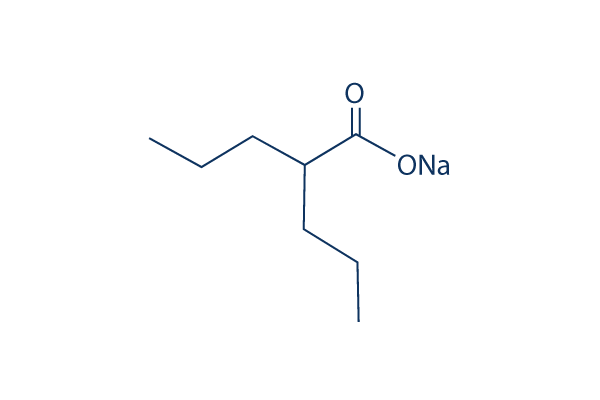
Estructura química
Peso molecular: 166.19
Control de calidad (Quality Control)
Cultivo celular, tratamiento y concentración de trabajo
(Cell Culture, Treatment & Working Concentration)
| Líneas celulares | Tipo de ensayo | Concentración | Tiempo de incubación | Formulación | Descripción de la actividad | PMID |
|---|---|---|---|---|---|---|
| HEK293 | Function assay | 1 mM | Increase in protein disulfide isomerase level in HEK293 cells at 1 mM by immunoblot | 17566732 | ||
| HEK293 | Function assay | 1 mM | Increase in GRP78 protein level in HEK293 cells at 1 mM by immunoblot | 17566732 | ||
| A549 | Function assay | 150 uM | 24 hrs | Inhibition of human HDAC in A549 cells assessed as increase in histone-H4 acetylation at 150 uM after 24 hrs by Western blot | 18294844 | |
| GM15850 | Function assay | 400 uM | 12 hrs | Inhibition of HDAC in human GM15850 cells assessed as increase in total acetylated histone level at 400 uM after 12 hrs by Western blot analysis | 16921367 | |
| PC12 | Function assay | 1 uM | 24 hrs | Induction of autophagy in rat stable inducible PC12 cells expressing A53T alpha-synuclein assessed as A53T alpha-synuclein clearance at 1 uM after 24 hrs by densitometric analysis | 18391949 | |
| PC12 | Function assay | 1 uM | 96 hrs | Induction of autophagy in rat stable inducible PC12 cells expressing EGFP-HDQ74 assessed as soluble EGFP-HDQ74 clearance at 1 uM after 96 hrs by densitometric analysis | 18391949 | |
| SK-N-MC | Function assay | 1 mM | 48 hrs | Induction of autophagy in human SK-N-MC cells expressing EGFP-HDQ74 assessed as reduction in EGFP-HDQ74 aggregation at 1 uM after 48 hrs by densitometric analysis | 18391949 | |
| HL60 | Function assay | 1 mM | 24 hrs | Inhibition of HDAC in human HL60 cells assessed as increase in histone H3 acetylation at 1 mM after 24 hrs by Western blotting method | 25304896 | |
| Haga clic para ver más datos experimentales de líneas celulares | ||||||
Información química, almacenamiento y estabilidad (Chemical Information, Storage & Stability)
| Peso molecular | 166.19 | Fórmula | C8H15NaO2 |
Almacenamiento (Desde la fecha de recepción) | |
|---|---|---|---|---|---|
| Nº CAS | 1069-66-5 | Descargar SDF | Almacenamiento de soluciones madre |
|
|
| Sinónimos | Sodium valproate,NSC 93819,2-Propylpentanoic Acid | Smiles | CCCC(CCC)C(=O)[O-].[Na+] | ||
Solubilidad (Solubility)
|
In vitro |
Water : 100 mg/mL
DMSO
: 33 mg/mL
(198.56 mM)
Ethanol : 33 mg/mL |
Calculadora de Molaridad
|
In vivo |
|||||
Calculadora de formulación in vivo (Solución clara)
Paso 1: Introduzca la información a continuación (Recomendado: Un animal adicional para tener en cuenta la pérdida durante el experimento)
Paso 2: Introduzca la formulación in vivo (Esto es solo la calculadora, no la formulación. Por favor, contáctenos primero si no hay una formulación in vivo en la sección de Solubilidad.)
Resultados del cálculo:
Concentración de trabajo: mg/ml;
Método para preparar el líquido maestro de DMSO: mg fármaco predissuelto en μL DMSO ( Concentración del líquido maestro mg/mL, Por favor, contáctenos primero si la concentración excede la solubilidad del DMSO del lote del fármaco. )
Método para preparar la formulación in vivo: Tomar μL DMSO líquido maestro, luego añadirμL PEG300, mezclar y clarificar, luego añadirμL Tween 80, mezclar y clarificar, luego añadir μL ddH2O, mezclar y clarificar.
Método para preparar la formulación in vivo: Tomar μL DMSO líquido maestro, luego añadir μL Aceite de maíz, mezclar y clarificar.
Nota: 1. Por favor, asegúrese de que el líquido esté claro antes de añadir el siguiente disolvente.
2. Asegúrese de añadir el (los) disolvente(s) en orden. Debe asegurarse de que la solución obtenida, en la adición anterior, sea una solución clara antes de proceder a añadir el siguiente disolvente. Se pueden utilizar métodos físicos como el vórtice, el ultrasonido o el baño de agua caliente para ayudar a la disolución.
Mecanismo de acción (Mechanism of Action)
| Targets/IC50/Ki |
HDAC
(Cell-free assay) Autophagy
(Cell-free assay) GABA receptor
(Cell-free assay) notch1
|
|---|---|
| In vitro |
Valproic acid acts through a distinct pathway that involves direct inhibition of histone deacetylase (IC(50) for HDAC1 = 0.4 mM). Valproic acid mimics the histone deacetylase inhibitor trichostatin A, causing hyperacetylation of histones in cultured cells. Valproic acid, like trichostatin A, also activates transcription from diverse exogenous and endogenous promoters. Valproic acid and trichostatin A have remarkably similar teratogenic effects in vertebrate embryos, while non-teratogenic analogues of valproic acid do not inhibit histone deacetylase and do not activate transcription. Valproic acid induces proliferation of peroxisomes in the rodent liver. Valproic acid at a concentration of 1 mM induces relief of this repression by Gal4 fusions of N‐CoR, TR or PPARδ in a cell line expressing the ligand‐binding domain of PPARδ fused to the DNA‐binding domain of the glucocorticoid receptor (GR) together with a GR‐controlled reporter gene. Valproic acid induces accumulation of hyperacetylated histone and inhibits HDAC activity. Valproic acid induces a specific type of differentiation characterized by reduced proliferation, morphological alterations, marker gene expression and particularly the accumulation of the AP-2 transcription factor as a potential marker of neuronal or neural crest cell-like differentiation in F9 teratocarcinoma cells. Valproic acid impairs cell proliferation or survival as indicated by decreased incorporation of [3H]thymidine in F9 and P19 teratocarcinoma cells. |
| In vivo |
Valproic acid delays growth of the primary tumors in the MT‐450 rat breast cancer model. |
Referencias |
|
Aplicaciones (Applications)
| Métodos | Biomarcadores | Imágenes | PMID |
|---|---|---|---|
| Western blot | Acetyl Histone H3 Active caspase-3 / PARP / Cleaved PARP acetyl-H4 |

|
28542253 |
| Growth inhibition assay | Cell viability |

|
28498322 |
Información del ensayo clínico (Clinical Trial Information)
(datos de https://clinicaltrials.gov, actualizado el 2026-08-13)
| Número NCT | Reclutamiento | Condiciones | Patrocinador/Colaboradores | Fecha de inicio | Fases |
|---|---|---|---|---|---|
| NCT07166393 | NOT_YET_RECRUITING | Moderate Traumatic Brain Injury (TBI); Severe Traumatic Brain Injury |
Northwestern University |
2027-05 | PHASE2; PHASE3 |
| NCT03048084 | RECRUITING | Glioma |
Leiden University Medical Center |
2018-02-01 | PHASE4 |
| NCT02068586 | ACTIVE_NOT_RECRUITING | Ciliary Body and Choroid Melanoma, Medium/Large Size; Ciliary Body and Choroid Melanoma, Small Size; Iris Melanoma; Stage I Intraocular Melanoma; Stage IIA Intraocular Melanoma; Stage IIB Intraocular Melanoma; Stage IIIA Intraocular Melanoma; Stage IIIB Intraocular Melanoma; Stage IIIC Intraocular Melanoma; Stage I Uveal Melanoma AJCC V7; Stage II Uveal Melanoma AJCC V7; Stage III Uveal Melanoma AJCC V7 |
Sidney Kimmel Comprehensive Cancer Center at Thomas Jefferson University |
2014-11-19 | PHASE2 |
| NCT06714357 | RECRUITING | Colorectal Cancer Metastatic |
National Cancer Institute, Naples |
2025-03-12 | PHASE2 |
| NCT05821556 | RECRUITING | Adenocarcinoma of the Pancreas |
National Cancer Institute, Naples |
2023-06-12 | PHASE2 |
| NCT01552434 | TERMINATED | Advanced Malignant Neoplasm; Castleman Disease; Digestive System Carcinoma; Erdheim-Chester Disease; Lip and Oral Cavity Carcinoma; Lymphangioleiomyomatosis; Malignant Endocrine Neoplasm; Malignant Female Reproductive System Neoplasm; Malignant Male Reproductive System Neoplasm; Malignant Neoplasm; Malignant Respiratory Tract Neoplasm; Malignant Thoracic Neoplasm; Malignant Urinary System Neoplasm; Mesothelial Neoplasm; Metastatic Malignant Neoplasm; Metastatic Urothelial Carcinoma; Neurofibromatosis Type 2; Recurrent Adult Soft Tissue Sarcoma; Recurrent Breast Carcinoma; Recurrent Childhood Soft Tissue Sarcoma; Recurrent Digestive System Carcinoma; Recurrent Female Reproductive System Carcinoma; Recurrent Male Reproductive System Carcinoma; Recurrent Malignant Neoplasm; Recurrent Pharyngeal Carcinoma; Recurrent Thyroid Gland Carcinoma; Refractory Malignant Neoplasm; Soft Tissue Neoplasm; Stage III Breast Cancer AJCC v7; Stage III Pharyngeal Cancer; Stage IIIA Breast Cancer AJCC v7; Stage IIIB Breast Cancer AJCC v7; Stage IIIC Breast Cancer AJCC v7; Stage IV Breast Cancer AJCC v6 and v7; Stage IV Pharyngeal Cancer; Stage IVA Pharyngeal Cancer; Stage IVB Pharyngeal Cancer; Stage IVC Pharyngeal Cancer; Thyroid Gland Neoplasm |
M.D. Anderson Cancer Center |
2012-10-16 | PHASE1 |

Los productos son solo para uso de investigación. No para uso humano. No vendemos a pacientes.
©Copyright 2013 Selleck Chemicals. Todos los derechos reservados.