
solo para uso en investigación
LY2886721 BACE inhibidor
Cat. No.S2156
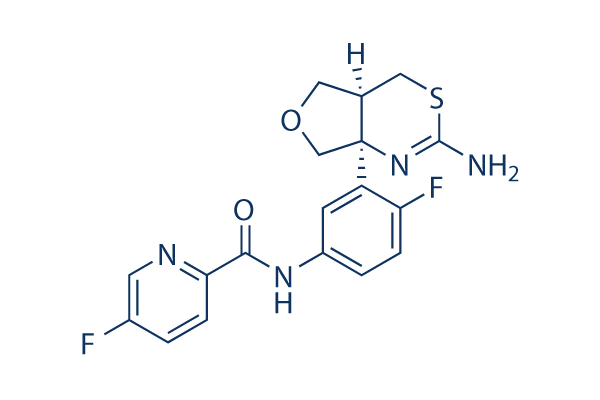
Estructura química
Peso molecular: 390.41
Control de calidad
Información química, almacenamiento y estabilidad
| Peso molecular | 390.41 | Fórmula | C18H16F2N4O2S |
Almacenamiento (Desde la fecha de recepción) | |
|---|---|---|---|---|---|
| Nº CAS | 1262036-50-9 | Descargar SDF | Almacenamiento de soluciones madre |
|
|
| Sinónimos | N/A | Smiles | C1C2CSC(=NC2(CO1)C3=C(C=CC(=C3)NC(=O)C4=NC=C(C=C4)F)F)N | ||
Solubilidad
|
In vitro |
DMSO
: 35 mg/mL
(89.64 mM)
Water : Insoluble Ethanol : Insoluble |
Calculadora de Molaridad
|
In vivo |
|||||
Calculadora de formulación in vivo (Solución clara)
Paso 1: Introduzca la información a continuación (Recomendado: Un animal adicional para tener en cuenta la pérdida durante el experimento)
Paso 2: Introduzca la formulación in vivo (Esto es solo la calculadora, no la formulación. Por favor, contáctenos primero si no hay una formulación in vivo en la sección de Solubilidad.)
Resultados del cálculo:
Concentración de trabajo: mg/ml;
Método para preparar el líquido maestro de DMSO: mg fármaco predissuelto en μL DMSO ( Concentración del líquido maestro mg/mL, Por favor, contáctenos primero si la concentración excede la solubilidad del DMSO del lote del fármaco. )
Método para preparar la formulación in vivo: Tomar μL DMSO líquido maestro, luego añadirμL PEG300, mezclar y clarificar, luego añadirμL Tween 80, mezclar y clarificar, luego añadir μL ddH2O, mezclar y clarificar.
Método para preparar la formulación in vivo: Tomar μL DMSO líquido maestro, luego añadir μL Aceite de maíz, mezclar y clarificar.
Nota: 1. Por favor, asegúrese de que el líquido esté claro antes de añadir el siguiente disolvente.
2. Asegúrese de añadir el (los) disolvente(s) en orden. Debe asegurarse de que la solución obtenida, en la adición anterior, sea una solución clara antes de proceder a añadir el siguiente disolvente. Se pueden utilizar métodos físicos como el vórtice, el ultrasonido o el baño de agua caliente para ayudar a la disolución.
Mecanismo de acción
| Targets/IC50/Ki |
BACE2
(Cell-free assay) 10.2 nM
BACE1
(Cell-free assay) 20.3 nM
|
|---|---|
| In vitro |
LY2886721 es una pequeña molécula oral, un inhibidor de la enzima de escisión de la proteína amiloide del sitio β (BACE) con el potencial de inhibir la síntesis de β-amiloide y, por lo tanto, de ralentizar la progresión clínica de la EA. Este compuesto también puede dirigirse a la γ-secretasa para inhibir la síntesis de β-amiloide. Inhibe la hBACE1 recombinante con una IC50 de 20,3 nM. En ensayos celulares, este químico inhibe Abeta con una IC50 de 18,7 nM y 10,7 nM, en cultivos neuronales de HEK293Swe y PDAPP, respectivamente. Tiene alta selectividad contra proteasas clave fuera del objetivo, lo que traduce eficientemente la actividad in vitro en una robusta reducción de amiloide β in vivo en modelos animales no clínicos. La evaluación de su actividad contra hBACE2 demuestra una IC50 de 10,2 nM. La evaluación de la actividad del compuesto contra catepsina D, pepsina, renina u otras proteasas aspartílicas importantes muestra esencialmente ninguna inhibición (IC50 >100.000 nM), lo que sugiere que la actividad contra estas proteasas aspartílicas comunes es poco probable que sea significativa.
|
| In vivo |
La administración oral de LY2886721 a ratones PDAPP produce reducciones dosis-dependientes de Abeta, C99 y sAPPbeta en el cerebro. Los niveles de Abeta cerebral disminuyen entre un 20% y un 65% en relación con los grupos tratados con vehículo tres horas después de una dosis de 3-30 mg/kg de este compuesto. Los niveles de C99 y sAPPb cerebrales también se reducen de manera dosis-dependiente, lo que es consistente con la inhibición de BACE1 in vivo. Las respuestas farmacodinámicas a este químico persisten hasta 9 horas post-dosis en cerebros de ratones PDAPP. Estudios farmacodinámicos en perros beagle revelan reducciones robustas y sostenidas de Abeta plasmático después de una dosis de 1 mg/kg. Los efectos centrales de la inhibición de BACE1 en perros se manifiestan por una reducción del 50% en Abeta del LCR a las 9 horas después de una dosis de 0,5 mg/kg. La t1/2 de eliminación terminal media geométrica se determina en 17,2 h (rango 8,19-36,3 h). La depuración oral aparente media geométrica es de 34,8 L/h (38% CV) y el volumen aparente de distribución durante la fase terminal fue de 863 L (56% CV) en todos los niveles de dosis. Este compuesto es libremente permeable a través de la barrera hematoencefálica.
|
Referencias |
|
Información del ensayo clínico
(datos de https://clinicaltrials.gov, actualizado el 2024-05-22)
| Número NCT | Reclutamiento | Condiciones | Patrocinador/Colaboradores | Fecha de inicio | Fases |
|---|---|---|---|---|---|
| NCT01807026 | Completed | Alzheimer Disease|Healthy Volunteers |
Eli Lilly and Company |
March 2013 | Phase 1 |
| NCT01534273 | Completed | Healthy Volunteers |
Eli Lilly and Company |
February 2012 | Phase 1 |
| NCT01367262 | Completed | Healthy Volunteers |
Eli Lilly and Company |
June 2011 | Phase 1 |
| NCT01227252 | Completed | Alzheimer''s Disease |
Eli Lilly and Company |
December 2010 | Phase 1 |
| NCT01133405 | Completed | Alzheimer''s Disease |
Eli Lilly and Company |
June 2010 | Phase 1 |
Soporte técnico
Tel: +1-832-582-8158 Ext:3
Si tiene alguna otra consulta, por favor deje un mensaje.

Los productos son solo para uso de investigación. No para uso humano. No vendemos a pacientes.
©Copyright 2013 Selleck Chemicals. Todos los derechos reservados.