
solo para uso en investigación
Azithromycin Antibiotics for Mammalian Cell Culture inhibidor
Cat. No.S1835
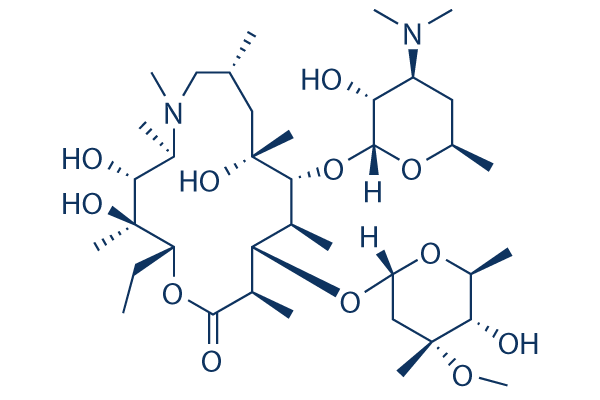
Estructura química
Peso molecular: 748.98
Control de calidad
- Citado en Nature Medicine por su calidad de primer nivel
- COA
- NMR
- Ficha técnica
- SDS
- Citado en Nature Medicine por su calidad de primer nivel
- COA
- NMR
- Ficha técnica
- SDS
- Citado en Nature Medicine por su calidad de primer nivel
- COA
- NMR
- Ficha técnica
- SDS
- Citado en Nature Medicine por su calidad de primer nivel
- COA
- Ficha técnica
- SDS
- Citado en Nature Medicine por su calidad de primer nivel
- COA
- Ficha técnica
- SDS
Cultivo celular, tratamiento y concentración de trabajo
| Líneas celulares | Tipo de ensayo | Concentración | Tiempo de incubación | Formulación | Descripción de la actividad | PMID |
|---|---|---|---|---|---|---|
| HeLa 299 | Antichlamydial assay | 44 to 48 hrs | Antichlamydial activity against Chlamydia trachomatis serovar L2 infected in human HeLa 299 cells assessed as reduction in number of inclusion bodies measured after 44 to 48 hrs by DAPI staining-based HCS assay, IC50=0.727μM. | 29232584 | ||
| THP1 | Function assay | 30 mins | Drug uptake in human THP1 cells at pH 6 to 7 after 30 mins | 19564365 | ||
| THP1 | Function assay | 24 hrs | Drug uptake in human THP1 cells after 24 hrs in presence of verapamil | 19564365 | ||
| THP1 | Function assay | 24 hrs | Drug uptake in human THP1 cells after 24 hrs in presence of gemfibrozil | 19564365 | ||
| Hep2 | Antichlamydial assay | 4 ug/ml | 8 hrs | Anti-Chlamydial activity against Chlamydia trachomatis Serovar LGV-L2 infected in Hep2 cells assessed as reduction in size and number of chlamydial inclusion at 4 ug/ml treated at 8 hrs post-infection and 24 hrs later re-infecting fresh Hep2 cells monolay | 32227948 | |
| Vero E6 | Antiviral assay | 2 days | Antiviral efficacy against SARS-CoV-2 (strain BavPat1) in Vero E6 cells assessed by inhibition of viral RNA replication measured by RT-PCR after 2 days, EC50=2.12μM. | ChEMBL | ||
| Vero E6 | Antiviral assay | 2 days | Antiviral efficacy against SARS-CoV-2 (strain BavPat1) in Vero E6 cells assessed by inhibition of viral RNA replication measured by RT-PCR after 2 days, EC90=8.65μM. | ChEMBL | ||
| Haga clic para ver más datos experimentales de líneas celulares | ||||||
Información química, almacenamiento y estabilidad
| Peso molecular | 748.98 | Fórmula | C38H72N2O12 |
Almacenamiento (Desde la fecha de recepción) | |
|---|---|---|---|---|---|
| Nº CAS | 83905-01-5 | Descargar SDF | Almacenamiento de soluciones madre |
|
|
| Sinónimos | XZ-450,CP-62993 | Smiles | CCC1C(C(C(N(CC(CC(C(C(C(C(C(=O)O1)C)OC2CC(C(C(O2)C)O)(C)OC)C)OC3C(C(CC(O3)C)N(C)C)O)(C)O)C)C)C)O)(C)O | ||
Solubilidad
|
In vitro |
DMSO
: 100 mg/mL
(133.51 mM)
Ethanol : 100 mg/mL Water : Insoluble |
Calculadora de Molaridad
|
In vivo |
|||||
Calculadora de formulación in vivo (Solución clara)
Paso 1: Introduzca la información a continuación (Recomendado: Un animal adicional para tener en cuenta la pérdida durante el experimento)
Paso 2: Introduzca la formulación in vivo (Esto es solo la calculadora, no la formulación. Por favor, contáctenos primero si no hay una formulación in vivo en la sección de Solubilidad.)
Resultados del cálculo:
Concentración de trabajo: mg/ml;
Método para preparar el líquido maestro de DMSO: mg fármaco predissuelto en μL DMSO ( Concentración del líquido maestro mg/mL, Por favor, contáctenos primero si la concentración excede la solubilidad del DMSO del lote del fármaco. )
Método para preparar la formulación in vivo: Tomar μL DMSO líquido maestro, luego añadirμL PEG300, mezclar y clarificar, luego añadirμL Tween 80, mezclar y clarificar, luego añadir μL ddH2O, mezclar y clarificar.
Método para preparar la formulación in vivo: Tomar μL DMSO líquido maestro, luego añadir μL Aceite de maíz, mezclar y clarificar.
Nota: 1. Por favor, asegúrese de que el líquido esté claro antes de añadir el siguiente disolvente.
2. Asegúrese de añadir el (los) disolvente(s) en orden. Debe asegurarse de que la solución obtenida, en la adición anterior, sea una solución clara antes de proceder a añadir el siguiente disolvente. Se pueden utilizar métodos físicos como el vórtice, el ultrasonido o el baño de agua caliente para ayudar a la disolución.
Mecanismo de acción
| Targets/IC50/Ki |
protein synthesis
|
|---|---|
| In vitro |
Azithromycin reduce aproximadamente un 40% del ARNm y la expresión proteica de IL-8 en células de fibrosis quística (FQ) alcanzando los niveles de células no FQ. Este compuesto produce una reducción del 50% y 70% de la unión de ADN de NF-kappaB y AP-1, respectivamente, lo que lleva a los niveles de células no FQ. Aumenta significativamente la intensidad de una molécula coestimuladora, CD80, en DCs, pero no CD86 y CD40 en células dendríticas (DCs). Este macrólido aumenta significativamente la producción de IL-10 y la Clarithromycin (CAM) inhibe significativamente la producción de IL-6 por las DCs. Aumenta la IL-10 y la CAM disminuye significativamente las producciones de IL-2, cuando las células T ingenuas derivadas del bazo se cocultivan con DCs tratadas previamente con LPS y estos macrólidos. Este agente inhibe selectivamente la endocitosis en fase fluida de la peroxidasa de rábano picante y el amarillo lucifer en macrófagos de ratón J774. Retrasa el secuestro de la transferrina unida al receptor y los complejos inmunes peroxidasa-anti-peroxidasa en las fosas y vesículas endocíticas de la superficie celular. Este químico regula a la baja los receptores de transferrina de la superficie celular, pero no los receptores Fc gamma, al causar un retraso importante en la accesibilidad de los receptores de transferrina internalizados a la ruta de reciclaje, sin ralentizar el eflujo posterior, lo que resulta en la redistribución del grupo de superficie a un grupo intracelular. Se inserta en la bicapa lipídica de DOPC, para disminuir su cohesión y facilitar la fusión de DPPC en la matriz fluida de DOPC.
|
Referencias |
|
Información del ensayo clínico
(datos de https://clinicaltrials.gov, actualizado el 2024-05-22)
| Número NCT | Reclutamiento | Condiciones | Patrocinador/Colaboradores | Fecha de inicio | Fases |
|---|---|---|---|---|---|
| NCT05972772 | Not yet recruiting | Infectious Disease|Therapeutics |
Lao-Oxford-Mahosot Hospital Wellcome Trust Research Unit|Mahidol Oxford Tropical Medicine Research Unit |
March 20 2024 | Phase 2|Phase 3 |
| NCT05796362 | Not yet recruiting | Infectious Disease|Drug Effect|Clinical Infection |
Brigham and Women''s Hospital|Bill and Melinda Gates Foundation |
April 2023 | Phase 1 |
Soporte técnico
Tel: +1-832-582-8158 Ext:3
Si tiene alguna otra consulta, por favor deje un mensaje.

Los productos son solo para uso de investigación. No para uso humano. No vendemos a pacientes.
©Copyright 2013 Selleck Chemicals. Todos los derechos reservados.