
solo para uso en investigación
Busulfan Thioredoxin Reductase Inhibitor
Cat. No.S1692
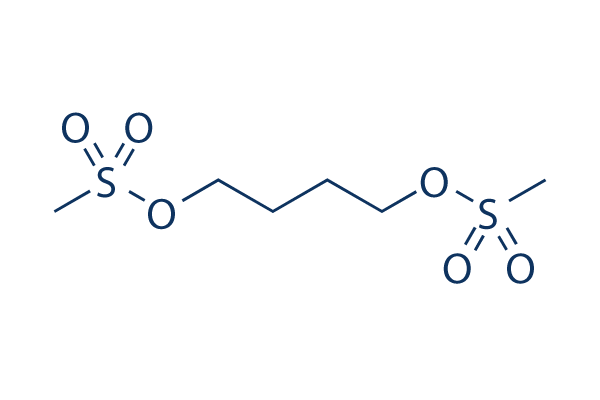
Estructura química
Peso molecular: 246.3
Saltar a
Control de calidad
Lote:
Pureza:
99.81%
99.81
Cultivo celular, tratamiento y concentración de trabajo
| Líneas celulares | Tipo de ensayo | Concentración | Tiempo de incubación | Formulación | Descripción de la actividad | PMID |
|---|---|---|---|---|---|---|
| SK-N-SH cells | Proliferation assay | 10-100 μM | 72 h | Antiproliferative activity against human SK-N-SH cells at 10 to 100 uM after 72 hrs by MTT assay | 24814532 | |
| SiMa cells | Proliferation assay | 10-100 μM | 72 h | Antiproliferative activity against human SiMa cells at 10 to 100 uM after 72 hrs by MTT assay | 24814532 | |
| Kelly cells | Proliferation assay | 10-100 μM | 72 h | Antiproliferative activity against human Kelly cells at 10 to 100 uM after 72 hrs by MTT assay | 24814532 | |
| LS cells | Proliferation assay | 10-100 μM | 72 h | Antiproliferative activity against human LS cells at 10 to 100 uM after 72 hrs by MTT assay | 24814532 | |
| K562 | Apoptosis assay | 48 hrs | Induction of apoptosis in imatinib mesylate-resistant human K562 cells after 48 hrs | 18339455 | ||
| SK-N-MC | qHTS assay | qHTS of pediatric cancer cell lines to identify multiple opportunities for drug repurposing: Primary screen for SK-N-MC cells | 29435139 | |||
| NB-EBc1 | qHTS assay | qHTS of pediatric cancer cell lines to identify multiple opportunities for drug repurposing: Primary screen for NB-EBc1 cells | 29435139 | |||
| A673 | qHTS assay | qHTS of pediatric cancer cell lines to identify multiple opportunities for drug repurposing: Confirmatory screen for A673 cells) | 29435139 | |||
| Haga clic para ver más datos experimentales de líneas celulares | ||||||
Información química, almacenamiento y estabilidad
| Peso molecular | 246.3 | Fórmula | C6H14O6S2 |
Almacenamiento (Desde la fecha de recepción) | |
|---|---|---|---|---|---|
| Nº CAS | 55-98-1 | Descargar SDF | Almacenamiento de soluciones madre |
|
|
| Sinónimos | NSC-750 | Smiles | CS(=O)(=O)OCCCCOS(=O)(=O)C | ||
Solubilidad
|
In vitro |
DMSO
: 49 mg/mL
(198.94 mM)
Water : Insoluble Ethanol : Insoluble |
Calculadora de Molaridad
Calculadora de Dilución
Calculadora de Peso Molecular
|
In vivo |
|||||
Calculadora de formulación in vivo (Solución clara)
Paso 1: Introduzca la información a continuación (Recomendado: Un animal adicional para tener en cuenta la pérdida durante el experimento)
mg/kg
g
μL
Paso 2: Introduzca la formulación in vivo (Esto es solo la calculadora, no la formulación. Por favor, contáctenos primero si no hay una formulación in vivo en la sección de Solubilidad.)
% DMSO
%
% Tween 80
% ddH2O
%DMSO
%
Resultados del cálculo:
Concentración de trabajo: mg/ml;
Método para preparar el líquido maestro de DMSO: mg fármaco predissuelto en μL DMSO ( Concentración del líquido maestro mg/mL, Por favor, contáctenos primero si la concentración excede la solubilidad del DMSO del lote del fármaco. )
Método para preparar la formulación in vivo: Tomar μL DMSO líquido maestro, luego añadirμL PEG300, mezclar y clarificar, luego añadirμL Tween 80, mezclar y clarificar, luego añadir μL ddH2O, mezclar y clarificar.
Método para preparar la formulación in vivo: Tomar μL DMSO líquido maestro, luego añadir μL Aceite de maíz, mezclar y clarificar.
Nota: 1. Por favor, asegúrese de que el líquido esté claro antes de añadir el siguiente disolvente.
2. Asegúrese de añadir el (los) disolvente(s) en orden. Debe asegurarse de que la solución obtenida, en la adición anterior, sea una solución clara antes de proceder a añadir el siguiente disolvente. Se pueden utilizar métodos físicos como el vórtice, el ultrasonido o el baño de agua caliente para ayudar a la disolución.
Mecanismo de acción
| In vitro |
Busulfan inhibe la frecuencia de células formadoras de áreas empedradas, pero no logra causar un aumento significativo en la apoptosis en células y progenitores similares a células madre hematopoyéticas. Este compuesto inhibe la función hematopoyética de células y progenitores similares a HSC a través de un mecanismo independiente de la apoptosis. Induce la senescencia de células hematopoyéticas de la médula ósea asociada con un aumento en la expresión de p16Ink4a y p19Arf de manera dependiente del tiempo. Este químico, un Alkylating Agent que causa DNA damage al entrecruzar ADN y ADN y proteínas, induce senescencia en fibroblastos diploides humanos normales WI38 a través de la cascada de la quinasa regulada por señal extracelular (Erk) y la proteína quinasa activada por mitógenos p38 (p38 MAPK) independiente de la vía p53-DNA damage. Induce una reducción transitoria de GSH pero un aumento continuo en la producción de ROS. La hipofosforilación de Rb inducida por este compuesto previene la apoptosis de las células madre espermatogoniales al inhibir la expresión de PCNA en las células testiculares. |
|---|---|
| In vivo |
Los ratones tratados con Busulfan exhiben un marcado aumento de apoptosis y una disminución del peso testicular. Este compuesto se administra a razón de 40 mg/kg de peso corporal para inducir un número máximo de células apoptóticas mientras se minimiza el número de células necróticas. Su acondicionamiento e irradiación resultan en una sensibilidad comparable de detección de HSC, evaluada mediante análisis de dilución límite en ratones NOD/SCID. Los ratones trasplantados con este químico tienen un injerto linfoide lento e incompleto. Él (20 mg/kg a 100 mg/kg) proporciona una reconstitución linfoide congénica dependiente de la dosis en ratones. |
Referencias |
|
Aplicaciones
| Métodos | Biomarcadores | Imágenes | PMID |
|---|---|---|---|
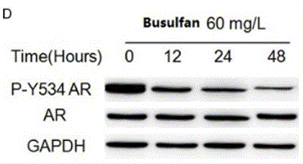
| Western blot | p-Y534 AR / AR Ack1 / Src |
|
27904688 |
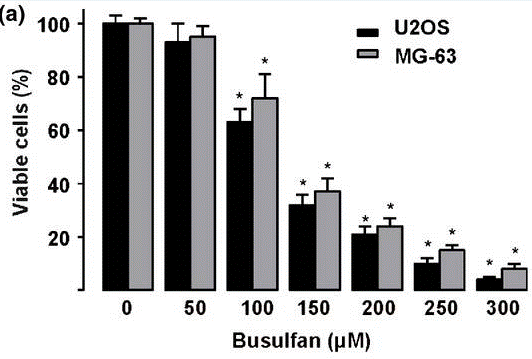
| Growth inhibition assay | Cell viability |
|
24815002 |
Información del ensayo clínico
(datos de https://clinicaltrials.gov, actualizado el 2024-05-22)
| Número NCT | Reclutamiento | Condiciones | Patrocinador/Colaboradores | Fecha de inicio | Fases |
|---|---|---|---|---|---|
| NCT04451200 | Not yet recruiting | Acute Leukemia|Mielodysplasic Syndrome|Myeloproliferative Neoplasm |
Institut Paoli-Calmettes |
November 2020 | Phase 2 |
| NCT03601286 | Recruiting | Severe Combined Immunodeficiency X-Linked |
Great Ormond Street Hospital for Children NHS Foundation Trust |
December 21 2018 | Phase 1 |
| NCT03235973 | Unknown status | Leukemia Myeloid Acute|Leukemia Lymphoblastic Acute |
Institut Paoli-Calmettes |
April 28 2018 | Phase 1 |
Soporte técnico
Tel: +1-832-582-8158 Ext:3
Si tiene alguna otra consulta, por favor deje un mensaje.
Preguntas frecuentes
Pregunta 1:
How can I reconstitute it for in vivo studies?
Respuesta:
This compound also can be dissolved in 2% DMSO+30% PEG 300+5% Tween 80+ddH2O at 5mg/ml as a clear solution. When preparing the solution, please dissolve it in DMSO clearly first. Then add PEG and Tween. After they mixed well, dilute with water. It in this formulation is not suitable for long-term storage. Please make the fresh solution each time before use.

Los productos son solo para uso de investigación. No para uso humano. No vendemos a pacientes.
©Copyright 2013 Selleck Chemicals. Todos los derechos reservados.