
solo para uso en investigación
Chloramphenicol Antibiotics for Plant Cell Culture inhibidor
Cat. No.S1677
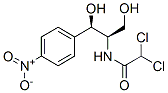
Estructura química
Peso molecular: 323.13
Control de calidad
Información química, almacenamiento y estabilidad
| Peso molecular | 323.13 | Fórmula | C11H12Cl2N2O5 |
Almacenamiento (Desde la fecha de recepción) | |
|---|---|---|---|---|---|
| Nº CAS | 56-75-7 | Descargar SDF | Almacenamiento de soluciones madre |
|
|
| Sinónimos | Chloromycetin | Smiles | C1=CC(=CC=C1C(C(CO)NC(=O)C(Cl)Cl)O)[N+](=O)[O-] | ||
Solubilidad
|
In vitro |
DMSO
: 65 mg/mL
(201.15 mM)
Ethanol : 65 mg/mL Water : Insoluble |
Calculadora de Molaridad
|
In vivo |
|||||
Calculadora de formulación in vivo (Solución clara)
Paso 1: Introduzca la información a continuación (Recomendado: Un animal adicional para tener en cuenta la pérdida durante el experimento)
Paso 2: Introduzca la formulación in vivo (Esto es solo la calculadora, no la formulación. Por favor, contáctenos primero si no hay una formulación in vivo en la sección de Solubilidad.)
Resultados del cálculo:
Concentración de trabajo: mg/ml;
Método para preparar el líquido maestro de DMSO: mg fármaco predissuelto en μL DMSO ( Concentración del líquido maestro mg/mL, Por favor, contáctenos primero si la concentración excede la solubilidad del DMSO del lote del fármaco. )
Método para preparar la formulación in vivo: Tomar μL DMSO líquido maestro, luego añadirμL PEG300, mezclar y clarificar, luego añadirμL Tween 80, mezclar y clarificar, luego añadir μL ddH2O, mezclar y clarificar.
Método para preparar la formulación in vivo: Tomar μL DMSO líquido maestro, luego añadir μL Aceite de maíz, mezclar y clarificar.
Nota: 1. Por favor, asegúrese de que el líquido esté claro antes de añadir el siguiente disolvente.
2. Asegúrese de añadir el (los) disolvente(s) en orden. Debe asegurarse de que la solución obtenida, en la adición anterior, sea una solución clara antes de proceder a añadir el siguiente disolvente. Se pueden utilizar métodos físicos como el vórtice, el ultrasonido o el baño de agua caliente para ayudar a la disolución.
Mecanismo de acción
| In vitro |
Chloramphenicol da lugar a un aumento constitutivo del nivel de transcrito de cspA y a una produccion constitutiva de CS7.4. Este compuesto regula a la baja la proteina Cox I codificada por el ADN mitocondrial, pero no las proteinas codificadas por el nucleo. Aumenta los niveles celulares de la proteina p21(waf1/cip1) y del ARNm de p21(waf1/cip1) a traves de una via independiente de p53. Este producto quimico, a concentraciones superiores a 0,1 g/L (0,3 mM), inhibe la actividad enzimatica desnitrificante (DEA) de suspensiones de humisol y suelos francos arenosos al alterar la actividad de las enzimas nitrato reductasa existentes. A concentraciones de 5 mM a 2 mM, inicia la apoptosis en celulas en division de una linea celular derivada de rinon de mono y en celulas progenitoras hematopoyeticas de sangre de cordon umbilical neonatal humana. Este compuesto suprime el crecimiento de las celulas progenitoras.
|
|---|---|
| In vivo |
Chloramphenicol produce un aumento de t1/2(beta) (en un 209%), una disminucion de ClB (en un 45%) y indices de recuperacion prolongados (en un 768 a 946%) en galgos. Este compuesto suprime los aumentos en el peso corporal y el peso del higado de animales experimentales y al mismo tiempo indujo un aumento notable en la peroxidacion lipidica en el higado durante la formacion de megamitocondrias. La formacion de megamitocondrias inducida por este producto quimico no se atribuye simplemente a la supresion del proceso de division de las mitocondrias debido a la disminucion de la sintesis de proteinas en las mitocondrias, sino que esta intimamente relacionada con el estres oxidativo.
|
Referencias |
|
Soporte técnico
Tel: +1-832-582-8158 Ext:3
Si tiene alguna otra consulta, por favor deje un mensaje.

Los productos son solo para uso de investigación. No para uso humano. No vendemos a pacientes.
©Copyright 2013 Selleck Chemicals. Todos los derechos reservados.