
Solo para uso en investigación
CNBP Antibody [E10D2]
Nº de cat.: F5127
-
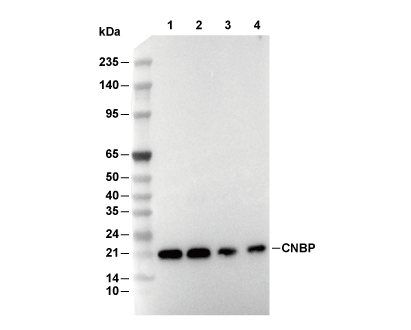 Lane 1: LNCAP, Lane 2: Hela, Lane 3: Jurkat, Lane 4: NIH/3T3
Fundamentos del experimento
Recommended wet transfer conditions: 200 mA, 60 min,Recommended to use 0.22 μm PVDF membrane.
Información de uso
| Dilución |
|---|
|
| Aplicación |
|---|
| WB, IP |
| Reactividad |
|---|
| Mouse, Rat, Human |
| Fuente |
|---|
| Mouse Monoclonal Antibody |
| Tampón de almacenamiento |
|---|
| PBS, pH 7.2+50% Glycerol+0.05% BSA+0.01% NaN3 |
| Almacenamiento (desde la fecha de recepción) |
|---|
| -20°C (avoid freeze-thaw cycles), 2 years |
| PM predicho PM observado |
|---|
| 19 kDa 19-25 kDa |
| *¿Por qué difieren los pesos moleculares predicho y real? Las siguientes razones pueden explicar las diferencias entre el peso molecular de la proteína predicho y real. |
| Control positivo | LNCaP cells; HeLa cells; HepG2 cells; Jurkat cells; K-562 cells; HSC-T6 cells; PC-12 cells; NIH/3T3 cells; Neuro-2a cells; HEK-293 cells; HT-29 cells; 4T1 cells |
|---|---|
| Control negativo |
Métodos experimentales
| WB |
|---|
Experimental Protocol:
Sample preparation
1. Tissue: Lyse the tissue sample by adding an appropriate volume of ice-cold RIPA/NP-40 Lysis Buffer (containing Protease Inhibitor Cocktail),and homogenize the tissue at a low temperature. 2. Adherent cell: Aspirate the culture medium and wash the cells with ice-cold PBS twice. Lyse the cells by adding an appropriate volume of RIPA/NP-40 Lysis Buffer (containing Protease Inhibitor Cocktail) and put the sample on ice for 5 min. 3. Suspension cell: Transfer the culture medium to a pre-cooled centrifuge tube. Centrifuge and aspirate the supernatant. Wash the cells with ice-cold PBS twice. Lyse the cells by adding an appropriate volume of RIPA/NP-40 Lysis Buffer (containing Protease Inhibitor Cocktail) and put the sample on ice for 5 min. 4. Place the lysate into a pre-cooled microcentrifuge tube. Centrifuge at 4°C for 15 min. Collect the supernatant;
5. Remove a small volume of lysate to determine the protein concentration;
6. Combine the lysate with protein loading buffer. Boil 20 µL sample under 95-100°C for 5 min. Centrifuge for 5 min after cool down on ice.
Electrophoretic separation
1. According to the concentration of extracted protein, load appropriate amount of protein sample and marker onto SDS-PAGE gels for electrophoresis. Recommended separating gel (lower gel) concentration: 10%. Reference Table for Selecting SDS-PAGE Separation Gel Concentrations 2. Power up 80V for 30 minutes. Then the power supply is adjusted (110 V~150 V), the Marker is observed, and the electrophoresis can be stopped when the indicator band of the predyed protein Marker where the protein is located is properly separated. (Note that the current should not be too large when electrophoresis, too large current (more than 150 mA) will cause the temperature to rise, affecting the result of running glue. If high currents cannot be avoided, an ice bath can be used to cool the bath.)
Transfer membrane
1. Take out the converter, soak the clip and consumables in the pre-cooled converter;
2. Activate PVDF membrane with methanol for 1 min and rinse with transfer buffer;
3. Install it in the order of "black edge of clip - sponge - filter paper - filter paper - glue -PVDF membrane - filter paper - filter paper - sponge - white edge of clip"; 4. The protein was electrotransferred to PVDF membrane. ( 0.22 µm PVDF membrane is recommended )) Reference Table for Selecting PVDF Membrane Pore Size Specifications Recommended conditions for wet transfer: 200 mA, 60 min. ( Note that the transfer conditions can be adjusted according to the protein size. For high-molecular-weight proteins, a higher current and longer transfer time are recommended. However, ensure that the transfer tank remains at a low temperature to prevent gel melting.)
Block
1. After electrotransfer, wash the film with TBST at room temperature for 5 minutes;
2. Incubate the film in the blocking solution for 1 hour at room temperature;
3. Wash the film with TBST for 3 times, 5 minutes each time.
Antibody incubation
1. Use 5% skim milk powder to prepare the primary antibody working liquid (recommended dilution ratio for primary antibody 1:5000), gently shake and incubate with the film at 4°C overnight; 2. Wash the film with TBST 3 times, 5 minutes each time;
3. Add the secondary antibody to the blocking solution and incubate with the film gently at room temperature for 1 hour;
4. After incubation, wash the film with TBST 3 times for 5 minutes each time.
Antibody staining
1. Add the prepared ECL luminescent substrate (or select other color developing substrate according to the second antibody) and mix evenly;
2. Incubate with the film for 1 minute, remove excess substrate (keep the film moist), wrap with plastic film, and expose in the imaging system. |
Descripción biológica
| Especificidad |
|---|
CNBP Antibody [E10D2] detects endogenous levels of total CNBP protein. |
| Localización subcelular |
|---|
| Cytoplasm, Endoplasmic reticulum, Nucleus |
| Uniprot ID |
|---|
| P62633 |
| Clon |
|---|
| E10D2 |
| Sinónimo |
|---|
| CNBP; CCHC-type zinc finger nucleic acid binding protein; Cellular nucleic acid-binding protein (CNBP); Zinc finger protein 9; RNF163; ZNF9 |
| Antecedentes |
|---|
CNBP (ZNF9) is a highly conserved CCHC-type zinc finger nucleic acid-binding protein critical for embryonic development and post-transcriptional gene regulation, characterized by seven tandem zinc knuckle motifs that coordinate zinc ions to form compact ββα folds, enabling high-affinity binding to G-rich single-stranded DNA and RNA sequences. The presence of an RGG box between the first and second zinc fingers facilitates the formation of phase-separated biomolecular droplets and enhances cooperative nucleic acid remodeling. CNBP functions as a G-quadruplex (G4) chaperone, actively unfolding stable G4 structures within the c-Myc promoter to promote RNA polymerase II transcription, and within the 5'UTR of ODC mRNA to facilitate cap-independent translation. CNBP can transactivate genes such as β-catenin and IL-6 through direct, G4-dependent promoter binding, with its activity and localization dynamically regulated by phosphorylation-triggered dimerization and nuclear translocation in response to cellular stress and cytokine signaling. Expansion of (CCTG)n repeats in CNBP intron 1 underlies myotonic dystrophy type 2 (DM2), where mutant RNA transcripts sequester functional CNBP, resulting in muscleblind-like protein toxicity, impaired myogenesis due to myf5 G4 stabilization, and progressive multisystem atrophy |
| Referencias |
|---|
|
Soporte técnico
Tel: +1-832-582-8158 Ext:3
Si tiene alguna otra consulta, por favor deje un mensaje.

Los productos son solo para uso de investigación. No para uso humano. No vendemos a pacientes.
©Copyright 2013 Selleck Chemicals. Todos los derechos reservados.