Mammalian target of rapamycin (mTOR), also known as FKBP12-rapamycin-associated protein (FRAP), is a 280 kDa serine/threonine kinase which plays a key role in regulating critical cellular processes such as growth, proliferation, cytoskeletal organization, transcription, protein synthesis and ribosomal biogenesis by integrating three major inputs-nutrients (amino acids), growth factors (insulin), and cellular energy status. [show the full text]

mTOR inhibitoren/activatoren (mTOR Inhibitors/Activators)
| Cat.nr. | Productnaam | Informatie | Productgebruik Citaten | Productvalidaties |
|---|---|---|---|---|
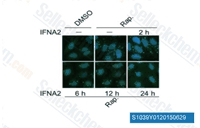
| S1039 | Rapamycin (Sirolimus) | La Rapamycine est un inhibiteur spécifique de mTOR avec un IC50 d'environ 0,1 nM dans les cellules HEK293. Ce composé se lie à FKBP12 et agit spécifiquement comme un inhibiteur allostérique de mTORC1. C'est un activateur d'autophagy et un immunosuppresseur. |
|
|
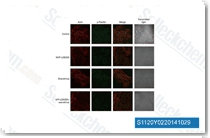
| S1120 | RAD001 (Everolimus) | Everolimus est un inhibiteur de mTOR de FKBP12 avec un IC50 de 1,6-2,4 nM dans un essai acellulaire. Everolimus induit l'apoptosis cellulaire et l'autophagy et inhibe la prolifération des cellules tumorales. |
|
|
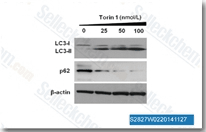
| S2827 | Torin 1 | Torin 1 est un puissant inhibiteur de mTORC1/2 avec un IC50 de 2 nM/10 nM dans les essais sans cellules; il présente une sélectivité 1000 fois supérieure pour mTOR que pour PI3K. |
|
|
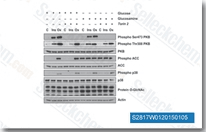
| S2817 | Torin 2 | Torin 2 est un inhibiteur puissant et sélectif de mTOR avec un IC50 de 0,25 nM dans la lignée cellulaire p53−/− MEFs ; une sélectivité 800 fois supérieure pour mTOR par rapport au PI3K et des propriétés pharmacocinétiques améliorées. Ce composé inhibe ATM/ATR/DNA-PK avec un EC50 de 28 nM/35 nM/118 nM, dans les lignées cellulaires PC3 respectivement. Il diminue la viabilité cellulaire et induit l'autophagy et l'apoptosis. |
|
|
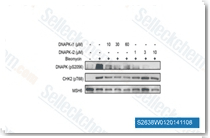
| S2638 | NU7441 (KU-57788) | NU7441 (KU-57788) est un inhibiteur de DNA-PK très puissant et sélectif avec une IC50 de 14 nM. Il inhibe également mTOR et PI3K avec une IC50 de 1,7 μM et 5 μM respectivement dans des essais acellulaires, et réduit la fréquence de NHEJ tout en augmentant le taux de HDR suite au clivage de l'ADN médiatisé par Cas9. |
|
|
| S9736 | ME-344 | Le ME-344 est un métabolite synthétique du NV-128, un puissant inhibiteur du complexe I de la phosphorylation oxydative mitochondriale (OXPHOS), perturbant la production d'ATP et la consommation d'oxygène. Il inhibe également mTOR en régulant à la baisse la voie AKT/mTOR, présentant une activité anticancéreuse en inhibant la croissance et la viabilité cellulaire dans les lignées cellulaires leucémiques avec des valeurs d'IC50 de 70 à 260 nM. | ||
| S8163 | Paxalisib (GDC-0084) | Paxalisib (GDC-0084, RG7666) est un inhibiteur de PI3K et mTOR qui pénètre le cerveau, avec des valeurs Kiapp de 2 nM, 46 nM, 3 nM, 10 nM et 70 nM pour PI3Kα, PI3Kβ, PI3Kδ, PI3Kγ et mTOR. |
|
|
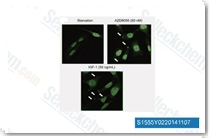
| S1555 | AZD8055 | AZD8055 est un nouvel inhibiteur de mTOR compétitif de l'ATP avec une IC50 de 0,8 nM dans les cellules MDA-MB-468 avec une excellente sélectivité (∼1 000 fois) contre les isoformes de PI3K et ATM/DNA-PK. Ce composé induit une apoptose caspase-dépendante et induit également l'autophagie. Phase 1. |
|
|
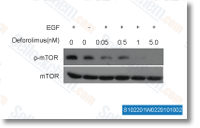
| S1022 | Ridaforolimus (Deforolimus, MK-8669) | Ridaforolimus (Deforolimus, MK-8669, AP23573) est un inhibiteur sélectif de mTOR avec une IC50 de 0,2 nM dans la lignée cellulaire HT-1080 ; bien qu'il ne soit pas classé comme un promédicament, l'inhibition de mTOR et la liaison à FKBP12 sont similaires à celles de la rapamycine. Phase 3. |
|
|
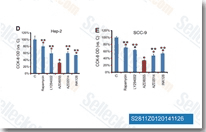
| S2811 | Sapanisertib (MLN0128, INK-128) | Sapanisertib (MLN0128, INK 128, TAK-228) est un inhibiteur puissant et sélectif de mTOR avec une IC50 de 1 nM dans les essais sans cellules ; >200 fois moins puissant pour les isoformes de PI3K de classe I, supérieur pour le blocage de mTORC1/2 et sensible aux gènes pro-invasion (vs Rapamycine). Phase 1. |
|
|
Mammalian target of Rapamycin (mTOR), also known as FKBP12-rapamycin-associated protein (FRAP), is a 280 kDa serine/threonine kinase [1-3]. mTOR kinase activity could be promoted by various extra- and intracellular stimulus like trophic factors, mitogens, hormones, amino acids and cellular stress [4-8]. In response to increased availability of stimuli, mTOR modulates numerous of important cellular processes, e.g. protein translation and autophagy, by phosphorylating its downstream molecules [9]. mTOR is the nuclear catalytic subunit of two complexes: mTORC1 and mTORC2 [1]. mTORC1 is comprised of mTOR, Raptor, mLST8, and PRAS40 (a mTOR inhibitor). This complex presented classic features of mTOR as a nutrient or energy sensor and protein synthesis conditioner [5, 10]. Low level of nutrient levels, growth factor and cellular stress inhibits the activity of mTORC1 [9, 10]. p70-S6 Kinase 1 (S6K1) and the eukaryotic initiation factor 4E (eIF4E) binding protein 1 (4E-BP1) are the best investigated targets of mTORC1 [5]. The activated mTORC1 showed a negative feedback inhibition on PI3K signaling [11]. mTORC1 could be specifically suppressed by rapamycin, as well as its allosteric ramifications. mTORC2 contains mTOR, Rictor, mLST8, and mSIN1 [12, 13]. Different from mTORC1, activated mTORC2 could induce the phosphorylation of Akt at serine 473 and serving as a positive feedback on PI3K signaling cascade [14]. Although mTORC2 was identified as a rapamycin-insensitive complex previously [14], an inhibition effect of rapamycin on free mTOR was observed in some cell lines [15]. Recent studies revealed that disordered activity of mTOR is related to some malignant and resistant cancer. The specific inhibitors, such as rapamycin and Temsirolimus(CCI-779), have been developed and trialed as novel anti-cancer agents [16, 17].

Producten zijn uitsluitend voor onderzoeksdoeleinden. Niet voor menselijk gebruik. Wij verkopen niet aan patiënten.
©Copyright 2013 Selleck Chemicals. Alle rechten voorbehouden.