
uitsluitend voor onderzoeksdoeleinden
GSK-3 Inhibitor IX (BIO) GSK-3 remmer
Cat.Nr.S7198
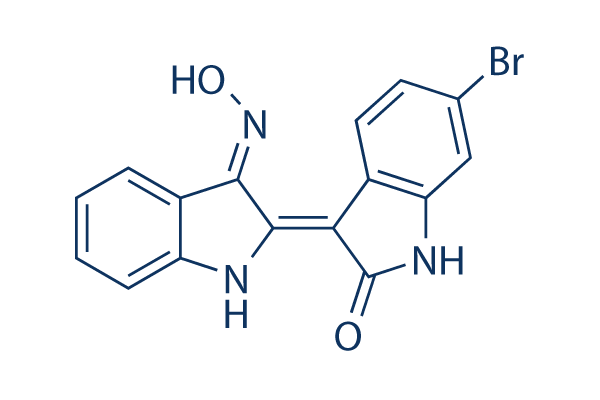
Chemische structuur
Moleculair gewicht: 356.17
Kwaliteitscontrole
| Gerelateerde doelwitten | PI3K Akt mTOR ATM/ATR DNA-PK AMPK PDPK1 PTEN PP2A PDK |
|---|---|
| Overige GSK-3 Inhibitoren | CHIR-99021 (Laduviglusib) Laduviglusib (CHIR-99021) Hydrochloride SB216763 CHIR-98014 TWS119 LY2090314 Tideglusib SB415286 AR-A014418 IM-12 |
Celkweek, behandeling & werkconcentratie
| Cellijnen | Assaytype | Concentratie | Incubatietijd | Formulering | Activiteitsbeschrijving | PMID |
|---|---|---|---|---|---|---|
| HEI-OC1 | Function assay | Protection against cisplatin-induced cell death in neonatal mouse HEI-OC1 cells assessed as reduction in caspase-3/7 activity, EC50 = 0.192 μM. | 30091915 | |||
| SH-SY5Y | Function assay | Inhibition of GSK3-mediated beta-casein phosphorylation in human SH-SY5Y cells in presence of MG132 by Western blot analysis, IC50 = 0.29 μM. | 18816110 | |||
| K562 | Antiproliferative assay | 72 hrs | Antiproliferative activity against human K562 cells after 72 hrs by MTT assay, IC50 = 1.3 μM. | 19783149 | ||
| IMR90 | Antiproliferative assay | 72 hrs | Antiproliferative activity against human IMR90 cells after 72 hrs by MTT assay, IC50 = 1.9 μM. | 19783149 | ||
| HCT116 | Antiproliferative assay | 72 hrs | Antiproliferative activity against human HCT116 cells after 72 hrs by MTT assay, IC50 = 5.2 μM. | 19783149 | ||
| HepG2 | Cytotoxicity assay | 24 hrs | Cytotoxicity against human HepG2 cells assessed as cell growth inhibition after 24 hrs by alamar blue assay, IC50 = 5.3 μM. | 28743492 | ||
| HL60 | Antiproliferative assay | 5 days | Antiproliferative activity against human HL60 cells after 5 days by MTT assay, IC50 = 5.4 μM. | 19783149 | ||
| HuH7 | Antiproliferative assay | 72 hrs | Antiproliferative activity against human HuH7 cells after 72 hrs by MTT assay, IC50 = 6.2 μM. | 19783149 | ||
| SH-SY5Y | Cytotoxicity assay | 48 hrs | Cytotoxicity against human SH-SY5Y cells after 48 hrs by MTS reduction assay, IC50 = 9 μM. | 18816110 | ||
| SH-SY5Y | Function assay | 48 hrs | Survival of human SH-SY5Y cells after 48 hrs by MTS reduction assay, IC50 = 9.5 μM. | 16854069 | ||
| SH-SY5Y | Function assay | Death of human SH-SY5Y cells in absence of 20 uM Q-VD-OPh by MTS reduction assay, IC50 = 10 μM. | 16854069 | |||
| SH-SY5Y | Function assay | Death of human SH-SY5Y cells in presence of 20 uM Q-VD-OPh by MTS reduction assay, IC50 = 13 μM. | 16854069 | |||
| SH-SY5Y | Function assay | 24 hrs | Survival of human SH-SY5Y cells after 24 hrs by MTS reduction assay, IC50 = 18 μM. | 16854069 | ||
| IMR32 | Cytotoxicity assay | 48 hrs | Cytotoxicity against human IMR32 cells assessed as cell viability after 48 hrs by MTT assay | 21802947 | ||
| SK-N-SH | Cytotoxicity assay | 48 hrs | Cytotoxicity against human SK-N-SH cells assessed as cell viability after 48 hrs by MTT assay | 21802947 | ||
| NB39 | Cytotoxicity assay | 48 hrs | Cytotoxicity against human NB39 cells assessed as cell viability after 48 hrs by MTT assay | 21802947 | ||
| A673 | qHTS assay | qHTS of pediatric cancer cell lines to identify multiple opportunities for drug repurposing: Primary screen for A673 cells | 29435139 | |||
| DAOY | qHTS assay | qHTS of pediatric cancer cell lines to identify multiple opportunities for drug repurposing: Primary screen for DAOY cells | 29435139 | |||
| Saos-2 | qHTS assay | qHTS of pediatric cancer cell lines to identify multiple opportunities for drug repurposing: Primary screen for Saos-2 cells | 29435139 | |||
| BT-37 | qHTS assay | qHTS of pediatric cancer cell lines to identify multiple opportunities for drug repurposing: Primary screen for BT-37 cells | 29435139 | |||
| RD | qHTS assay | qHTS of pediatric cancer cell lines to identify multiple opportunities for drug repurposing: Primary screen for RD cells | 29435139 | |||
| SK-N-SH | qHTS assay | qHTS of pediatric cancer cell lines to identify multiple opportunities for drug repurposing: Primary screen for SK-N-SH cells | 29435139 | |||
| BT-12 | qHTS assay | qHTS of pediatric cancer cell lines to identify multiple opportunities for drug repurposing: Primary screen for BT-12 cells | 29435139 | |||
| MG 63 (6-TG R) | qHTS assay | qHTS of pediatric cancer cell lines to identify multiple opportunities for drug repurposing: Primary screen for MG 63 (6-TG R) cells | 29435139 | |||
| NB1643 | qHTS assay | qHTS of pediatric cancer cell lines to identify multiple opportunities for drug repurposing: Primary screen for NB1643 cells | 29435139 | |||
| OHS-50 | qHTS assay | qHTS of pediatric cancer cell lines to identify multiple opportunities for drug repurposing: Primary screen for OHS-50 cells | 29435139 | |||
| Rh41 | qHTS assay | qHTS of pediatric cancer cell lines to identify multiple opportunities for drug repurposing: Primary screen for Rh41 cells | 29435139 | |||
| Rh30 | qHTS assay | qHTS of pediatric cancer cell lines to identify multiple opportunities for drug repurposing: Primary screen for Rh30 cells | 29435139 | |||
| SJ-GBM2 | qHTS assay | qHTS of pediatric cancer cell lines to identify multiple opportunities for drug repurposing: Primary screen for SJ-GBM2 cells | 29435139 | |||
| SK-N-MC | qHTS assay | qHTS of pediatric cancer cell lines to identify multiple opportunities for drug repurposing: Primary screen for SK-N-MC cells | 29435139 | |||
| NB-EBc1 | qHTS assay | qHTS of pediatric cancer cell lines to identify multiple opportunities for drug repurposing: Primary screen for NB-EBc1 cells | 29435139 | |||
| LAN-5 | qHTS assay | qHTS of pediatric cancer cell lines to identify multiple opportunities for drug repurposing: Primary screen for LAN-5 cells | 29435139 | |||
| Rh18 | qHTS assay | qHTS of pediatric cancer cell lines to identify multiple opportunities for drug repurposing: Primary screen for Rh18 cells | 29435139 | |||
| A549 | Function assay | 10 uM | 15 mins | Inhibition of human mPGES1 from human A549 cells assessed as PGE2 at 10 uM after 15 mins by HPLC | 24697244 | |
| HEK293 | Function assay | 0.5 to 1 uM | Inhibition of human GSK3 activity in HEK293 cells containing the Wnt/beta-catenin activated reporter pSuperTOPFLASH (STF293 cells) at 0.5 to 1 uM by Wnt reporter gene assay | 24697244 | ||
| sf9 | Function assay | 1 uM | Inhibition of recombinant human N-terminal GST-tagged CDK4 (S4 to E303 residues)/Cyclin D1 (Q4 to I295 residues) expressed in sf9 cells at 1 uM using RB-CTF as substrate by filter binding assay | 28557430 | ||
| sf9 | Function assay | 1 uM | Inhibition of human N-terminal GST/His6-tagged GSK3beta (M1 to T420 residues) expressed in baculovirus infected sf9 cells at 1 uM using RBER-IRStide as substrate by filter binding assay | 28557430 | ||
| sf9 | Function assay | 1 uM | Inhibition of recombinant human N-terminal GST-tagged CDK2 (M1 to L298 residues)/Cyclin A2 (M1 to L432 residues) expressed in baculovirus infected sf9 cells at 1 uM using Histone H1 as substrate by filter binding assay | 28557430 | ||
| sf9 | Function assay | 1 uM | Inhibition of recombinant human N-terminal GST-tagged CDK5 (M1 to P292 residues)/p35NCK (M1 to R307 residues) expressed in baculovirus infected sf9 cells at 1 uM using RB-CTF as substrate by filter binding assay | 28557430 | ||
| sf9 | Function assay | 1 uM | Inhibition of human N-terminal GST/His6-tagged Aurora B (A2 to A344 residues) expressed in sf9 cells at 1 uM using tetra(LRRLSLG) as substrate by filter binding assay | 28557430 | ||
| sf9 | Function assay | 1 uM | Inhibition of human N-terminal GST/His6-tagged FGFR1 (G400 to R820 residues) expressed in baculovirus infected sf9 cells at 1 uM using Poly(Glu,Tyr)4:1 as substrate by filter binding assay | 28557430 | ||
| sf9 | Function assay | 1 uM | Inhibition of recombinant human N-terminal GST/His6-tagged CDK1 (M1 to M297 residues)/Cyclin B1 (M1 to V433 residues) expressed in sf9 cells at 1 uM using RB-CTF as substrate by filter binding assay | 28557430 | ||
| sf9 | Function assay | 1 uM | Inhibition of recombinant human N-terminal GST-tagged CDK2 (M1 to L298 residues)/Cyclin E1 (M1 to A395 residues) expressed in sf9 cells at 1 uM using RB-CTF as substrate by filter binding assay | 28557430 | ||
| sf9 | Function assay | 1 uM | Inhibition of human N-terminal GST/His6-tagged Aurora A (M1 to S403 residues) expressed in baculovirus infected sf9 cells at 1 uM using tetra(LRRLSLG) as substrate by filter binding assay | 28557430 | ||
| sf9 | Function assay | 1 uM | Inhibition of human N-terminal GST-tagged Aurora B (M1 to S27 residues) expressed in sf9 cells at 1 uM using CDC25C-derived peptide as substrate by filter binding assay | 28557430 | ||
| HT22 | Function assay | 10 uM | 24 hrs | Inhibition of GSK3-mediated beta casein phosphorylation in mouse HT22 cells at 10 uM after 24 hrs by Western blot analysis in presence of MG132 | 22998443 | |
| Klik om meer experimentele gegevens over de cellijn te bekijken | ||||||
Chemische informatie, Opslag en Stabiliteit
| Moleculair gewicht | 356.17 | Formule | C16H10BrN3O2 |
Opslag (Vanaf de ontvangstdatum) | |
|---|---|---|---|---|---|
| CAS-nr. | 667463-62-9 | SDF downloaden | Opslag van stamoplossingen |
|
|
| Synoniemen | GSK-3 Inhibitor IX, 6-bromoindirubin-3-oxime, 6-Bromoindirubin-3'-oxime, MLS 2052 | Smiles | C1=CC=C2C(=C1)C(=C(N2)C3=C(NC4=C3C=CC(=C4)Br)O)N=O | ||
Oplosbaarheid
|
In vitro |
DMSO
: 71 mg/mL
(199.34 mM)
Ethanol : 7 mg/mL Water : Insoluble |
Molariteitscalculator
|
In vivo |
|||||
In vivo Formuleringscalculator (Heldere oplossing)
Stap 1: Voer de onderstaande informatie in (Aanbevolen: Een extra dier voor het geval van verlies tijdens het experiment)
Stap 2: Voer de in vivo formulering in (Dit is alleen de calculator, geen formulering. Neem eerst contact met ons op als er geen in vivo formulering is in het gedeelte Oplosbaarheid.)
Berekeningsresultaten:
Werkconcentratie: mg/ml;
Methode voor het bereiden van DMSO-mastervloeistof: mg geneesmiddel vooraf opgelost in μL DMSO ( Concentratie mastervloeistof mg/mL, Neem eerst contact met ons op als de concentratie de DMSO-oplosbaarheid van de partij geneesmiddel overschrijdt. )
Methode voor het bereiden van in vivo formulering: Neem μL DMSO mastervloeistof, voeg vervolgens toeμL PEG300, mengen en helder maken, voeg vervolgens toeμL Tween 80, mengen en helder maken, voeg vervolgens toe μL ddH2O, mengen en helder maken.
Methode voor het bereiden van in vivo formulering: Neem μL DMSO mastervloeistof, voeg vervolgens toe μL Maïsolie, mengen en helder maken.
Opmerking: 1. Zorg ervoor dat de vloeistof helder is voordat u het volgende oplosmiddel toevoegt.
2. Zorg ervoor dat u het/de oplosmiddel(en) in de juiste volgorde toevoegt. U moet ervoor zorgen dat de verkregen oplossing, bij de vorige toevoeging, een heldere oplossing is voordat u verdergaat met het toevoegen van het volgende oplosmiddel. Fysische methoden zoals vortexen, echografie of een warmwaterbad kunnen worden gebruikt om het oplossen te bevorderen.
Werkingsmechanisme
| Kenmerken |
The first pharmacological agent shown to maintain self-renewal in human and mouse embryonic stem cells.
|
|---|---|
| Targets/IC50/Ki |
GSK-3
(Cell-free assay) 5 nM
TYK2
(Cell-free assay) 30 nM
CDK5/p35
(Cell-free assay) 0.08 μM
CDK2/CyclinA
(Cell-free assay) 0.30 μM
CDK1/CyclinB
(Cell-free assay) 0.32 μM
JAK3
(Cell-free assay) 0.5 μM
|
| In vitro |
BIO (6-bromoindirubin-3'-oxime) is een specifieke remmer van glycogeen synthase kinase-3 (GSK-3), met een IC50 van 5 nM voor GSK-3α/β, vertoont een >16-voudige selectiviteit ten opzichte van CDK5. Deze verbinding interageert in de ATP-bindingspocket van deze kinasen, vermindert β-cateninefosforylering op een GSK-3-specifieke plaats in cellulaire modellen, en bootst Wnt-signalering in Xenopus-embryo's nauwkeurig na. In menselijke en muizen embryonale stamcellen handhaaft deze chemische stof het ongedifferentieerde fenotype en ondersteunt het de expressie van de pluripotente staat-specifieke transcriptiefactoren Oct-3/4, Rex-1 en Nanog. Deze door verbindingen gemedieerde Wnt-activering is functioneel reversibel, aangezien het stopzetten van de verbinding leidt tot normale multidifferentiatieprogramma's in zowel menselijke als muizen embryonale stamcellen. Het bevordert proliferatie in zoogdiercardiomyocyten. 6BIO is ook een pan-JAK remmer, met IC50-waarden van 0,03, 1,5, 8,0, 0,5 μM voor TYK2, JAK1, JAK2 en JAK3. Deze verbinding remt selectief de fosforylering van STAT3 en induceert apoptose van menselijke melanoomcellen.
|
| Kinase Assay |
Kinasetest
|
|
Kinase-activiteiten worden getest in Buffer A of C bij 30°C, bij een finale ATP-concentratie van 15 μM. Blanke waarden worden afgetrokken en activiteiten berekend als pmoles fosfaat ingebouwd tijdens een incubatie van 10 min. Controles worden uitgevoerd met geschikte verdunningen van dimethylsulfoxide. In enkele gevallen wordt fosforylering van het substraat beoordeeld door autoradiografie na SDS-PAGE. GSK-3α/β wordt gezuiverd uit varkenshersenen door affiniteitschromatografie op geïmmobiliseerd axine. Het wordt getest, na een 1/100 verdunning in 1 mg BSA/ml 10 mM DTT, met 5 μl 40 μM GS-1 peptide, een specifiek GSK-3 substraat, (YRRAAVPPSPSLSRHSSPHQSpEDEEE), in buffer A, in aanwezigheid van 15 μM [γ-32P] ATP (3.000 Ci/mmol; 1 mCi/ml) in een finaal volume van 30 μl. Na 30 min incubatie bij 30°C worden aliquots van 25 μl van het supernatant gespot op stukjes Whatman P81 fosfocellulosepapier van 2,5 × 3 cm, en 20 seconden later worden de filters vijf keer gewassen (gedurende ten minste 5 min elke keer) in een oplossing van 10 ml fosforzuur/liter water. De natte filters worden geteld in aanwezigheid van 1 ml ACS-scintillatievloeistof.
|
|
| In vivo |
BIO onderdrukt de groei van melanoomtumoren in een muis xenograftmodel.
|
Referenties |
|
Toepassingen
| Methoden | Biomarkers | Afbeeldingen | PMID |
|---|---|---|---|
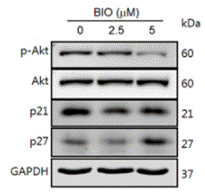
| Western blot | p-AKT / AKT / p21 / p27 p-β-catenin / β-catenin FoxO3a / FoxO1 / p-FoxO3a / p-FoxO1 |
|
27510556 |
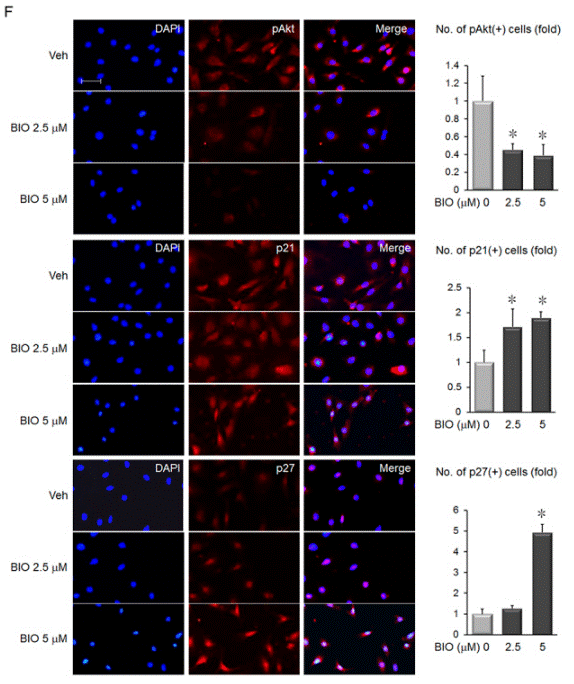
| Immunofluorescence | pAKT / p21 / p27 TNF-α E-cadherin / Nanog Oct3/4 |
|
27510556 |
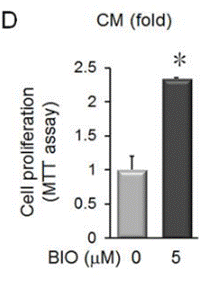
| Growth inhibition assay | Cell proliferation |
|
27510556 |
Informatie klinische proef
(gegevens van https://clinicaltrials.gov, bijgewerkt op 2024-05-22)
| NCT-nummer | Rekrutering | Aandoeningen | Sponsor/Medewerkers | Startdatum | Fasen |
|---|---|---|---|---|---|
| NCT06337422 | Not yet recruiting | Healthy Volunteer |
International Bio service |
September 23 2024 | Phase 1 |
| NCT04276857 | Not yet recruiting | Locally Advanced Pancreatic Cancer|Irreversible Electroporation |
University of Saskatchewan |
September 1 2024 | Not Applicable |
| NCT06359041 | Not yet recruiting | Generalized Myasthenia Gravis (gMG) |
Cabaletta Bio |
August 2024 | Phase 1|Phase 2 |
Technische ondersteuning
Tel: +1-832-582-8158 Ext:3
Als u nog andere vragen heeft, kunt u een bericht achterlaten.

Producten zijn uitsluitend voor onderzoeksdoeleinden. Niet voor menselijk gebruik. Wij verkopen niet aan patiënten.
©Copyright 2013 Selleck Chemicals. Alle rechten voorbehouden.