B-raf plays crucial roles in MAPK signaling pathway, ErbB signaling pathway, Insulin signaling pathway and mTOR signaling pathway which have effect on cell survival, growth and differentiation. RAF can be regulated by RAS and PKC. [show the full text]

Raf remmers (Raf Inhibitors)
Isoform-selectieve producten
| Cat.nr. | Productnaam | Informatie | Productgebruik Citaten | Productvalidaties |
|---|---|---|---|---|
| S2807 | Dabrafenib (GSK2118436) | Dabrafenib is een mutant BRAFV600E specifieke remmer met IC50 van 0,7 nM in celvrije assays, met respectievelijk 7- en 9-voudig minder potentie tegen B-Raf(wt) en c-Raf. |
|

|
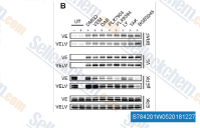
| S7842 | LY3009120 | LY3009120 (DP-4978) is een krachtige pan-Raf-remmer met een IC50 van respectievelijk 44 nM, 31-47 nM en 42 nM voor A-raf, B-Raf en C-Raf in A375-cellen. Deze verbinding induceert autophagy. Fase 1. |
|
|
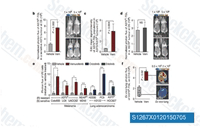
| S1267 | PLX4032 (Vemurafenib) | Vemurafenib (PLX4032, RG7204, RO5185426) is een nieuwe en potente remmer van B-RafV600E met een IC50 van 31 nM in een celvrije test. 10-voudig selectief voor B-RafV600E boven wild-type B-Raf in enzymatische tests en de cellulaire selectiviteit kan 100-voudig overschrijden. Vemurafenib (PLX4032, RG7204) induceert autophagy. |
|
|
| E1649 | Exarafenib (KIN-2787) | Exarafenib (KIN-002787, KIN-2787, RAF/KIN_2787) is een oraal beschikbare, selectieve remmer van pan-RAF. Exarafenib is effectief bij RAF-afhankelijke kankers, inclusief alle klassen van BRAF-afwijkingen. Exarafenib onderdrukt de MAPK-signalering in RAF-afhankelijke melanoomcellijnen. KIN-2787 vertoont een lage nanomolaire tot picomolaire potentie tegen RAF1, BRAF en ARAF met een IC50 van 0,06-3,46 nM met minimale activiteit tegen niet-RAF-kinasen. | ||
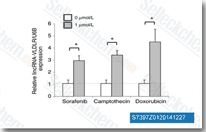
| S7397 | Sorafenib (BAY 43-9006) | Sorafenib is een multikinase-remmer van Raf-1 en B-Raf met respectievelijk een IC50 van 6 nM en 22 nM in celvrije assays. Sorafenib remt VEGFR-2, VEGFR-3, PDGFR-β, Flt-3 en c-KIT met respectievelijk een IC50 van 90 nM, 20 nM, 57 nM, 59 nM en 68 nM. Sorafenib induceert autophagy en apoptosis en activeert ferroptosis met antitumoractiviteit. |
|
|
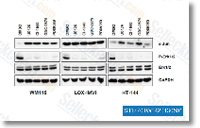
| S1104 | GDC-0879 | GDC-0879 (AR-00341677) is een nieuwe, potente en selectieve B-Raf-remmer met IC50 van 0,13 nM in A375- en Colo205-cellen, met activiteit tegen c-Raf; geen remming bekend van andere proteïnekinasen. |
|
|
| S7170 | Avutometinib (Ro5126766, CH5126766) | Avutometinib (RO5126766, CH5126766, VS 6766, CKI-27, R-7304, RG-7304) is een duale RAF/MEK-remmer met IC50 van respectievelijk 8,2 nM, 19 nM, 56 nM en 160 nM voor BRAF V600E, BRAF, CRAF en MEK1. Fase 1. |
|
|
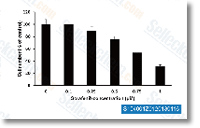
| S1040 | Sorafenib Tosylate (BAY 43-9006) | Sorafenib Tosylate is een multikinase-remmer van Raf-1 en B-Raf met een IC50 van respectievelijk 6 nM en 22 nM in celvrije assays. Sorafenib Tosylate remt VEGFR-2, VEGFR-3, PDGFR-β, Flt-3 en c-KIT met een IC50 van respectievelijk 90 nM, 20 nM, 57 nM, 59 nM en 68 nM. Sorafenib Tosylate induceert autophagy en apoptosis en activeert ferroptosis met antitumoractiviteit. |
|
|
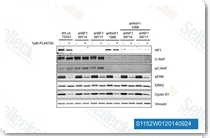
| S1152 | PLX-4720 | PLX4720 is een krachtige en selectieve remmer van B-RafV600E met een IC50 van 13 nM in een celvrije test, even krachtig als c-Raf-1 (Y340D- en Y341D-mutaties), 10-voudige selectiviteit voor B-RafV600E dan wild-type B-Raf. |
|
|
| S5069 | Dabrafenib Mesylate | Dabrafenib Mesylate (GSK2118436) is de mesylaat zoutvorm van dabrafenib, een oraal biologisch beschikbare remmer van het B-raf (BRAF) proteïne met IC50's van 0,8 nM, 3,2 nM en 5 nM voor respectievelijk B-Raf (V600E), B-Raf (WT) en C-Raf. |
|
|
RAF kinase signaling is highlighted in the RAS-RAF-MEK-ERK signal transduction cascade. Activated RAS kinase signaling results in the activation of RAF proteins. Following these events, MEK1 and MEK2 dual specificity protein kinases become phosphorylated and activated. It should be noted that RAF kinases display restricted substrate specificity for these MEK enzymes. The RAF family of protein-serine/threonine kinases comprise of A-RAF, B-RAF, and C-RAF oncogenes originally discovered in the early 1980s. RAF family proteins function as six dimeric members, either in homo- and heterodimer formation. Since there are four RAS members, the total number of RAS-RAF interactions is equivalent to twenty-four. And downstream, with two MEK members available the total number of interactions between RAF-MEK constituents is twelve.[1]
All RAF kinases share three conserved regions (CR): CR1, CR2, and CR3. CR1 consists of cysteine-rich domain (binds to two zinc ions) and a RAS-binding domain. These properties facilitate CR1 interaction with RAS and phospholipids in the membrane. CR2, is a serine/threonine rich domain that facilitates the binding of regulatory protein 14-3-3 upon phosphorylation – this result in inactivation. At the C-terminus is the protein kinase domain, CR3, which contains a downstream stimulatory 14-3-3 binding site. Regulating RAF kinase activity are a number of protein-protein interactions, phosphorylation, dephosphorylation and conformational changes. In their inactivated state, most RAF proteins are found in the cytosol.[1]
It was not until 2002, that B-RAF mutations were noted in cancer cells lines. Most notably, B-RAF has been associated with melanomas and papillary thyroid, ovarian, and colorectal tumors. And to a lesser degree cancers of the lung, pancreas, and bladder have also been found to have aberrant B-RAF activity. Consequently, since B-RAF mutations are involved in several different cancer types it is believed that B-RAF functions as an oncogene driver. In clinical trials, the first RAF inhibitor was Bayer’s Sorafenib (Nexavar). The compound was found to be effective in restricting tumor activity in renal cell carcinoma and hepatocellular cancers and is currently in use for these indications. Recently, PLX4032 was discovered to be a highly selective RAF inhibitor (Roche) and is currently in advanced clinical trials for testing against melanomas.[2]

Producten zijn uitsluitend voor onderzoeksdoeleinden. Niet voor menselijk gebruik. Wij verkopen niet aan patiënten.
©Copyright 2013 Selleck Chemicals. Alle rechten voorbehouden.