
uitsluitend voor onderzoeksdoeleinden
PF-3758309 PAK remmer
Cat.Nr.S7094
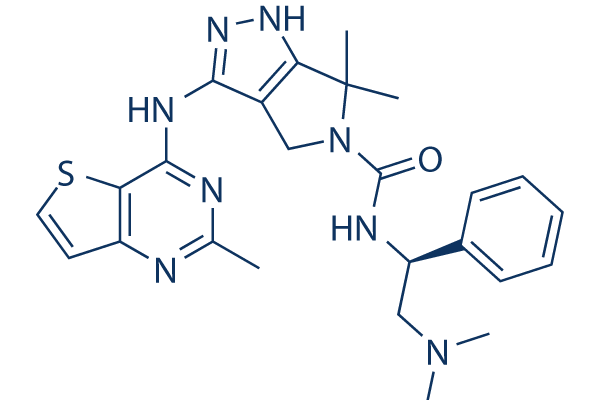
Chemische structuur
Moleculair gewicht: 490.62
Kwaliteitscontrole
| Gerelateerde doelwitten | Akt Wnt/beta-catenin PKC HSP ROCK Microtubule Associated Integrin Bcr-Abl Actin FAK |
|---|---|
| Overige PAK Inhibitoren | IPA-3 FRAX597 FRAX486 FRAX1036 LCH-7749944 NVS-PAK1-1 Hydrastine GNE 2861 G-5555 |
Celkweek, behandeling & werkconcentratie
| Cellijnen | Assaytype | Concentratie | Incubatietijd | Formulering | Activiteitsbeschrijving | PMID |
|---|---|---|---|---|---|---|
| human MDA-MB-436 cells | Cytotoxic assay | 24-48 h | Cytotoxicity against human MDA-MB-436 cells assessed as reduction in cell viability after 24 to 48 hrs by Celltiter-glo luminescence assay, IC50=0.79 nM | 24432870 | ||
| HCT116 | Antiproliferative activity against | 72 hrs | Antiproliferative activity against human HCT116 cells after 72 hrs by CCK8 assay, IC50=0.039μM. | 29886323 | ||
| A549 | Antiproliferative activity against | 72 hrs | Antiproliferative activity against human A549 cells after 72 hrs by CCK8 assay, IC50=0.463μM. | 29886323 | ||
| TC32 | qHTS of pediatric cancer cell lines to identify multiple opportunities for | qHTS of pediatric cancer cell lines to identify multiple opportunities for drug repurposing: Primary screen for TC32 cells | 29435139 | |||
| DAOY | qHTS of pediatric cancer cell lines to identify multiple opportunities for | qHTS of pediatric cancer cell lines to identify multiple opportunities for drug repurposing: Primary screen for DAOY cells | 29435139 | |||
| SJ-GBM2 | qHTS of pediatric cancer cell lines to identify multiple opportunities for | qHTS of pediatric cancer cell lines to identify multiple opportunities for drug repurposing: Primary screen for SJ-GBM2 cells | 29435139 | |||
| A673 | qHTS of pediatric cancer cell lines to identify multiple opportunities for | qHTS of pediatric cancer cell lines to identify multiple opportunities for drug repurposing: Primary screen for A673 cells | 29435139 | |||
| SK-N-MC | qHTS of pediatric cancer cell lines to identify multiple opportunities for | qHTS of pediatric cancer cell lines to identify multiple opportunities for drug repurposing: Primary screen for SK-N-MC cells | 29435139 | |||
| BT-37 | qHTS of pediatric cancer cell lines to identify multiple opportunities for | qHTS of pediatric cancer cell lines to identify multiple opportunities for drug repurposing: Primary screen for BT-37 cells | 29435139 | |||
| NB-EBc1 | qHTS of pediatric cancer cell lines to identify multiple opportunities for | qHTS of pediatric cancer cell lines to identify multiple opportunities for drug repurposing: Primary screen for NB-EBc1 cells | 29435139 | |||
| U-2 OS | qHTS of pediatric cancer cell lines to identify multiple opportunities for | qHTS of pediatric cancer cell lines to identify multiple opportunities for drug repurposing: Primary screen for U-2 OS cells | 29435139 | |||
| Saos-2 | qHTS of pediatric cancer cell lines to identify multiple opportunities for | qHTS of pediatric cancer cell lines to identify multiple opportunities for drug repurposing: Primary screen for Saos-2 cells | 29435139 | |||
| SK-N-SH | qHTS of pediatric cancer cell lines to identify multiple opportunities for | qHTS of pediatric cancer cell lines to identify multiple opportunities for drug repurposing: Primary screen for SK-N-SH cells | 29435139 | |||
| NB1643 | qHTS of pediatric cancer cell lines to identify multiple opportunities for | qHTS of pediatric cancer cell lines to identify multiple opportunities for drug repurposing: Primary screen for NB1643 cells | 29435139 | |||
| LAN-5 | qHTS of pediatric cancer cell lines to identify multiple opportunities for | qHTS of pediatric cancer cell lines to identify multiple opportunities for drug repurposing: Primary screen for LAN-5 cells | 29435139 | |||
| BT-12 | qHTS of pediatric cancer cell lines to identify multiple opportunities for | qHTS of pediatric cancer cell lines to identify multiple opportunities for drug repurposing: Primary screen for BT-12 cells | 29435139 | |||
| Rh18 | qHTS of pediatric cancer cell lines to identify multiple opportunities for | qHTS of pediatric cancer cell lines to identify multiple opportunities for drug repurposing: Primary screen for Rh18 cells | 29435139 | |||
| OHS-50 | qHTS of pediatric cancer cell lines to identify multiple opportunities for | qHTS of pediatric cancer cell lines to identify multiple opportunities for drug repurposing: Primary screen for OHS-50 cells | 29435139 | |||
| RD | qHTS of pediatric cancer cell lines to identify multiple opportunities for | qHTS of pediatric cancer cell lines to identify multiple opportunities for drug repurposing: Primary screen for RD cells | 29435139 | |||
| MG 63 (6-TG R) | qHTS of pediatric cancer cell lines to identify multiple opportunities for | qHTS of pediatric cancer cell lines to identify multiple opportunities for drug repurposing: Primary screen for MG 63 (6-TG R) cells | 29435139 | |||
| fibroblast cells | qHTS of pediatric cancer cell lines to identify multiple opportunities for | qHTS of pediatric cancer cell lines to identify multiple opportunities for drug repurposing: Primary screen for control Hh wild type fibroblast cells | 29435139 | |||
| Rh41 | qHTS of pediatric cancer cell lines to identify multiple opportunities for | qHTS of pediatric cancer cell lines to identify multiple opportunities for drug repurposing: Primary screen for Rh41 cells | 29435139 | |||
| A673 | qHTS of pediatric cancer cell lines to identify multiple opportunities for | qHTS of pediatric cancer cell lines to identify multiple opportunities for drug repurposing: Confirmatory screen for A673 cells) | 29435139 | |||
| BT-12 | qHTS of pediatric cancer cell lines to identify multiple opportunities for | qHTS of pediatric cancer cell lines to identify multiple opportunities for drug repurposing: Confirmatory screen for BT-12 cells | 29435139 | |||
| Klik om meer experimentele gegevens over de cellijn te bekijken | ||||||
Chemische informatie, Opslag en Stabiliteit
| Moleculair gewicht | 490.62 | Formule | C25H30N8OS |
Opslag (Vanaf de ontvangstdatum) | |
|---|---|---|---|---|---|
| CAS-nr. | 898044-15-0 | SDF downloaden | Opslag van stamoplossingen |
|
|
| Synoniemen | PF-03758309 | Smiles | CC1=NC2=C(C(=N1)NC3=NNC4=C3CN(C4(C)C)C(=O)NC(CN(C)C)C5=CC=CC=C5)SC=C2 | ||
Oplosbaarheid
|
In vitro |
DMSO
: 98 mg/mL
(199.74 mM)
Ethanol : 98 mg/mL Water : Insoluble |
Molariteitscalculator
|
In vivo |
|||||
In vivo Formuleringscalculator (Heldere oplossing)
Stap 1: Voer de onderstaande informatie in (Aanbevolen: Een extra dier voor het geval van verlies tijdens het experiment)
Stap 2: Voer de in vivo formulering in (Dit is alleen de calculator, geen formulering. Neem eerst contact met ons op als er geen in vivo formulering is in het gedeelte Oplosbaarheid.)
Berekeningsresultaten:
Werkconcentratie: mg/ml;
Methode voor het bereiden van DMSO-mastervloeistof: mg geneesmiddel vooraf opgelost in μL DMSO ( Concentratie mastervloeistof mg/mL, Neem eerst contact met ons op als de concentratie de DMSO-oplosbaarheid van de partij geneesmiddel overschrijdt. )
Methode voor het bereiden van in vivo formulering: Neem μL DMSO mastervloeistof, voeg vervolgens toeμL PEG300, mengen en helder maken, voeg vervolgens toeμL Tween 80, mengen en helder maken, voeg vervolgens toe μL ddH2O, mengen en helder maken.
Methode voor het bereiden van in vivo formulering: Neem μL DMSO mastervloeistof, voeg vervolgens toe μL Maïsolie, mengen en helder maken.
Opmerking: 1. Zorg ervoor dat de vloeistof helder is voordat u het volgende oplosmiddel toevoegt.
2. Zorg ervoor dat u het/de oplosmiddel(en) in de juiste volgorde toevoegt. U moet ervoor zorgen dat de verkregen oplossing, bij de vorige toevoeging, een heldere oplossing is voordat u verdergaat met het toevoegen van het volgende oplosmiddel. Fysische methoden zoals vortexen, echografie of een warmwaterbad kunnen worden gebruikt om het oplossen te bevorderen.
Werkingsmechanisme
| Kenmerken |
PF-3758309 is potent toward a broad array of tumor cell lines from different tumor types.
|
|---|---|
| Targets/IC50/Ki |
PAK1
(Cell-free assay) 13.7 nM(Ki)
PAK6
(Cell-free assay) 17.1 nM(Ki)
PAK5
(Cell-free assay) 18.1 nM(Ki)
PAK4
(Cell-free assay) 18.7 nM(Ki)
PAK3
(Cell-free assay) 99 nM
PAK2
(Cell-free assay) 190 nM
|
| In vitro |
PF-3758309 is een potente (Kd = 2,7 nM), ATP-competitieve remmer van PAK4 met Ki van 18,7 nM. In cellen remt deze verbinding de fosforylering van het PAK4-substraat GEF-H1 (IC50 = 1,3 nM) en verankering-onafhankelijke groei van een panel van tumorcellijnen (IC50 = 4,7 nM). Het remt ook endogene pGEF-H1 accumulatie in HCT116 cellen. Deze chemische stof remt potent celproliferatie (IC50 = 20 nM) en verankering-onafhankelijke groei (IC50 = 27 nM) van A549 cellen. |
| Kinase Assay |
Fosfo-GEF-H1 Cellulaire Assay
|
|
TR-293-KDG cellen zijn geconstrueerd uit HEK293 cellen die stabiel getransfecteerd zijn met tetracycline-induceerbare PAK4-kinase domein (aminozuren 291-591) en constitutief tot expressie gebrachte HA-getagde GEFH1ΔDH (aminozuren 210-921). TR-293-KDG cellen worden 3 uur geïncubeerd met PF-3758309, gevangen op een anti-HA antilichaam-gecoate plaat, gedetecteerd met een anti-fosfo-S810-GEF-H1 antilichaam, en gekwantificeerd met een mierikswortelperoxidase-geit anti-konijn antilichaam conjugaat.
|
|
| In vivo |
PF-3758309 blokkeert de groei van meerdere humane tumor xenografts, met een plasma EC50 waarde van 0,4 nM in het meest gevoelige model. Deze verbinding is antiproliferatief en induceert apoptose in een HCT116 tumormodel. |
Referenties |
Toepassingen
| Methoden | Biomarkers | Afbeeldingen | PMID |
|---|---|---|---|
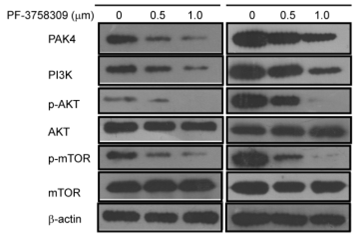
| Western blot | PAK4 / PI3K / p-AKT / AKT / p-mTOR / mTOR |
|
28407679 |
Technische ondersteuning
Tel: +1-832-582-8158 Ext:3
Als u nog andere vragen heeft, kunt u een bericht achterlaten.
Veelgestelde vragen
Vraag 1:
If this compound crosses the blood brain barrier?
Antwoord:
We're sorry we don't have any data on whether it can cross BBB or not, the following reference indicate that this compound can not: http://www.ncbi.nlm.nih.gov/pmc/articles/PMC3490962/.

Producten zijn uitsluitend voor onderzoeksdoeleinden. Niet voor menselijk gebruik. Wij verkopen niet aan patiënten.
©Copyright 2013 Selleck Chemicals. Alle rechten voorbehouden.